
Larb Gai
Larb Gai is a Thai-Lao dish of minced chicken mixed with herbs, lime juice, and toasted rice powder, served as a salad.
Contents (5 sections)▾
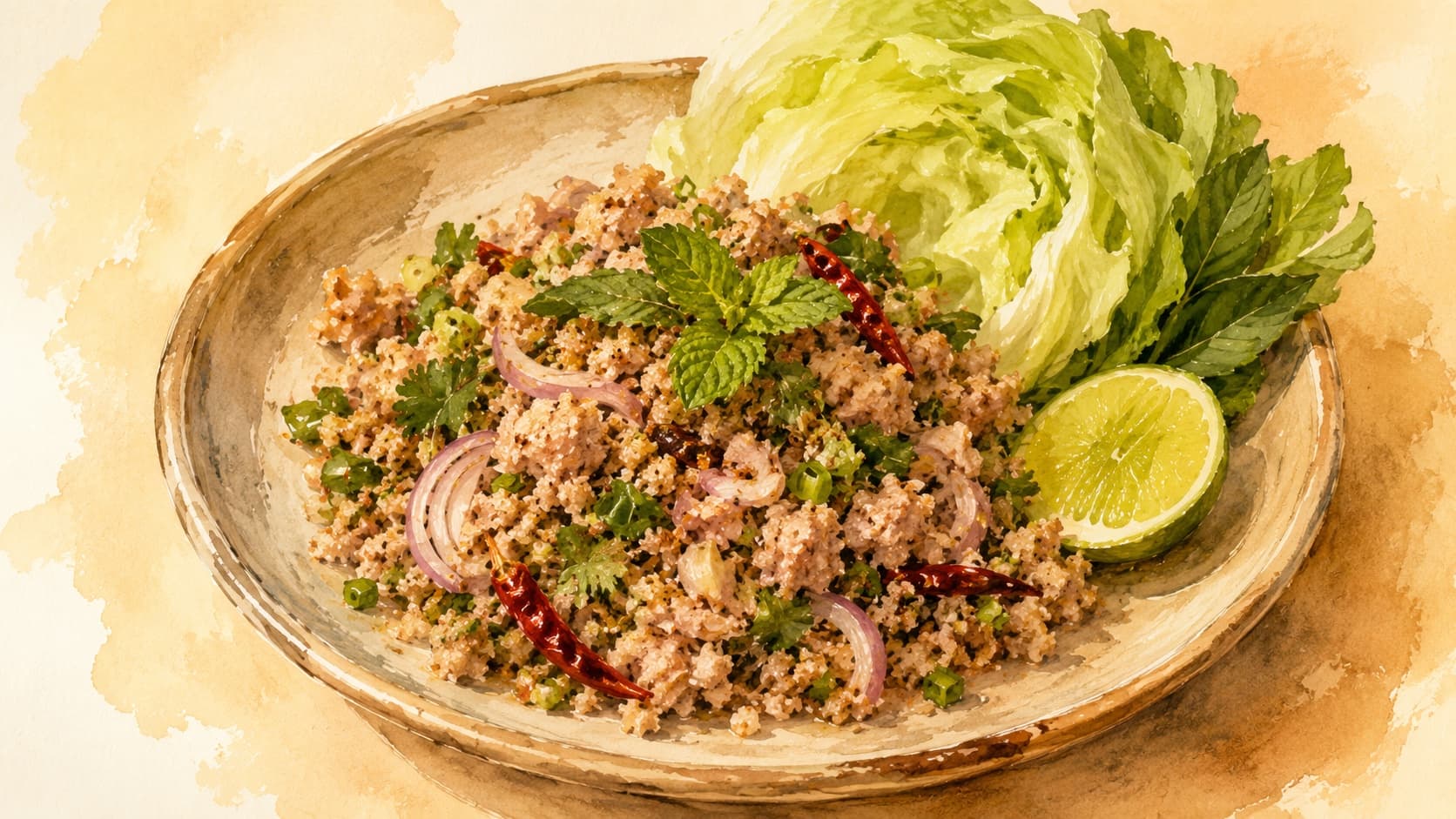
Ingredients
- 500 g minced chicken
- 2 tbsp fish sauce
- 3 tbsp lime juice
- 2 tbsp toasted rice powder
- 1 tbsp sugar
- 1 red onion, finely sliced
- 2 cloves garlic, minced
- 2-3 Thai bird chilies, finely chopped
- 1 cup fresh mint leaves, chopped
- 1 cup cilantro leaves, chopped
- Lettuce leaves, for serving
- Salt, to taste
Steps
1. In a pan over medium heat (approximately 180°C), cook the minced chicken for 8-10 minutes, stirring occasionally, until fully cooked and no longer pink in the center (internal temperature should reach 75°C).
2. Once cooked, remove from heat and let it cool for 5 minutes before transferring to a bowl.
3. Add 3 tablespoons of fish sauce, 2 tablespoons of lime juice, 2 tablespoons of toasted rice powder, 1 teaspoon of sugar, 2 minced garlic cloves, and 1-2 finely chopped chilies to the chicken. Mix well to combine all ingredients.
4. Stir in 1/4 cup of finely sliced red onion, 1 cup of chopped mint, and 1 cup of chopped cilantro, ensuring everything is evenly coated. Adjust seasoning with salt and more lime juice to taste.
5. Serve the Larb Gai on a bed of lettuce leaves, garnished with additional herbs if desired.
Why this works
Larb Gai achieves its signature flavor through the balance of salty, sour, and spicy components, which are essential in Thai and Lao cuisine. The fish sauce provides umami depth, while lime juice adds brightness, creating a refreshing contrast to the minced chicken. Toasted rice powder contributes a unique nuttiness and enhances the dish's texture. If the mixture seems too dry, adding a touch more lime juice or fish sauce can help adjust the moisture level. Additionally, ensure the minced chicken is cooked thoroughly to an internal temperature of 75°C to avoid any risk of undercooked meat, which can lead to food safety issues. The herbs introduce freshness, making every bite vibrant. This dish thrives on its ability to be customized—feel free to adjust the spice levels according to your preference, ensuring a satisfying and bold flavor experience. The careful selection of ingredients and precise cooking times enhance the dish's authenticity and its overall appeal, making it a delightful addition to any meal.
Common mistakes
Chicken mince not cooked to safe temperature (BLOCK-level safety). Target: Instant-read thermometer at 74 °C (165 °F) — the USDA-recommended safe minimum for poultry — in the thickest part of the meat, with no pink centre. Why it matters: Ground chicken is the highest-risk mince in the kitchen. Salmonella and Campylobacter, common on raw poultry surfaces, are distributed throughout the meat when it is minced. Whole cuts let you sear the surface and the inside stays safe; mince does not give you that margin. Lime juice and chilli do not pasteurise. What to do: Cook over medium heat for 8–10 minutes, breaking the mince into small crumbles so heat penetrates evenly. If using a thermometer, insert into the densest clump. Visually, juices should run clear and the meat should look uniformly opaque — no rosy fibres anywhere.
Chicken dressed while still hot. Target: Mince barely warm to the touch when you add lime, fish sauce, and herbs. Why it matters: Hot meat steam-wilts the mint and cilantro instantly — the volatile aromatic oils that define larb's brightness boil off in seconds. Lime juice exposed to high heat also flattens; the brightness goes muddy. What to do: Spread the cooked mince on a wide plate or shallow bowl to cool quickly for 3–5 minutes. Dress while still warm enough to absorb flavour, cool enough to keep herbs alive.
Toasted rice powder absent or stale. Target: Freshly toasted, deeply fragrant rice powder with visible texture — not soft flour-like dust. Why it matters: Khao khua is the textural backbone of larb. It provides the nutty crunch, absorbs excess juice, and carries roasted aroma. Stale powder loses its perfume within a week; pre-ground rice flour does nothing — it just turns the dressing pasty. What to do: Toast raw sticky rice (or jasmine rice) in a dry pan over low-medium heat, stirring constantly, until deep amber and aromatic — about 10–15 minutes. Cool, then grind coarsely. Add last, just before serving, so it stays crunchy.
Lime added too far in advance. Target: Bright, sharp acidity that hits the front of the tongue. Why it matters: Lime juice is mostly citric and ascorbic acid; both degrade with heat and time. A larb dressed and held even 20 minutes tastes flatter than one finished at the table — the same lime, less brightness. What to do: Mix the cooked mince with fish sauce and chilli first; let it sit briefly so the salt penetrates. Add lime and herbs just before serving, with the rice powder going in last.
What to look for
- Mince uniformly opaque white-grey, juices running clear: the safe-temperature visual cue for cooked poultry — no pink fibres anywhere.
- A clean lime perfume rising as you toss: the acid is still alive; if you smell only fish sauce and cooked chicken, the lime went in too early.
- Rice powder still visible as flecks, audible crunch when you stir: added at the right moment, before moisture dissolves it.
- Herbs that bounce back when pressed lightly, not clinging in soft mats: the meat was cool enough when they went in.
A note on history
Larb (also spelled laab, laap, or larp) originated in the historic kingdom of Lan Xang — spanning what is now Laos and northern Thailand — and is regarded as a national dish of Laos. The name traces to a Lao word for "luck" or "good fortune", and the dish remains tied to celebrations and ceremonies. In Thailand, larb is closely associated with Isan (the northeast, bordering Laos), where the cuisine shares deep roots with Lao cooking; northern Lanna-region larb is earthier and richer, while Isan-style runs hotter and more aggressively seasoned. Sources: Larb (Wikipedia), Anatomy of Larb (PBS SoCal — The Migrant Kitchen).
Get the essays in your inbox — free
Weekly notes on flavor, fermentation, and food history — the writing behind the Atlas of Flavor. No spam; unsubscribe anytime.