
Kutab
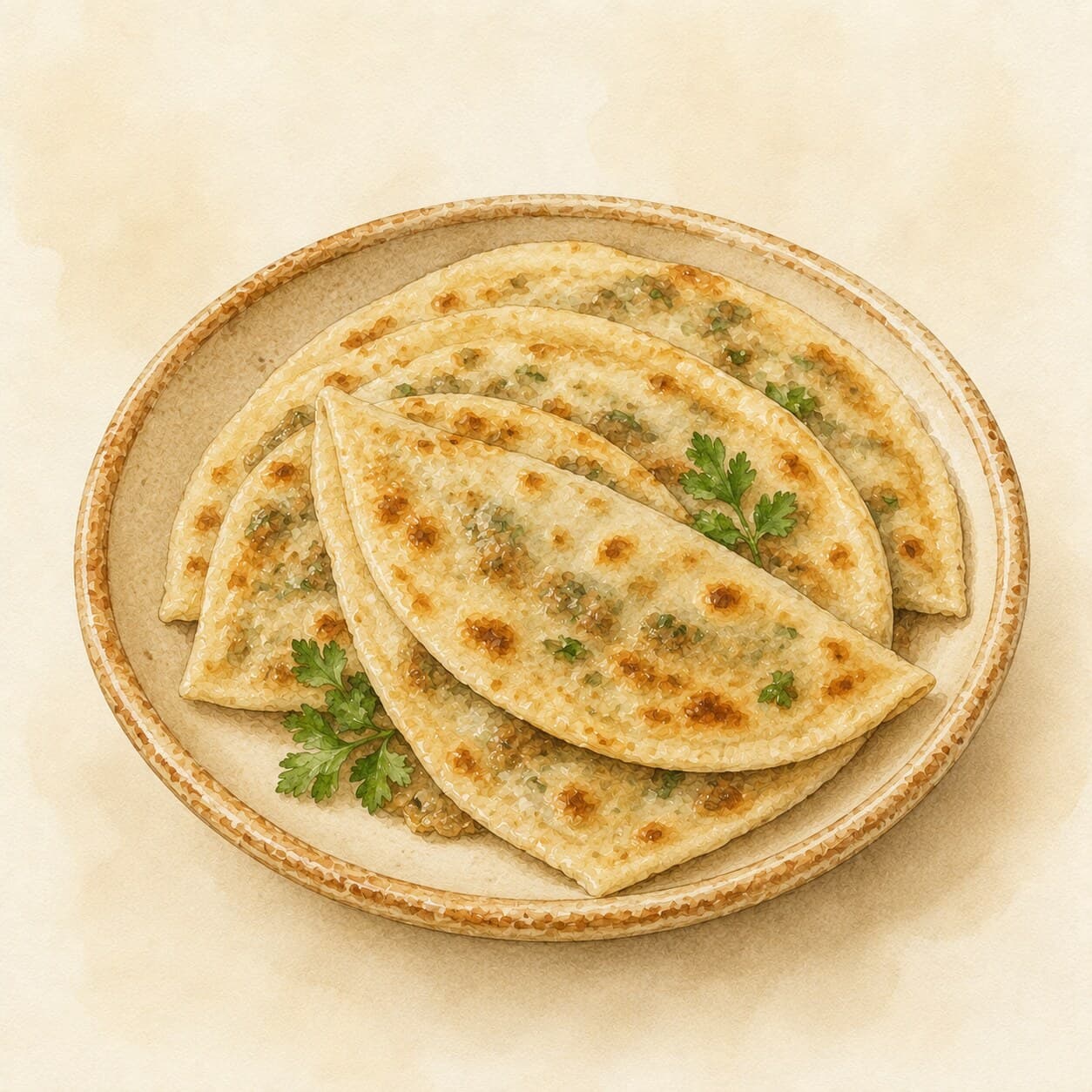
Kutab is a delightful Azerbaijani pancake stuffed with fresh greens or ground lamb, pan-fried to perfection.
Contents (5 sections)▾
Ingredients
- 300 g all-purpose flour
- 150 ml water
- 1 tsp salt
- 200 g fresh spinach, chopped
- 100 g fresh dill, chopped
- 100 g fresh cilantro, chopped
- 300 g ground lamb
- 50 g butter, melted
- black pepper to taste
Steps
In a bowl, mix the flour, salt, and water until a soft dough forms. Knead for about 5 minutes until smooth, then let it rest for 20 minutes covered to relax the gluten.
In a separate bowl, combine the chopped spinach, dill, cilantro, ground lamb, and black pepper. Mix well to create the filling.
Divide the dough into equal portions. Roll each portion into a thin circle, about 20 cm in diameter, on a floured surface.
Place a generous spoonful of filling on one half of the dough circle, then fold the other half over to form a half-moon shape. Pinch the edges to seal securely.
Heat a non-stick skillet over medium heat. Cook each kutab for 3-4 minutes on each side until golden brown and cooked through. Brush with melted butter after cooking. Cook the ground meat until it reaches 71 °C / 160 °F on an instant-read thermometer (no longer pink throughout) — colour, float and time are guides, not the safety test.
Why this works
The key to perfect kutab lies in the thinness of the dough and the balance of filling. By rolling the dough thinly, it cooks evenly and achieves a delightful crispness. The combination of fresh greens or ground lamb offers a flavorful contrast to the crispy exterior. Since this is a dry-frying technique (cooking in the pan with no oil), ensure your skillet is at the right temperature; too hot will burn the outside while leaving the filling raw. If the kutab breaks while folding, dampen the edges slightly with water to help seal them securely. This method brings out the natural flavors of the ingredients while creating a satisfying texture that complements the rich filling.
Common mistakes
Rolling the dough too thick, so the outside cooks before the raw filling does.
Target: Roll each portion out thin — a couple of millimeters — to the roughly 20 cm circle called for, so heat can reach the raw lamb filling quickly.
Why it matters: Kutab relies on a thin dough cooking through in just 3-4 minutes per side; a thick dough insulates the raw ground lamb at the center, so the outside can brown, or even scorch, while the meat inside is still pink.
What to do: Roll on a floured surface, rotating and checking the thickness as you go, until the dough is thin and even all over.
Judging the kutab done by the color of the dough alone.
Target: Confirm the filling is cooked through — no pink or raw-looking meat — not just that the outside is golden brown.
Why it matters: This filling starts raw, ground lamb mixed directly with chopped raw greens, and a thin dough browns quickly on a hot skillet; a nicely browned outside is not proof that the thickest part of the filling has reached a safe temperature, especially if the pan ran hot or the dough rolled unevenly.
What to do: Cut into the first kutab off the skillet and check that the lamb is fully opaque with no pink before trusting the rest of the batch; ground lamb should reach about 71°C (160°F).
Overfilling the dough or leaving the seal loose.
Target: Use a modest, even spoonful of filling and pinch the edges firmly closed all the way around.
Why it matters: Overfilling makes it hard to seal completely, and a weak seal lets filling — including raw meat juices — leak onto the skillet mid-cook, which burns and also means part of the filling never finishes cooking inside a sealed pocket.
What to do: Leave a small border of bare dough around the filling, fold it over, and press the edges with your fingers or crimp with a fork, checking for gaps before it goes on the heat.
Leaving the raw lamb in dense clumps instead of mixing it evenly through the greens.
Target: Combine the lamb and chopped greens thoroughly so the meat is spread thin and even through the filling, not left in dense pockets.
Why it matters: A thin, evenly mixed layer of meat cooks through quickly and evenly in the short time the kutab spends on the skillet; a dense, unbroken clump of raw lamb acts like a small meatball at its center and may not reach a safe temperature in the same few minutes that cook the surrounding dough and greens.
What to do: Mix the lamb and greens thoroughly with a fork or your hands before portioning the filling, breaking up any clumps of meat.
What to look for
- Rolled dough thin enough that you can almost see a shadow of your hand through it, with even thickness all over.
- Both sides of the cooking kutab turning evenly golden-brown, with no pale, raw-looking patches of dough.
- Filling that's fully opaque when cut open, with no pink or raw-looking lamb, and greens cooked through rather than raw and stiff.
- A sealed edge pinched tight all the way around, with no filling or juices leaking onto the skillet.
A note on history
Qutab (also transliterated kutab or gutab) doesn't have one single, precisely dated origin story — it's claimed across Azerbaijani, Turkmen, and Turkish cuisine alike, and cooked traditionally on a saj, a convex metal griddle set over a fire, which is what lets the thin dough cook so quickly over high heat (Wikipedia: Qutab).
What's better documented is the dish's regional variety: Azerbaijan alone has named local versions such as Shamakhi qutab and Ganja qutab, while in Nakhchivan it's traditionally baked in a tandir (a clay oven) rather than pan-fried, and fillings range from the herbs and ground meat used here to pumpkin and other vegetables depending on season and region (Wikipedia: Qutab).
Get the essays in your inbox — free
Weekly notes on flavor, fermentation, and food history — the writing behind the Atlas of Flavor. No spam; unsubscribe anytime.