
Khinkali (Georgian Soup Dumplings)
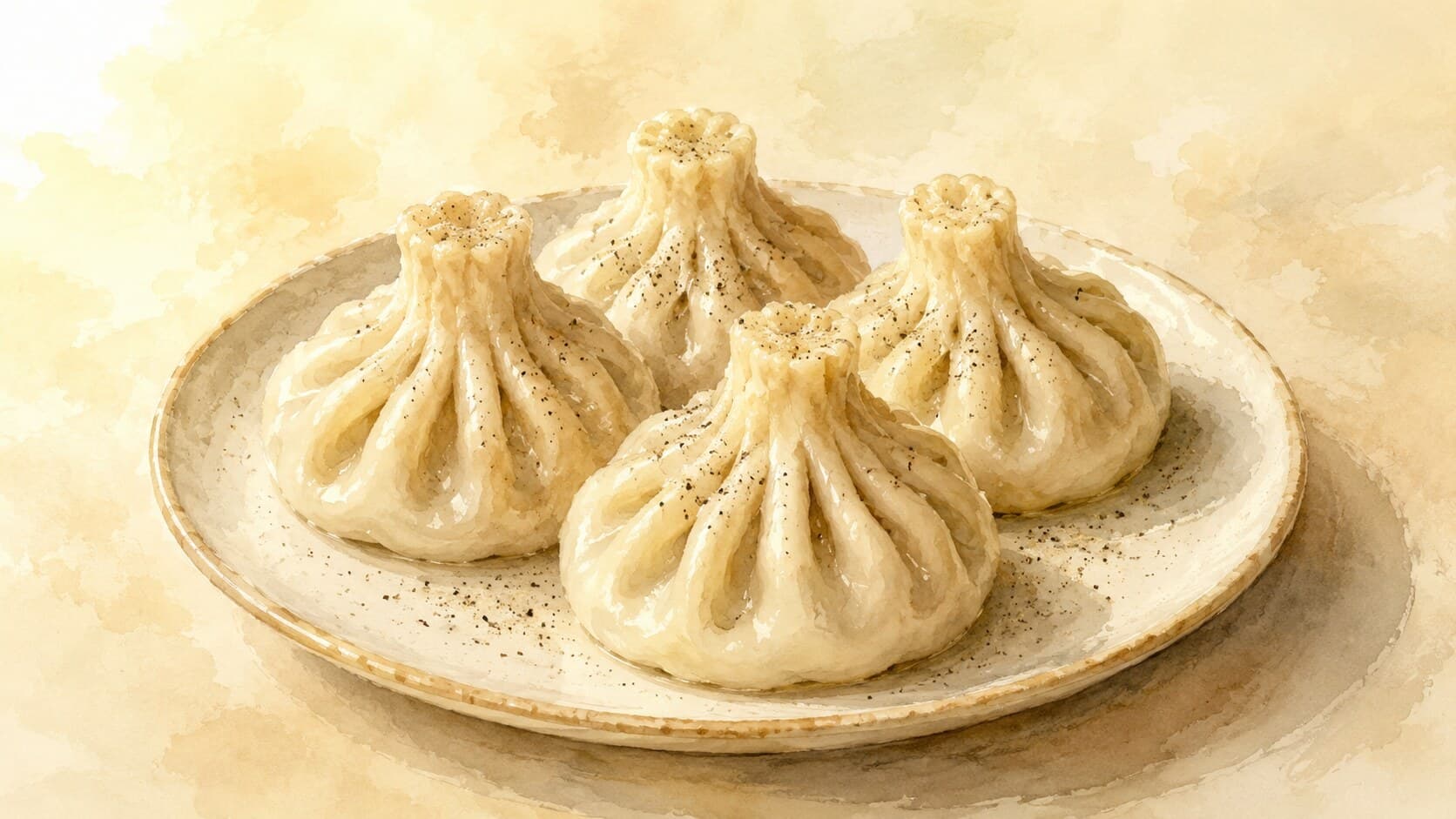
Khinkali are Georgian soup dumplings made with a dough wrapper filled with seasoned meat and spices, then steamed to retain the filling's juices.
Contents (5 sections)▾
Ingredients
- 500 g ground beef
- 200 g ground pork
- 250 ml beef broth
- 1 medium onion, finely chopped
- 2 cloves garlic, minced
- 1 tsp ground black pepper
- 1 tsp salt
- 1 tsp coriander, ground
- 500 g all-purpose flour
- 200 ml water
- 1 tsp salt (for dough)
- flour for dusting
Steps
In a large bowl, mix the ground beef, ground pork, chopped onion, minced garlic, black pepper, salt, and coriander until well combined.
Gradually add the beef broth to the meat mixture, stirring until it becomes a cohesive filling. This ensures the filling is juicy.
In another bowl, combine the flour and 1 tsp salt. Gradually add water while mixing until a soft dough forms. Knead for about 10 minutes until smooth.
Cover the dough with a damp cloth and let it rest for 30 minutes at room temperature. This relaxes the gluten, making it easier to roll out.
Divide the dough into small balls (about 25g each). Roll each ball into a thin circle, about 10 cm in diameter, ensuring the edges are thinner than the center.
Place about 1 tablespoon of the filling in the center of each dough circle. Gather the edges and pleat them together to form a pouch, twisting the top to seal.
Bring a large pot of salted water to a boil. Carefully drop the khinkali into the water, ensuring they do not stick together. Cook for 10-12 minutes until they float and the dough is tender. Cook the ground meat until it reaches 71 °C / 160 °F on an instant-read thermometer (no longer pink throughout) — colour, float and time are guides, not the safety test.
Remove the khinkali with a slotted spoon and serve hot, dusted with black pepper. Enjoy carefully, as the broth inside can be very hot!
Why this works
This recipe utilizes a combination of ground beef and pork, which together provide a rich flavor and juicy texture. The addition of beef broth to the filling is crucial; it enhances the meat's flavor and creates the signature broth inside the dumpling. The dough is made with flour and water, which, when kneaded and allowed to rest, develops gluten that gives the khinkali its chewy texture. If the dough seems too dry, add water a little at a time; if it feels too sticky, dust it with a bit of flour. Proper pleating and sealing of the dumplings are essential to retain the broth during cooking. They should be boiled until they float, indicating that they are cooked through; undercooking will leave the dough too firm, while overcooking can result in a mushy texture. Mastering these techniques will yield delightful khinkali every time.
Common mistakes
Serving khinkali without verifying the meat is fully cooked through (food-safety issue). Target: Internal temperature of the raw-meat filling 71 °C / 160 °F or higher — no pink, no glassy raw meat, juices run clear. Slice one khinkali (Georgian soup dumpling, traditionally stuffed with raw spiced meat and broth) open before serving to verify. Why it matters: The filling goes into the wrapper raw — a mix of ground beef and pork seasoned with onion, garlic, and broth. Pork and beef can carry Salmonella, E. coli, and (with pork) Trichinella; the boil has to bring the meat's coldest interior point fully through, not just heat the wrapper. "They floated" is necessary but not sufficient. What to do: Boil the full 10–12 minutes after the dumplings rise to the surface. Lift one to a plate, cut it open, and look at the meat: opaque grey-brown throughout with no pink and no raw juices. If you're cooking a big batch in stages, check one from each batch — wrapper thickness varies. If in doubt, give them another 1–2 minutes.
Pleating without leaving a steam pocket — the broth bursts out. Target: A generous air pocket above the filling at sealing time; pleats gathered upward like a money-bag, twisted firmly only at the very top crown. Why it matters: The "soup" inside khinkali comes from the broth and pork fat rendering into liquid during the boil — the wrapper has to be a sealed pressure vessel with space for that liquid to collect. If you press the filling flush to the wrapper before pleating, the wrapper splits at first contact with boiling water and the broth ends up in the pot. What to do: Cup the disc in your palm, mound filling in the center, then gather and pleat upward, leaving room above the meat. Twist the gathered top firmly and pinch off any excess dough at the crown — a tight knot is what holds the broth.
Rolling the wrapper to a uniform thickness. Target: A thin edge (about 1–2 mm) tapering to a slightly thicker center (about 3 mm). Why it matters: The edges get pleated into many overlapping layers — when they cook those layers become a dense doughy knot. A wrapper that's already thick at the edge produces a hard, gluey crown nobody wants to eat. The center needs the bit of extra body because that's where the broth's weight pulls. What to do: Roll out the disc from the center outward, lifting and rotating, so the rolling pin spends more time at the rim. A noticeable thin halo around a slightly raised center is the goal.
Boiling in cramped water — dumplings stick and tear. Target: A wide, rolling boil in a large pot, well-salted water, with plenty of room around each khinkali. Why it matters: Khinkali need to circulate freely in the water — if they touch the bottom or each other while the wrapper is still hydrating, they fuse and tear when separated, releasing the very broth you worked to seal in. What to do: Drop them in one at a time into actively boiling water, and stir gently with a wooden spoon for the first 30 seconds to keep them moving. Cook in batches if the pot looks crowded — fewer at a time is much better than a torn batch.
What to look for
- Filling before pleating: visibly wet and loose, but not slumping into a puddle. Adding broth gradually until the meat looks shiny and barely holds shape is the right consistency — that's the soup waiting to form.
- Dough disc before filling: thin translucent halo at the rim, slightly thicker center. Held up to light, the edge is nearly see-through; the middle is opaque.
- Pleated khinkali on the board: visible "money-bag" shape with a clear twisted crown, no flat or saggy ones. A flat one is sealed too tightly to leave room for broth; a saggy one is over-filled and will tear.
- In the pot at doneness: floating freely, wrapper looks translucent and glossy, pleats relaxed open. Cut one open: the meat is opaque grey-brown all the way through, no pink, and a clear pool of hot broth sits at the bottom.
A note on history
Khinkali originated in the highland regions of eastern Georgia — most often credited to Pshavi, Khevsureti, and Tusheti, where they were a portable, high-calorie food for shepherds and travellers in the mountains, originally filled with mutton and seasoned with thyme that grew locally (Wikipedia; Highlander Travel). As the dish moved into central Georgia and Tbilisi, the filling shifted to a mix of beef and pork and the thyme was replaced by cumin and black pepper, producing the now-common kalakuri (city-style) khinkali (Feast Journal; Highlander Travel). The traditional eating ritual — lift by the twisted crown, bite a small hole, drink the broth, then eat the meat and wrapper but leave the doughy crown stub on the plate — preserves the same practical logic the highland herders started with: the crown is a handle, not food.
Get the essays in your inbox — free
Weekly notes on flavor, fermentation, and food history — the writing behind the Atlas of Flavor. No spam; unsubscribe anytime.