
Kefta Mkaouara
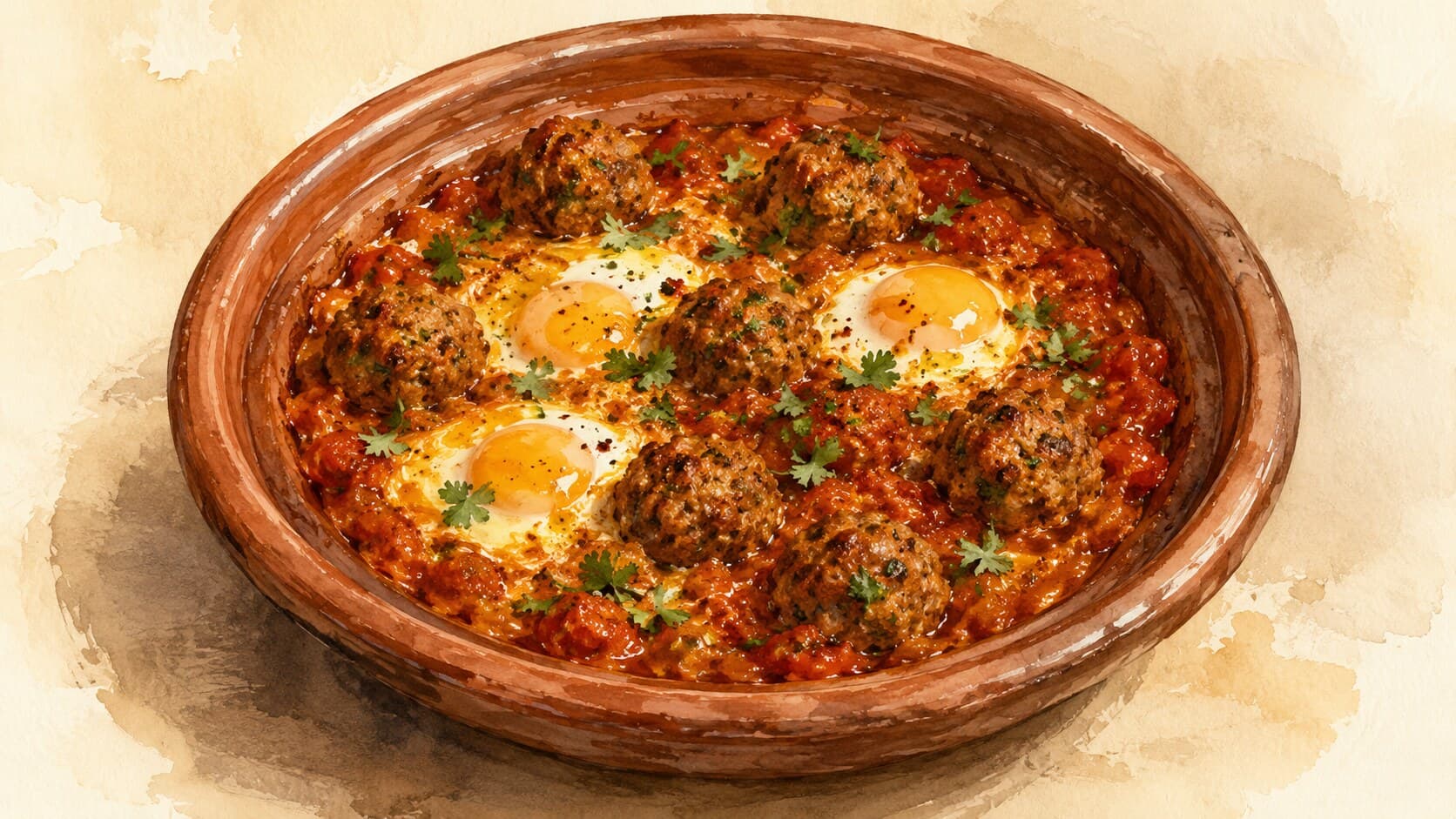
Kefta Mkaouara features spiced meatballs simmered in a rich tomato sauce, topped with poached eggs for a delicious North African main dish.
Contents (5 sections)▾
Ingredients
- 500 g ground lamb or beef
- 1 medium onion, finely chopped
- 3 cloves garlic, minced
- 2 tsp ground cumin
- 1 tsp ground coriander
- 1 tsp paprika
- 1/2 tsp cayenne pepper
- 400 g canned chopped tomatoes
- 200 ml water
- 4 large eggs
- 3 tbsp olive oil
- Salt, to taste
- Fresh parsley, chopped, for garnish
Steps
In a large tagine or wide pan, heat olive oil over medium heat. Sauté the chopped onion and minced garlic for about 5 minutes until softened.
In a bowl, combine the ground lamb or beef with cumin, coriander, paprika, cayenne, and salt. Form into meatballs about the size of golf balls.
Add the meatballs to the pan, browning them on all sides for about 5-7 minutes. This enhances flavor through browning.
Pour in the canned tomatoes and water, stirring gently to combine. Bring to a simmer and reduce heat to low. Cover and cook for 10 minutes. Cook the ground meat until it reaches 71 °C / 160 °F on an instant-read thermometer (no longer pink throughout) — colour, float and time are guides, not the safety test.
Make small wells in the sauce and crack the eggs into these wells. Cover and cook for an additional 5 minutes, or until eggs are set to your liking.
Remove from heat, garnish with chopped parsley, and serve hot with crusty bread.
Why this works
The technique of simmering the spiced meatballs in a cumin-tomato sauce allows the flavors to meld beautifully. As the meatballs cook, they absorb the aromatic spices while infusing the sauce with rich flavors. The addition of poached eggs at the end creates a luxurious texture contrast, with runny yolks that enrich each bite. If the sauce seems too thin, allow it to simmer uncovered for a few more minutes to reduce and thicken. Conversely, if the sauce is too thick, adding a splash of water can help adjust the consistency. This dish is a great introduction to the shakshuka pattern, where the interplay of sauce and eggs creates a comforting, satisfying meal.
Safety note. The canonical finish has eggs with set whites and just-runny yolks — a just-runny yolk is undercooked egg with no validated Salmonella kill step. To keep it runny, use an egg pasteurized in the shell (through to the contents); otherwise continue cooking until the yolks are fully set. High-risk diners (pregnancy, immunocompromised, very young or old) should use a pasteurized egg, or continue cooking until the yolks are fully set before serving.
Common mistakes
Skipping the brown stage on the kefta.
Target: Meatballs visibly seared on at least two sides — deep brown patches, not just grey — before any tomato liquid hits the pan.
Why it matters: Kefta (Moroccan seasoned ground meat) needs Maillard browning (the heat-driven reaction between proteins and sugars that builds the savory, roasted flavor) before it goes into sauce. Once submerged in tomato liquid, the temperature drops to a simmer and the surface can no longer brown — it just turns the pale-grey of poached meat, and the dish loses its backbone.
What to do: Heat oil until it shimmers. Lay the meatballs in without crowding, leave them undisturbed 90 seconds per side. Their job at this stage is color, not doneness — the simmer finishes them through.
Adding the eggs while the sauce is still aggressive.
Target: Sauce reduced to a thick gravy, surface barely simmering — small bubbles, not rolling boil — before eggs go in.
Why it matters: A vigorous boil rocks the eggs apart and toughens the whites before they can set neatly in their wells. A gentle simmer gives you tidy nests where whites set fully opaque and yolks reach at minimum a just-set state — fully cooked through, not raw at the center.
What to do: Reduce the sauce uncovered for the last 5 minutes if it looks thin. Make actual wells with a spoon. Crack each egg into a small cup first so any shell is caught, then slide it into the well. Cover and let steam do the work — peek at 4 minutes.
Undercooking the kefta center.
Target: Meatballs cooked through to 71 °C / 160 °F at the core for ground meat — that reading is the safety test — with the center fully opaque and no pink.
Why it matters: Ground meat carries surface bacteria mixed throughout, not just on the outside as with whole cuts — so the entire interior must reach a safe temperature. A 10-minute simmer at golf-ball size is usually enough, but oversized meatballs can stay pink at the core.
What to do: Keep the meatballs no larger than 4 cm across. Push an instant-read thermometer into the core of a meatball — it must read 71 °C / 160 °F before the eggs go in, so keep one to hand. Halving one to see no pink and clear juices is a supporting check, not a substitute for the reading; if it reads below 71 °C, simmer 3–5 minutes longer and check again.
Spices added raw to the meat with no bloom.
Target: Cumin, coriander, paprika briefly warmed in oil with the onion before the meatballs join — or toasted whole and ground.
Why it matters: Dried spices need fat and heat to release their volatile aromatics; thrown in raw they taste flat and slightly dusty. Blooming (gently frying spices in oil to release their aroma) is the difference between a Moroccan tagine (a shallow conical North African clay pot, also the stew cooked in it) and a generic tomato stew.
What to do: Sweat the onion in olive oil first. Add a pinch of the spice mix to the pan and stir for 30 seconds until the kitchen smells of cumin. Then add tomato. The bulk of the spice still goes into the meat — the bloom is a base layer for the sauce.
What to look for
- Meatballs after the sear: dark mahogany patches on at least two sides, sticky fond on the pan bottom. That fond is the dish's depth — don't wash it away.
- Sauce just before eggs: thick enough that a spoon dragged across the pan leaves a track that closes slowly. A watery sauce will not hold the eggs in their wells.
- Eggs as they cook: whites turning fully opaque from the edges inward, a thin film over the yolks. Whites should be completely set with no clear, jelly-like areas.
- Finished tagine: whites fully opaque and set, yolks at minimum just-set (no raw, liquid center), bright tomato sauce clinging to meatballs, herbal-spiced steam. Olive oil should pool slightly on top.
A note on history
Kefta describes the spiced ground-meat mixture itself, while mkaouara (also spelled mkawra) refers to the act of rolling that mixture into small balls; the dish takes its name from the technique that defines it (Linsfood; Three Friends Cook). It belongs to a wider Moroccan tagine tradition — beef or lamb meatballs simmered in a tomato-onion sauce seasoned with cumin, paprika, and sometimes cinnamon, finished with eggs cracked into the sauce in the final minutes — and is canonically served from the same vessel it was cooked in, with crusty bread to pull through the sauce (Veena Azmanov). As the cookbook authors above note, no two households make it exactly the same — region, family, and cook all leave fingerprints.
Get the essays in your inbox — free
Weekly notes on flavor, fermentation, and food history — the writing behind the Atlas of Flavor. No spam; unsubscribe anytime.