
Käsespätzle (Kasspatzn)
Käsespätzle consists of soft egg noodles mixed with melted cheese and topped with fried onions, commonly served as a main dish in Austrian cuisine.
Contents (5 sections)▾
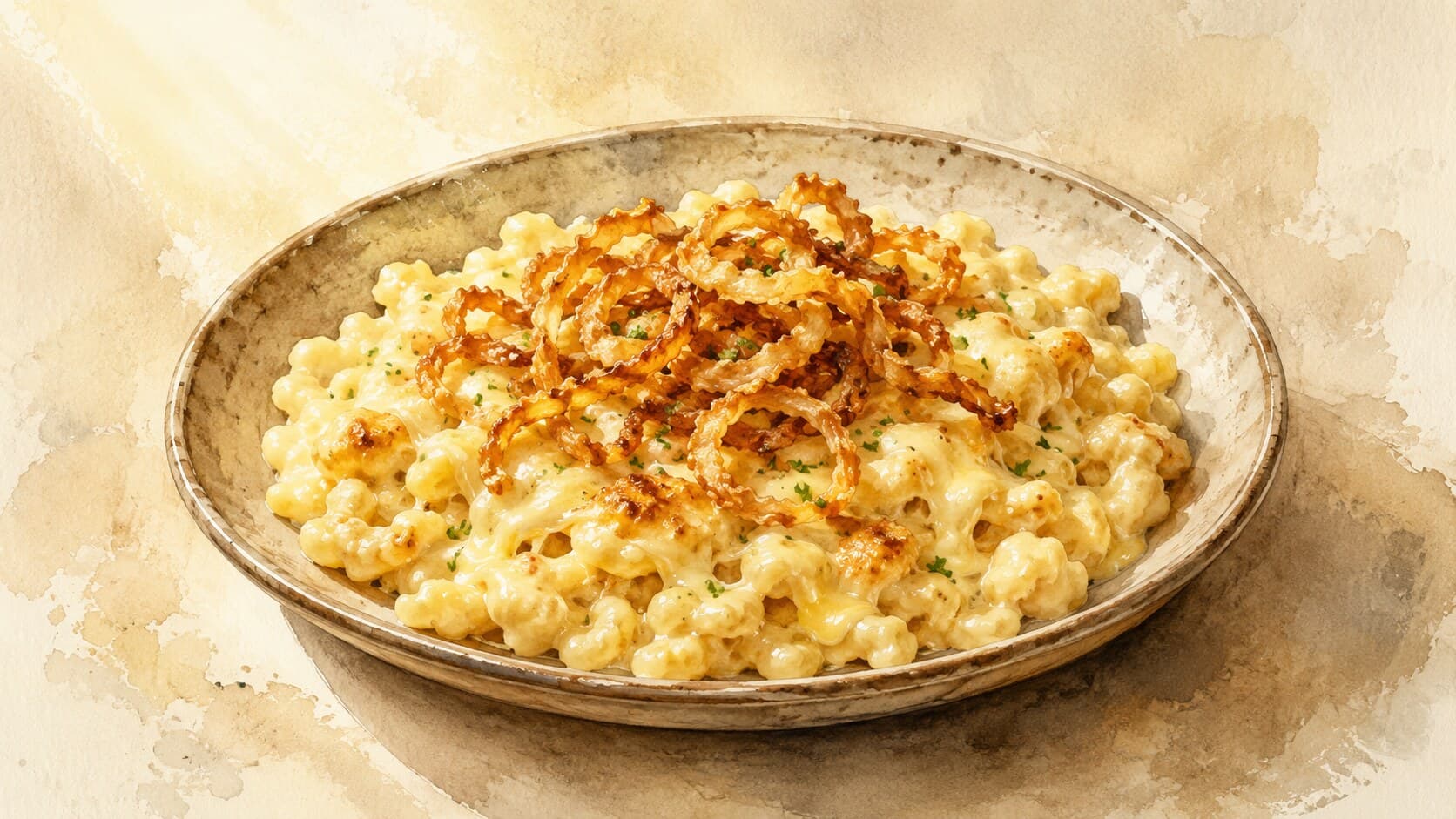
Ingredients
- 300 g all-purpose flour
- 3 large eggs
- 100 ml milk
- 1 tsp salt
- 200 g grated Alpine cheese (e.g., Emmental or Gruyère)
- 2 medium onions, sliced
- 2 tbsp butter
- Black pepper to taste
- Fresh parsley for garnish, to taste
Steps
In a mixing bowl, combine 300 g of flour, 3 large eggs, 100 ml of milk, and 1 tsp of salt. Whisk until a smooth batter forms, then let it rest for 10 minutes.
Bring a large pot of salted water to a boil. Using a spätzle maker or a colander, press the batter into the boiling water. Cook for 2-3 minutes until the spätzle float to the surface, then remove them with a slotted spoon.
In a skillet, melt 2 tbsp of butter over medium heat. Add the sliced onions and sauté until golden brown and crispy, about 8-10 minutes. Remove and set aside.
In a large mixing bowl, combine the cooked spätzle with the grated cheese, mixing until the cheese melts. Season with black pepper.
Transfer the cheesy spätzle to a serving dish, top with the browned onions and garnish with fresh parsley. Serve immediately.
Why this works
Käsespätzle's (an Alpine baked-pasta dish: soft egg-dough noodles tossed with melted mountain cheese and topped with browned onions) charm lies in its combination of texture and flavor. The spätzle, made from a simple batter, relies on the right consistency to achieve its characteristic softness. If the batter seems too thick, add a splash more milk to create a smoother dough, ensuring easy passage through the spätzle maker. The choice of Alpine cheese is crucial as it melts beautifully, creating a creamy sauce that clings to the noodles. Cooking the onions until they're deep golden brown adds a contrasting crunch and a sweet, savory depth to each bite. This dish excels in comfort food applications, especially during cold seasons, making it a mountain meal. For a successful preparation, ensure your water is at a rolling boil to cook the spätzle quickly; otherwise, they may become gummy. A final tip: if your cheese doesn't melt thoroughly, return the dish to a low heat for a couple of minutes, stirring gently to achieve that creamy texture you desire.
Common mistakes
Pressing the batter through cold water.
Target: A vigorous rolling boil — large bubbles breaking the surface continuously.
Why it matters: Spätzle (small free-form egg dumplings) need to set their starch (the surface protein-and-starch matrix that holds the shape) the instant they hit the water. A weak simmer lets the soft batter trail apart into shreds, and the dumplings absorb water and turn gummy before they coagulate.
What to do: Bring a wide pot of well-salted water to a real rolling boil before the press touches it. Work in two or three batches so the temperature doesn't crash.
Skipping the rest after mixing the batter.
Target: 10–20 minutes of rest before pressing.
Why it matters: Resting lets the flour fully hydrate and the gluten relax, so the dumplings hold together without becoming tough. Pressed straight away, the batter is uneven — some bits too loose, others too elastic.
What to do: Mix, cover, walk away. The batter should fall from a spoon in a slow, sticky ribbon — thick enough to hold a shape, loose enough to drop through the holes of the press.
Drowning the dish in cheese all at once.
Target: Layer in two or three additions, off heat or on very low heat, tossing between each.
Why it matters: Alpine cheeses like Emmental or Gruyère are stringy when overheated — the proteins tighten and squeeze fat out, leaving a greasy, ropey mass instead of a glossy coat. The pasta's own residual heat melts the cheese cleanly.
What to do: Drain spätzle while still steaming. Tip into a warm bowl or pan. Fold in cheese in thirds, letting each addition soften before the next.
Sweet onions instead of deep brown.
Target: Onions cooked until mahogany, not just translucent — 15–25 minutes on medium-low.
Why it matters: The fried-onion topping is the dish's contrast — sweet, bitter-edged Maillard depth (the browning reaction that builds savory aroma) against the soft cheesy noodles. Pale, soggy onions disappear into the cheese; truly browned onions cut through it.
What to do: Slice thinly and evenly. Start in cold butter, salt early to draw water out, then cook patiently. The pan should sound like a steady, soft sizzle — not silence, not a roar.
What to look for
- Batter on the spoon: slow, sticky ribbon that breaks reluctantly. Not pourable like pancake batter, not stiff like bread dough.
- Spätzle in the pot: bobs to the surface within 1–2 minutes, holds its irregular shape. Pieces stay distinct — not melted together.
- Cheese-coated noodles: glossy coat, threads stretch a few centimeters when lifted, no oily pool at the bottom of the bowl. That puddle of fat means the cheese has split.
- Fried onions on top: deep mahogany, crisp edges, almost-burnt at the tips. Should crunch audibly under the spoon.
A note on history
Spätzle itself was first recorded around 1725 in the Swabian region of southwest Germany (Wikipedia). The cheese version — Käsespätzle — spread south and east through the Alpine herding economy, taking on local names: Kasspatzn or Kasspatzln in Tyrol, Käsknöpfle in Vorarlberg and Liechtenstein, Kasnocken in Salzburg's Pinzgau region (Tyrol.com; Mission Food Adventure). By the late 1800s it had moved from farmhouse to Alpine guesthouse menu, where tourists adopted it as the canonical mountain meal it still is today.
Get the essays in your inbox — free
Weekly notes on flavor, fermentation, and food history — the writing behind the Atlas of Flavor. No spam; unsubscribe anytime.