
Kafta Kebab
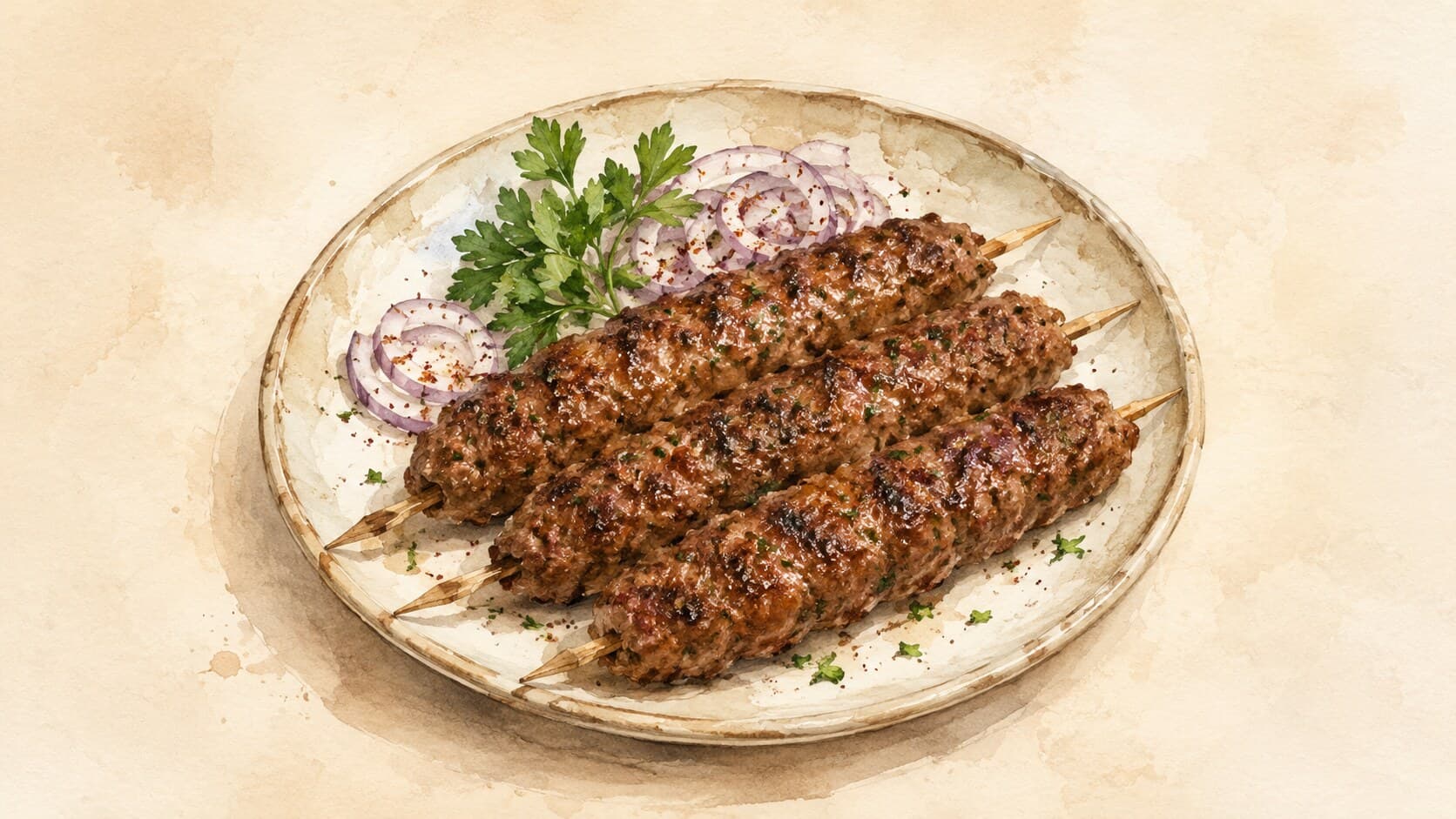
Kafta Kebab consists of spiced ground lamb and beef formed onto skewers and grilled, often served in various regional styles.
Contents (5 sections)▾
Ingredients
- 500 g ground lamb
- 500 g ground beef
- 1 small onion, finely grated
- 4 cloves garlic, minced
- 1 tsp ground cumin
- 1 tsp ground coriander
- 1 tsp allspice
- 1 tsp sumac
- 1 tsp salt
- 1/2 tsp black pepper
- 1/4 cup fresh parsley, chopped
- 1/4 cup fresh mint, chopped
- 2 tbsp olive oil
- flatbreads, for serving
- grilled tomatoes, for serving
- grilled onions, for serving
Steps
In a large bowl, combine the ground lamb, ground beef, grated onion, minced garlic, spices (cumin, coriander, allspice, sumac, salt, and pepper), parsley, mint, and olive oil. Mix until the ingredients are well incorporated, ensuring a smooth consistency.
Divide the mixture into equal portions, about 100 g each, and mold them around flat skewers. Ensure they are tightly formed to prevent them from falling apart during grilling.
Preheat your grill to high heat (around 230°C/450°F). This high temperature is crucial for achieving a nice char and sealing in the juices of the kafta.
Place the skewers on the grill and cook for about 5-7 minutes per side, turning occasionally, until the kafta is nicely browned and reaches an internal temperature of 71 °C / 160 °F at the thickest point on an instant-read thermometer; colour, char and time are cues, not the safety test.
Serve the kafta kebabs hot off the grill with grilled tomatoes, onions, and flatbreads for a complete meal.
Why this works
This kafta kebab (spiced ground-meat shaped onto a skewer and grilled over high heat) recipe combines ground lamb and beef for a rich flavor and juicy texture, while the incorporation of spices and herbs infuses the meat with aromatic notes. Working the meat mixture until smooth ensures a cohesive blend that adheres well to the skewers, preventing them from breaking apart during grilling. Grilling at high temperatures rapidly caramelizes the surface, creating a char that enhances flavor while keeping the inside moist. If the kafta seems too loose to hold its shape, consider chilling the skewers for 15-20 minutes before grilling to firm them up. Ensure even shaping around the skewers for uniform cooking; uneven pieces will cook at different rates, leading to some being overdone while others remain undercooked. This balance of technique and ingredient synergy results in a well-executed dish suitable for various occasions.
Common mistakes
Under-mixing the meat.
Target: Knead the ground lamb-and-beef mixture with the grated onion, garlic, herbs, and spices for a full 3–5 minutes, until it turns slightly sticky and holds its shape when you press a small portion in your palm without crumbling.
Why it matters: Kafta needs myosin (a sticky protein in muscle that's released when ground meat is worked with salt) to extract and bind the meat together. Without that binding, the kafta cracks off the skewer the moment the grill heat hits it — and falling pieces hit the coals, where they char black before the rest is cooked. Working the mix until tacky is the single most important step for clean skewers.
What to do: Mix with one bare hand (cold), pressing and folding for several minutes. Stop when the mass clings to your palm rather than falling away in loose pieces.
Center still pink — undercooked ground meat.
Target: Skewers fully cooked through, no pink in the center, internal temperature at the thickest point reaching 71 °C / 160 °F.
Why it matters: This is a food-safety line, not a doneness preference. Whole-muscle steaks can be safely eaten medium-rare because bacteria live on the surface — searing the outside kills them. Ground meat is different: grinding mixes surface bacteria throughout the entire mass, so every part of a kafta skewer is, in effect, the "surface." A pink center in ground lamb or beef is unsafe regardless of how good the lamb is.
What to do: Push an instant-read thermometer into the thickest part — it must read 71 °C / 160 °F, and that reading is the safety test; get one before grilling ground meat. Cutting the thickest skewer to look for pink or pearly translucence is a supporting sign, not a substitute — if you see any, they are not done.
Grill not hot enough at the start.
Target: A grill or pan preheated to high — around 230°C / 450°F — hot enough that you can hear the meat hiss the moment it touches the surface.
Why it matters: High heat triggers the Maillard reaction — the browning chemistry that creates the deep, savory, slightly charred crust that defines a real kafta. On a lukewarm grill, the meat sweats out its juices instead of searing, and you end up with grey, dry skewers that taste boiled. The crust is also what seals the surface so the inside stays juicy.
What to do: Preheat the grill until you can't comfortably hold your hand 10 cm above the grate for more than a couple of seconds. Only then add the skewers.
Skewers too thick.
Target: Even cylinders about 2.5 cm thick, packed firmly around flat skewers (the flat shape grips the meat better than round).
Why it matters: If a kafta cylinder is much thicker than 2.5 cm, the outside chars before the inside reaches safe temperature — and you're forced to choose between burnt crust or undercooked center. Uniform thickness across all skewers also means they finish together, so none sit on the grill drying out while others catch up.
What to do: Wet your hands, take roughly 100 g of mix, and press it firmly along the skewer in an even cylinder. Avoid building up a bulge in the middle.
What to look for
- The mix after kneading: tacky enough that a small pinched portion clings to your fingertips rather than falling off, and the mass in the bowl holds a shape when you press it.
- Skewers on a hot grill: audible sizzle the moment they touch the grate; within 30 seconds the underside has gone from raw pink to a deep brown-mahogany, with the spice oils starting to rise in steam.
- Mid-cook, after first flip: visible char marks but not blackened, juices beading on the cooked side, and the cylinder stays firmly on the skewer. If a piece is sliding off, the grill was too cool or the mix wasn't worked enough.
- Doneness check: a clean cut through the thickest skewer shows uniform brown-grey color, no pink center — a supporting sign once the thermometer reads 71 °C / 160 °F, not a stand-in for it. Juices that run out should be clear, not pink.
A note on history
The word kafta (also spelled kofta or kefta outside Lebanon) comes from the Persian kūfta, meaning "to grind" or "pounded meat" (Wikipedia: Kofta). The earliest written recipes for spiced ground-meat preparations appear in medieval Arab cookbooks, and the technique spread across an enormous arc — from the Indian subcontinent through Central Asia, the Levant, the Balkans, and North Africa — adapting to each region's spice palette and cooking method. The Lebanese skewer-grilled form codified here is one branch of that family, alongside Persian kabab koobideh, Turkish köfte, and South Asian kofta curries (196 Flavors: Kofta Kebab).
Get the essays in your inbox — free
Weekly notes on flavor, fermentation, and food history — the writing behind the Atlas of Flavor. No spam; unsubscribe anytime.