
Simmered Kabocha (Kabocha no Nimono)
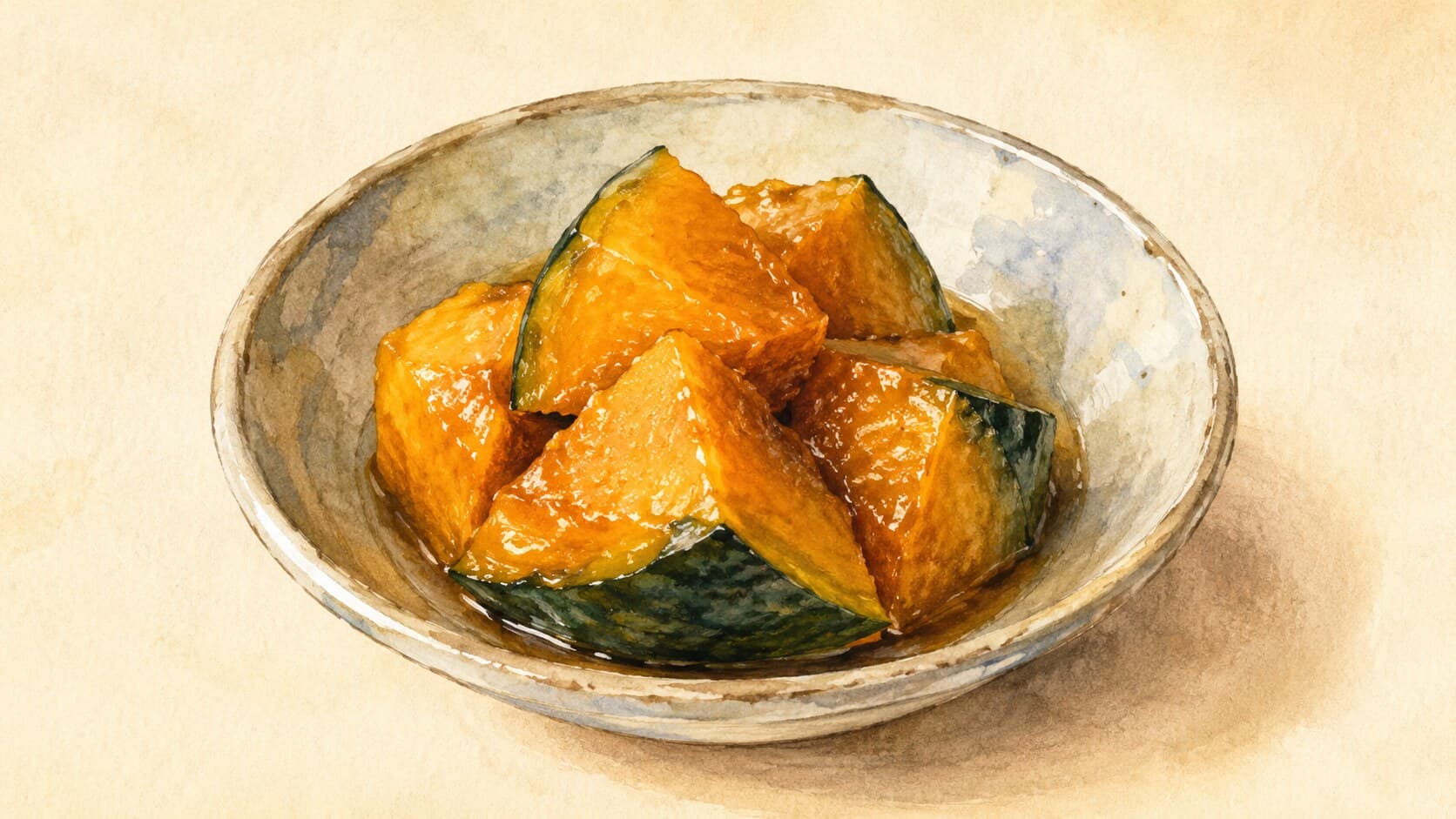
Simmered kabocha (Kabocha no Nimono) is a Japanese side dish made with tender kabocha squash cooked in a savory-sweet broth.
Contents (5 sections)▾
Ingredients
- 500 g kabocha squash, peeled and cut into chunks
- 300 ml dashi broth
- 3 tbsp soy sauce
- 2 tbsp mirin
- 1 tbsp sugar
- to taste salt
- 1 piece kombu (optional, for dashi)
Steps
In a pot, combine dashi broth, soy sauce, mirin, sugar, and kombu if using. Bring to a simmer over medium heat, approximately 5 minutes.
Add kabocha chunks to the pot, making sure they are skin-side down. This helps them absorb the flavors better.
Simmer gently for about 15 minutes, or until the kabocha is tender. Check for doneness by piercing a piece with a fork; it should slide in easily.
If the kabocha seems too firm, continue simmering for an additional 5 minutes until soft.
Taste the broth and adjust seasoning with salt if necessary before serving.
Why this works
Simmered kabocha, or 'kabocha no nimono' (a Japanese-style gently simmered side dish, where vegetables soak up a seasoned broth), is a classic Japanese dish that showcases the natural sweetness of the squash while being enhanced by the umami-rich dashi broth (a light Japanese stock made from kombu seaweed and/or bonito flakes). The technique of simmering allows the kabocha to cook evenly while absorbing the flavors from the seasoning. Cooking skin-side down prevents the pieces from breaking apart and helps maintain their shape. If the kabocha seems too firm during cooking, continue simmering for an additional 5 minutes; this ensures it becomes soft enough to enjoy while still holding its form. Properly balancing the sweetness of the sugar with the savory notes from the soy sauce and dashi creates a well-rounded flavor. This dish serves well as a side, complementing heavier main courses, especially during the cooler months when kabocha is in season. The precision in timing and temperature ensures that the kabocha is cooked to perfection, allowing for a delightful texture and flavor that is both comforting and satisfying.
Common mistakes
Uneven kabocha chunks.
Target: Roughly equal pieces, about 4–5 cm across, with one flat face (skin side) for stable contact with the pot.
Why it matters: Kabocha (a Japanese winter squash with a hard green skin and dense orange flesh) is dense — heat travels slowly through it. If some pieces are twice the size of others, the small ones turn to mush while the big ones still have a raw, hard center when you bite in. Even cuts mean every piece reaches the same tenderness at the same time.
What to do: After scooping the seeds, cut the squash into wedges, then crosscut each wedge into chunks of similar weight. Don't worry about perfect cubes — match the rough size.
Pieces packed too tightly in the pot.
Target: A single layer with each piece touching the simmering liquid, ideally skin-side down on the pot bottom.
Why it matters: Kabocha no nimono cooks by fukumeni — the broth carries flavor into the flesh through osmosis (the way salt and umami compounds move from a stronger solution into the lower-concentration cells of the squash). If pieces are stacked, the top layer steams in flat water vapor instead of soaking in seasoned dashi, and the flavor ends up uneven.
What to do: Use a pot wide enough to hold all the kabocha in one layer. If you must double up, swap top and bottom pieces gently halfway through.
Skin-side up.
Target: Skin side down on the pot, cut flesh facing the broth.
Why it matters: The skin is the protective wall — flavor crosses into the flesh through the cut surface, not the skin. Cut-side down also exposes the soft flesh directly to the hot pot bottom, which is exactly where it tends to collapse. Skin-side down anchors each piece on its toughest face and lets the flesh absorb seasoning from above.
What to do: Place each piece deliberately: skin to the pot, cut face up toward the broth.
Raw center after the timer.
Target: A skewer or chopstick slides cleanly through the thickest part with no resistance; the flesh is fully tender, no hard or pale-yellow core.
Why it matters: Kabocha is a starchy squash — a hard center isn't just unpleasant texture, it means the starch hasn't gelatinized and the flavor never penetrated. Underdone kabocha also doesn't reheat well; the center stays grainy.
What to do: Test the thickest piece, not the smallest. If it resists the skewer, simmer another 3–5 minutes — kabocha is forgiving in this direction; the danger is overshooting into mush, which only happens if you keep boiling hard. Low simmer continues to soften without breaking up.
What to look for
- The broth before kabocha goes in: gently simmering, small bubbles around the edge, not a rolling boil. A rolling boil tears the skin and breaks the chunks before they're soft enough to absorb flavor.
- Mid-simmer (around minute 8): the kabocha skin has deepened from raw green to a darker, glossier shade; the broth has reduced slightly and clings to the pieces.
- Doneness test: a skewer slides into the thickest piece with no resistance, the way it would through a cooked potato. If it stops or pushes back, it needs more time.
- Finished dish on the plate: each piece holds its shape, the skin slightly puckered, the cut flesh deep orange and glossy with soy-dashi. The broth at the bottom of the bowl tastes round and lightly sweet — that's the dashi-osmosis at work.
A note on history
Kabocha squash arrived in Japan in the mid-1500s, brought by Portuguese sailors who had stopped in Cambodia on their way north. The Japanese name itself is a linguistic fossil of that route — kabocha is thought to come from Camboja abóbora ("Cambodia pumpkin" in Portuguese), shortened over centuries of local use (Wikipedia: Kabocha). The squash was adopted into the nimono (simmered-dish) tradition that forms the backbone of Japanese home cooking, and Japanese farmers later refined varieties for sweetness, dense flesh, and good keeping quality — producing the deep-orange, chestnut-textured cultivars we recognize today as Nihon kabocha and the modern kuri-kabocha ("chestnut squash") group (Specialty Produce: Kabocha Squash).
Get the essays in your inbox — free
Weekly notes on flavor, fermentation, and food history — the writing behind the Atlas of Flavor. No spam; unsubscribe anytime.