
Iwashi Ume-ni
Iwashi Ume-ni is a traditional Japanese simmered sardine dish where umeboshi contributes a clean tartness that pairs naturally with blue fish.
Contents (5 sections)▾
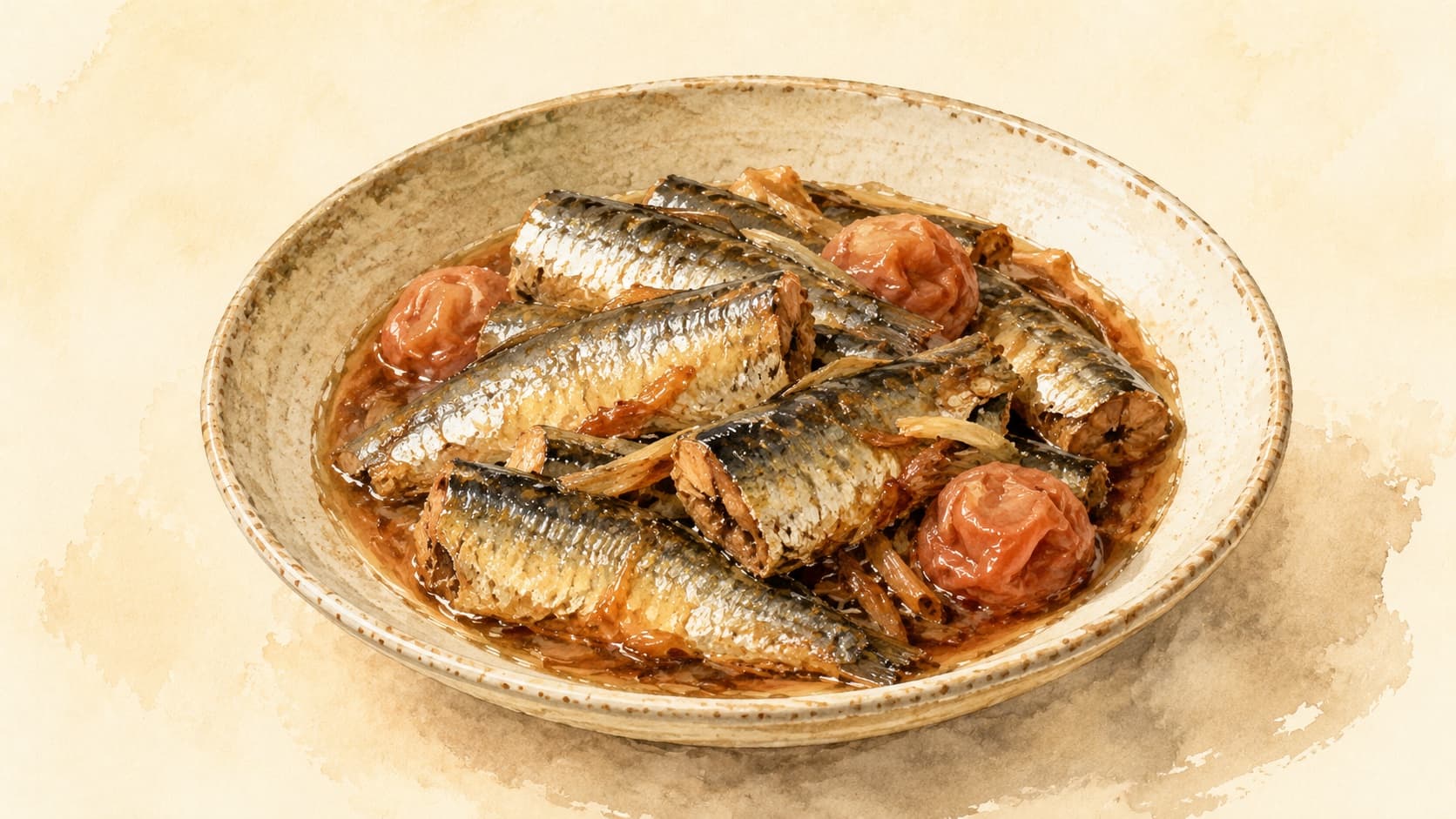
Ingredients
- 2 whole sardines (iwashi), cleaned
- 3 umeboshi (pickled plums), pitted
- 200 ml dashi stock
- 1 tbsp soy sauce
- 1 tbsp mirin
- 1 tsp sugar
- 1 inch ginger, sliced
- 2 green onions, chopped
Steps
In a pot, combine the dashi stock, soy sauce, mirin, sugar, and sliced ginger. Bring to a simmer over medium heat.
Add the cleaned sardines to the pot, ensuring they are submerged in the liquid. Simmer gently for about 10 minutes to allow the flavors to infuse and the bones to soften.
After 10 minutes, add the umeboshi to the pot, allowing them to dissolve slightly into the broth. Continue simmering for another 5 minutes.
Finally, garnish with chopped green onions before serving. Ensure the dish is warm but not boiling when serving to maintain the delicate texture of the fish.
For leftovers, cool the dish promptly, transfer to a clean covered container, and refrigerate. Do not leave the simmered sardines at room temperature. Consume within 1–2 days; reheat thoroughly before eating.
Why this works
The technique of simmering sardines in a broth containing umeboshi pairs the tartness of the pickled plum with the natural richness of the fish, producing a balanced flavor characteristic of Japanese home cooking. Extended gentle simmering allows the small bones to become noticeably softer in texture, which is one reason this style is associated with sardines and other small blue fish — though we recommend eating around the spine as you would with any whole-fish dish rather than relying on the bones being uniformly edible. If the sardines seem firm after the initial simmer, simply extend the cooking time by a few minutes, ensuring they remain moist and tender. Despite its long simmering, this is a fresh-cooked everyday dish, not a preserve: cool leftovers promptly, refrigerate in a clean covered container, and eat within 1–2 days.
Common mistakes
Stopping the simmer before the fish is fully cooked.
Target: Simmer the sardines until the flesh is opaque all the way to the spine — no glassy, pink, or translucent core. Internal temperature 63°C / 145°F or above at the thickest point.
Why it matters: Ume-ni (a Japanese gentle-simmer technique with pickled plum) is a fully cooked dish, not a rare or sashimi preparation. Sardines are an oily fish that can carry the parasite Anisakis when raw; simmering through to opaqueness is the safety step. The umeboshi's acidity adds flavor and helps cut the fishy edge, but it does not make the fish food-safe on its own.
What to do: Maintain a gentle simmer (small bubbles, not a rolling boil), and check by lifting one sardine out and parting the flesh at the back. If the centre is still glassy, give it 2–3 more minutes.
Boiling instead of simmering.
Target: A gentle, just-trembling surface — small bubbles rising slowly. 85–95°C in the liquid, never a rolling boil.
Why it matters: A hard boil tears the sardine skin, scatters the flesh, and pushes water out of the muscle so the fish ends up dry. The whole point of ni (Japanese simmered dishes) is gentle convection that lets the broth migrate in without ripping the protein structure.
What to do: Once the broth reaches a simmer, drop the heat to low and use a otoshibuta (drop-lid — a small wooden or parchment lid that sits directly on the food and presses the fish into the broth without aggressive movement). Crumpled parchment with a small steam hole works as a substitute.
Skipping the brief blanch / cleaning step.
Target: Sardines cleaned (head, guts, dark blood line removed), rinsed quickly under cold running water, patted dry; a brief 5-second dip in just-boiled water before the simmer is optional but helps.
Why it matters: The blood line and surface slime carry most of the fishy smell. Once those are gone, the umeboshi-and-ginger broth can do its job — perfuming clean fish rather than masking strong fish.
What to do: Use the tip of a small spoon to scoop out the dark blood line along the spine. Rinse under cold water and pat completely dry with paper towels before adding to the broth.
Adding umeboshi too early so it dissolves into mush.
Target: Add whole umeboshi (pits removed only if you prefer) about halfway through the simmer, not at the start.
Why it matters: Umeboshi (Japanese salt-pickled plums; salty-sour) lose their pleasantly chunky body and turn the broth uniformly murky if simmered too long. The flavor shifts from layered (clean plum tartness on top of dashi umami) to one-note sour-salty.
What to do: Bring the broth to a simmer, add the sardines, and only add the umeboshi after about 5 minutes so they retain some structure and contribute their tartness without disappearing into the liquid.
What to look for
- Broth ready: just-trembling surface, broth turning lightly golden, the smell of dashi and ginger clearly perceptible before the fish goes in. A rolling boil at this stage is too hot.
- Sardines cooked through: flesh opaque white from skin to spine — no translucent core when one is lifted and parted. Juices clear, not pink.
- Bones softened but not magic: the small ribs flex and yield to chopstick pressure — but the spine itself still feels like spine. Eat around it as you would with any whole fish.
- Done: broth reduced to a glossy coating, sardines glistening with a faint umeboshi-pink tint at the edges, no foamy scum left on the surface. Skim any scum at the start; do not let it boil back in.
A note on history
Iwashi (sardines) have been central to Japanese fishing communities — Chiba's Kujukuri and Choshi coastlines were major sardine ports as far back as the Edo period (1603–1868), and many of the seasonings now associated with preserved sardines — soy, miso, ginger, umeboshi, yuzu — were already being used to balance the fish's oiliness in home kitchens by then (Sardinele.com). Pairing iwashi with umeboshi in particular is a long-running combination in Japanese home cooking: the plum's citric acid cuts the oily blue-fish character, contributes a mild antibacterial edge during the cooking, and was traditionally valued as a summer-stamina pairing (RecipeTin Japan). Gentle simmering with umeboshi to soften small bones is still a standard ume-ni technique passed down in family cookbooks.
Get the essays in your inbox — free
Weekly notes on flavor, fermentation, and food history — the writing behind the Atlas of Flavor. No spam; unsubscribe anytime.