
Huevos Rancheros
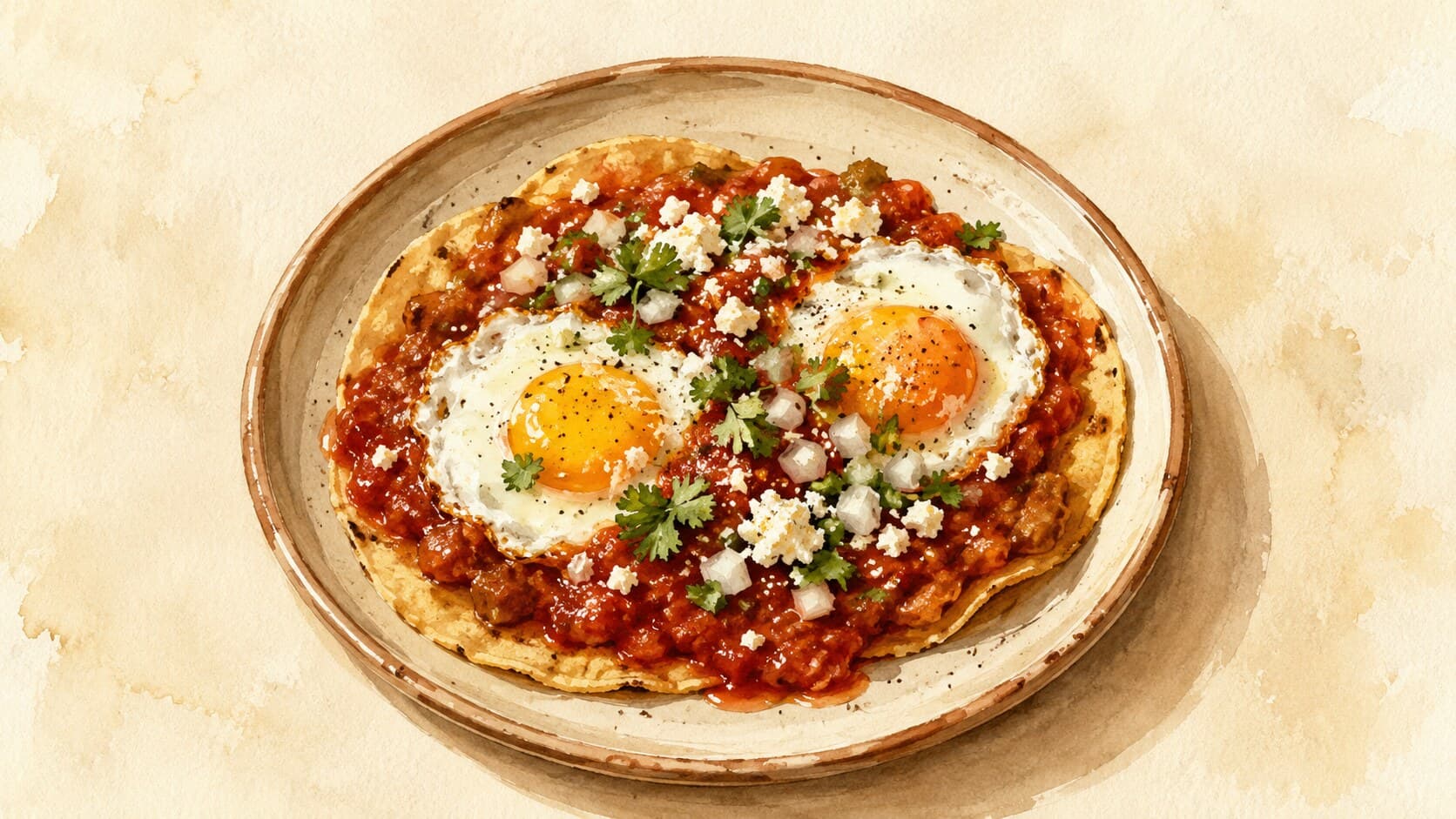
Huevos Rancheros consists of sunny-side-up eggs served on corn tortillas, topped with salsa. It emphasizes egg cooking and tortilla handling.
Contents (5 sections)▾
Ingredients
- 4 eggs
- 2 corn tortillas
- 150 g salsa roja
- 50 g crumbled queso fresco
- 1 tbsp vegetable oil
- 1 sprig cilantro, chopped
- Salt to taste
- Pepper to taste
Steps
Heat the vegetable oil in a skillet over medium heat until shimmering, about 2 minutes. This ensures the tortillas become crispy yet pliable.
Fry the corn tortillas one at a time for about 1 minute on each side until golden and slightly crisp. Remove and set aside on paper towels to absorb excess oil.
In the same skillet, crack the eggs. For ordinary (non-pasteurized) eggs, cook until the yolks are fully set, no longer runny. For soft, runny sunny-side-up yolks, use eggs pasteurized in the shell (through to the contents) — for everyone, not only high-risk diners. Season with salt and pepper.
On each tortilla, layer the salsa roja, followed by the fried eggs. Top with crumbled queso fresco and chopped cilantro.
Serve immediately while hot to enjoy the contrast of textures and flavors.
Why this works
The success of Huevos Rancheros lies in the balance of textures and flavors: the crispy tortillas serve as a sturdy base for the soft, runny eggs, creating a harmonious bite. The salsa roja (a Mexican red tomato-and-chile salsa, lightly cooked so the flavors meld), typically rich in acidity and spice, complements the eggs perfectly, while the crumbled queso fresco (a fresh Mexican cow's-milk cheese — mild, salty, crumbly like feta but softer) adds a creamy texture that balances the dish. When frying the tortillas, ensuring the oil is sufficiently heated helps achieve the right crispness; if the tortillas become too soggy, increase the heat slightly. If the eggs seem overcooked, reduce the cooking time and turn off the heat when the whites are set but the yolks remain runny, ensuring a perfectly gooey yolk to mix with the salsa. This dish is about layering flavors and textures to create a breakfast that feels vibrant and satisfying.
Safety note. The sunny-side-up egg with a runny yolk is the canonical presentation — when broken into the salsa it becomes the dish's binder. But softness, appearance, clock time, and residual pan heat are not by themselves proof the egg is safe: this recipe's runny method has no validated Salmonella kill step. To keep the runny yolk, use an egg pasteurized in the shell (treated through to the contents) — ordinary freshness, or a "raw-eating" (生食用) egg label, is not the same as pasteurized. For high-risk diners (pregnancy, immunocompromised, very young or old), use a pasteurized egg or cook the eggs through to set yolks, or substitute with scrambled or fried-hard eggs. The salsa-and-tortilla base stands on its own.
Common mistakes
Cold oil, soggy tortillas. Target: Oil shimmering before the tortilla touches it — a bead of water flicked in should sizzle immediately. Why it matters: Cold oil soaks into the corn matrix instead of frying it. You get a greasy, limp disc that goes soft under salsa rather than a crisp base that holds its shape. Hot oil triggers fast surface starch gelatinization (the moisture inside flashes to steam) — that's what gives you the audible snap and the dry, crackery surface. What to do: Heat the oil a full 2 minutes on medium. Test before frying. If the tortilla quietly sinks instead of sizzling, lift it out and wait.
Cooking eggs at full heat to "set faster." Target: Medium-low heat; whites fully opaque and firm (no translucent jelly), yolks at minimum set on the surface — for high-risk diners (pregnancy, immune-compromised, young, elderly) cook the yolk through completely. Why it matters: High heat denatures egg-white proteins so fast that the bottom turns rubbery and brown before the top sets. Lower heat lets the proteins coagulate evenly — the white firms gently, the yolk warms through. Do NOT serve the egg with translucent or jelly-like whites: undercooked whites are the food-safety risk, and they slip off the tortilla anyway. What to do: Crack onto warm — not screaming — oil. Cover with a lid for the last minute to set the top from radiant heat. For vulnerable diners, flip and finish until the yolk no longer trembles.
Cold salsa on hot eggs. Target: Salsa warmed in a small pan to about 60–70°C (a gentle steam, no boiling). Why it matters: A cold salsa drops the dish temperature in seconds and condenses moisture into the tortilla — the whole plate goes from crisp to soggy in one minute. Warming the salsa also blooms the dried-chile aromatics in the fat. What to do: Warm the salsa in a side pan while the eggs finish. Spoon over hot.
Wet queso fresco straight from the package. Target: Crumbled queso patted dry on a paper towel before scattering. Why it matters: Packaged queso fresco carries surface whey. On a hot plate the whey weeps onto the tortilla and dilutes the salsa. Dry-surface crumbles sit cleanly and melt at the contact points only — the textural contrast you want. What to do: Crumble onto a paper towel, blot once, then scatter.
What to look for
- Tortilla after frying: deep gold, slightly blistered, audibly crisp at the edge. Press the center with a finger — it should resist, not yield. A bendy tortilla means under-fried.
- Egg white in the pan: fully opaque, dry-glossy surface, no clear jelly. Translucent patches mean the proteins haven't coagulated yet — keep cooking. Brown lacy edges mean the heat was too high.
- Salsa as it goes on: visibly steaming, glossy from warm fat. A dull, cool-looking salsa will pull the dish down.
- Final assembly: distinct layers visible — tortilla edge, salsa pool, intact egg, dry cheese crumb. If everything blurs into one wet zone, the plate sat too long or the components were the wrong temperature.
A note on history
Huevos rancheros — "rancher's eggs" — comes from the rural haciendas of Mexico, where it was the almuerzo, the substantial mid-morning meal that ranch hands and vaqueros (cowherds) ate between roughly 9 and 11 a.m. after their first hours of work. It was a resourceful dish: leftover salsa and tortillas from the previous day, fried in oil and topped with the eggs that were always plentiful on a working farm. Mexican herders crossing from Sonora and Chihuahua into Texas, New Mexico, and Arizona carried the dish north, which is how it became one of the foundational breakfasts of the American Southwest. Sources: Wikipedia — Huevos rancheros, Nuestro Stories — The History of Huevos Rancheros.
Get the essays in your inbox — free
Weekly notes on flavor, fermentation, and food history — the writing behind the Atlas of Flavor. No spam; unsubscribe anytime.