
Herb Butter (Beurre Maître d'Hôtel)
Herb Butter (Beurre Maître d'Hôtel) enhances steaks with a rich blend of fresh herbs and butter.
Contents (5 sections)▾
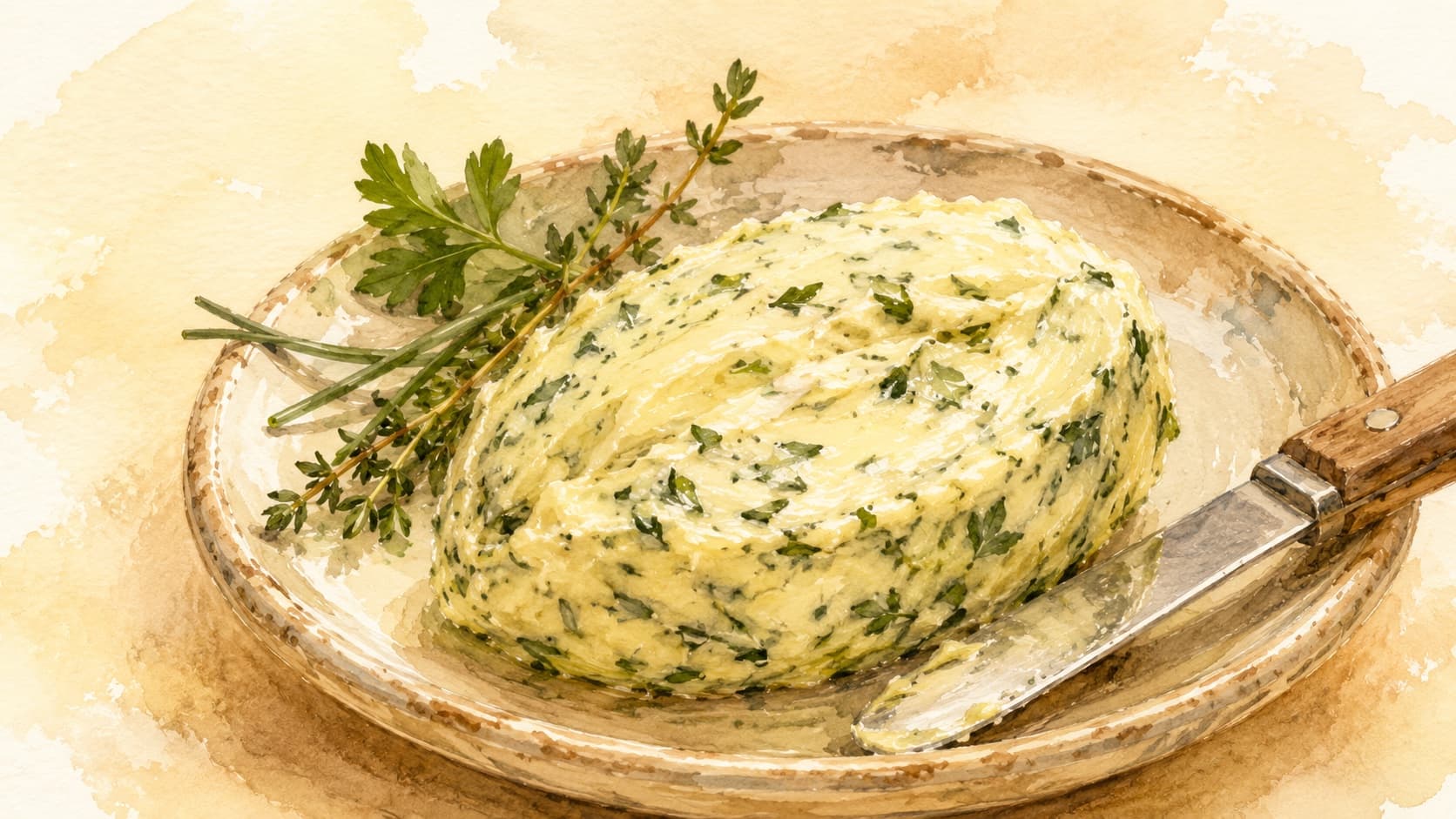
Ingredients
- 100 g unsalted butter, softened
- 2 tbsp fresh parsley, finely chopped
- 1 tbsp fresh chives, finely chopped
- 1 tbsp fresh thyme, finely chopped
- 1 clove garlic, minced
- 1 tsp lemon juice
- Salt, to taste
- Black pepper, to taste
Steps
In a medium bowl, combine the softened butter with parsley, chives, thyme, garlic, and lemon juice. Mix well until all ingredients are evenly incorporated for about 2-3 minutes.
Season the mixture with salt and black pepper to taste. Adjust seasoning according to your preference, adding salt in increments of 1/4 teaspoon.
Transfer the herb butter onto a piece of parchment paper. Shape it into a log by rolling it tightly and twisting the ends. Refrigerate for at least 1 hour at 4°C (39°F) until firm.
Slice the chilled herb butter into rounds, about 1/2 inch thick, and place atop your cooked steak. Let it melt slightly for 2-3 minutes before serving to enhance flavor.
Why this works
Herb Butter, or Beurre Maître d'Hôtel, is a classic French technique that complements meats beautifully, brightening their flavor with fresh herbs and the richness of butter. By combining softened butter with finely chopped herbs and seasonings, you create a compound butter (butter mixed with flavorings — herbs, citrus, garlic — then chilled into a log so you can slice off cold rounds) that can be formed into a log for easy slicing. The key here is to ensure the butter is at the right consistency; too soft, and it won't hold its shape; too hard, and it won't blend well with the herbs. If your butter seems too soft, chill it slightly for an additional 10-15 minutes before shaping. Conversely, if it breaks apart while slicing, let it sit at room temperature for 5-10 minutes to soften slightly. This balance between temperature and texture is crucial for achieving a smooth and flavorful spread. The freshness of the herbs enhances the butter and adds a vibrant color and aroma to the dish, making it a perfect topping for grilled or pan-seared steaks. The careful attention to the butter's temperature ensures that it melds seamlessly with the meat, creating a luxurious dining experience.
Common mistakes
Trying to mix cold, hard butter. Target: Butter pliable but not greasy — soft enough that a fingertip leaves a dent, not so soft that it looks oily or beads water on the surface. Why it matters: Cold butter resists folding herbs evenly — the herbs streak through unmixed pockets and the texture becomes a paste of pebbles. Over-soft butter is a different failure: as it warms past about 32°C / 90°F, the emulsion (the structure that holds water droplets inside butterfat) starts to break, fat weeps out, and the compound butter goes greasy with no body. What to do: Cube the butter and leave it at room temperature for 30–60 minutes — or, if rushed, microwave at 10% power in 10-second bursts. Never let it look glossy or melted.
Wet herbs. Target: Parsley, chives, thyme washed and then thoroughly dried before chopping. Why it matters: Water from washed herbs sits in tiny droplets inside the butter. Once chilled, it doesn't disappear; instead it creates damp spots that turn fastest in the fridge, shortening shelf life and giving the surface a tired, dull look within a day. What to do: Spin-dry the herbs in a salad spinner, then pat them between paper towels. They should rustle, not stick to the knife when chopped.
Adding raw garlic and then leaving it loose at room temperature. Target: If garlic is included, refrigerate the compound butter promptly after shaping and use within 3–4 days — or freeze. Why it matters: Raw garlic crushed into butter (a low-acid, oxygen-poor environment) is the classic risk profile for Clostridium botulinum spores to multiply if held warm. This is the same reason garlic-in-oil must be refrigerated. With dairy butter the risk is small but real once garlic is present. What to do: Shape, wrap, refrigerate within an hour. Slice off rounds chilled, not from a log left out on the counter all day. For longer storage, freeze the log whole and slice while frozen.
Chopping the herbs too coarsely. Target: Fine, even mince — particles small enough that they distribute uniformly through the butter without clumping. Why it matters: Big pieces of parsley or thyme stem won't melt with the butter on a hot steak; they sit on top as fibrous flecks and the herb flavor stays patchy instead of perfuming the whole bite. What to do: Strip thyme leaves from the stem first. Use a sharp knife and rock-chop the herbs into a fine mince — a dull knife bruises herbs and turns them dark.
What to look for
- Butter ready to mix: holds the shape of a fingertip dent, looks matte not glossy, slightly cool to the touch. That matte surface means the fat is plastic, not melting.
- After folding the herbs: green flecks distributed evenly, no streaks of plain yellow butter, no pooling water. Even color = even flavor on the plate.
- Logged and rolled: firm cylinder, parchment twists tightly at the ends without tearing. If the parchment is greasy on the outside, the butter went too soft — chill before re-rolling.
- On a hot steak: the disc slumps and starts to melt within 10 seconds, releasing a clear herb-scented oil that pools and runs. That gloss on the plate is the sauce — finished in the moment, no pan required.
A note on history
Beurre Maître d'Hôtel is one of the earliest documented beurres composés (compound butters) in the French repertoire (Wikipedia: Beurre maître d'hôtel, Oak City Spice Blends). The name reflects how it was traditionally prepared — by the maître d'hôtel, the dining-room head, often at the table from softened butter, parsley, lemon juice, and seasoning, then spooned onto a freshly grilled steak or fish (Wikipedia). Its codification belongs to the rise of French haute cuisine in the 17th and 18th centuries, and by the 19th century chefs like Marie-Antoine Carême and Auguste Escoffier had developed the compound-butter family into a documented technique with dozens of variations (Oak City Spice Blends). The parsley-lemon original remains the most widely cooked of them, because it does on a hot plate what no jus or pan sauce can — finishes the dish in one slumping disc.
Get the essays in your inbox — free
Weekly notes on flavor, fermentation, and food history — the writing behind the Atlas of Flavor. No spam; unsubscribe anytime.