
Hainanese Chicken Rice
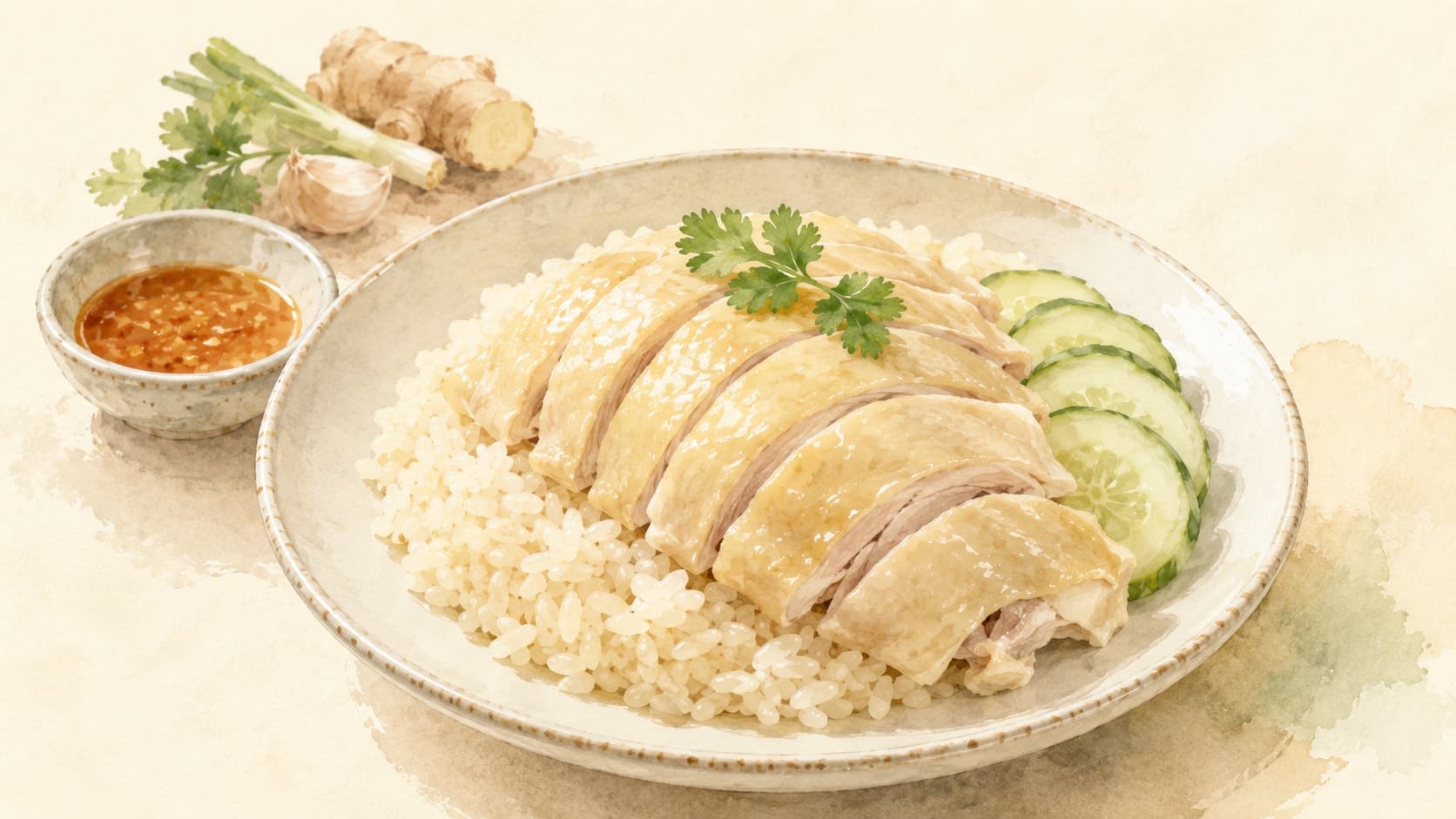
Experience the authentic taste of Hainanese Chicken Rice, a beloved Singaporean classic featuring succulent poached chicken and fragrant rice cooked in chicken fat.
Contents (5 sections)▾
Ingredients
- 1 whole chicken (about 1.5 kg)
- 2 liters water
- 3 cloves garlic, smashed
- 1 thumb-sized ginger, sliced
- 2 tbsp soy sauce
- 3 cups jasmine rice
- 1/4 cup chicken fat (schmaltz)
- 1/2 tsp salt
- 1/4 cup spring onions, chopped
- 1 cucumber, sliced
- 1 tbsp sesame oil
- to taste: chili sauce
Steps
In a large pot, bring 2 liters of water to a boil. Add the whole chicken, smashed garlic, and sliced ginger, then reduce the heat to low and poach for about 30 minutes — a larger bird will need longer.
Confirm the bird is fully cooked before removing it: the thickest part of the thigh (where it meets the body) must reach 74 °C / 165 °F on an instant-read thermometer, with clear, not pink, juices — for a whole bird, time alone is not proof. If it is not there yet, return it to the poach. Once confirmed, remove the chicken and let it cool. Reserve the poaching liquid, straining it if necessary.
In a separate saucepan, heat the chicken fat over medium heat. Add the rinsed jasmine rice and stir for a couple of minutes until lightly toasted.
Pour in 4 cups of the reserved poaching liquid and add 1/2 tsp salt. Bring to a boil, then reduce the heat to low, cover, and simmer for 15 minutes.
Once the rice is cooked, fluff it with a fork and let it sit covered for another 5 minutes. Meanwhile, rub the chicken with soy sauce and sesame oil.
Slice the poached chicken and serve it with the fragrant rice, garnished with chopped spring onions and cucumber slices. Accompany with chili sauce.
Why this works
Hainanese Chicken Rice showcases the technique of poaching, which is essential for achieving tender, juicy chicken. By poaching the chicken in a flavorful broth, the meat absorbs the aromas of garlic and ginger, enhancing its flavor. The rice is cooked in chicken fat, allowing it to take on a rich, savory taste, creating a perfect harmony of flavors. If the chicken seems too dry, ensure you poach it at a gentle simmer rather than a rapid boil, which can toughen the meat. Additionally, maintaining a balance in the poaching liquid is key; if it seems too salty, dilute it with a bit of water. This recipe highlights the importance of flavor infusion through cooking methods, ensuring a delightful dining experience.
Common mistakes
Hard-boiling the chicken. Target: Poach (cook gently in liquid kept just below a simmer — small bubbles trembling at the bottom of the pot, surface barely moving) at around 80–85°C. Why it matters: At a rolling boil (100°C) the muscle fibers contract violently and squeeze out their juices — you get dry, stringy chicken and a greasy broth. Gentle poaching keeps the protein structure intact and the meat tender. The chicken still cooks fully through; gentle heat does not mean undercooked. What to do: Bring the water to a boil, lower the chicken in, then immediately drop the heat so the surface is barely shimmering. Cover and hold there for the full poaching time. Confirm doneness before serving — see the safety check below.
Pulling the chicken before it's cooked through. Target: Juices at the thickest part of the thigh (where it meets the body) run clear, not pink. Internal temperature 74°C / 165°F at the bone. No translucent or raw-looking flesh anywhere. Why it matters: Poultry that hasn't reached a safe doneness risks salmonella and campylobacter — both can cause serious illness. The whole-chicken poach in this recipe must take the bird all the way through. "Just-set" or pink chicken is not the goal here, and not safe. What to do: After the recipe's poaching time, lift the chicken slightly out of the pot, tilt it, and watch the juices that pool at the thigh-body joint. They should run clear. If they're pink or red, return the chicken to the pot and continue poaching, checking every 5 minutes. A thermometer at the thigh bone confirms 74°C / 165°F.
Ice bath misunderstood. Target: Plunge the fully-cooked chicken into iced water immediately after poaching for 5–10 minutes. Why it matters: The ice bath is a texture step, not a doneness step. It stops the residual heat from continuing to cook the surface, contracts the skin against the meat for the signature silky-glossy bite, and makes the bird easier to carve. The chicken must already be cooked through when it goes into the ice — this is not a way to leave it pink. What to do: Confirm doneness first (clear juices / 74°C). Only then transfer to the ice bath. Rub the skin lightly with sesame oil after, before slicing.
Cooking the rice in plain water. Target: Toast the rinsed rice in rendered chicken fat with the aromatics, then cook it in the strained poaching broth — not in water. Why it matters: This is what separates Hainanese chicken rice from "chicken with rice." The fat-toasting coats each grain in a thin lipid layer (lipid: fat), which keeps grains separate and carries the chicken aroma deep into the rice during steam-cooking. Water-cooked rice tastes flat next to the chicken. What to do: After confirming the chicken is fully cooked, strain the broth through a fine sieve. Toast the rice 2 minutes in the chicken fat, add the broth (about 1.5 parts broth to 1 part rice by volume), then cook covered on low until done.
What to look for
- Poaching pot at temperature: tiny pearl-bubbles at the bottom, the surface trembling but not breaking. If the water rolls and breaks, lower the heat.
- Done chicken (lifted on a spider — a wide wire-mesh skimmer for lifting things out of broth or oil): juices at the thigh joint run clear yellow, no pink or red; flesh visible at the deepest point looks opaque white, not translucent. If pink, return to the pot.
- Rice toasting in fat: the grains turn slightly translucent at the edges and the fat smells faintly nutty. That's the moment to add the broth.
- Finished rice: each grain separate and glossy, faintly yellow from the fat, smelling distinctly of chicken — not just of rice. If gummy, the broth-to-rice ratio was too high.
A note on history
Hainanese chicken rice traces back to Wenchang chicken from Hainan Island in southern China — a dish built around small free-range birds famously fed banyan seeds, coconut pulp, and peanut bran. Hainanese immigrants brought the dish south during the great wave of migration from the 1860s through the 1930s (catalyzed by the 1858 Treaty of Tianjin opening Haikou to international trade). In Singapore, Hainanese cooks adapted the Wenchang preparation to local birds and palates, and by the 1930s–1940s shops like Yet Con, Chin Chin, and Swee Kee had made it a defining national dish (SCMP, Singapore Roots).
Get the essays in your inbox — free
Weekly notes on flavor, fermentation, and food history — the writing behind the Atlas of Flavor. No spam; unsubscribe anytime.