
Gumbo
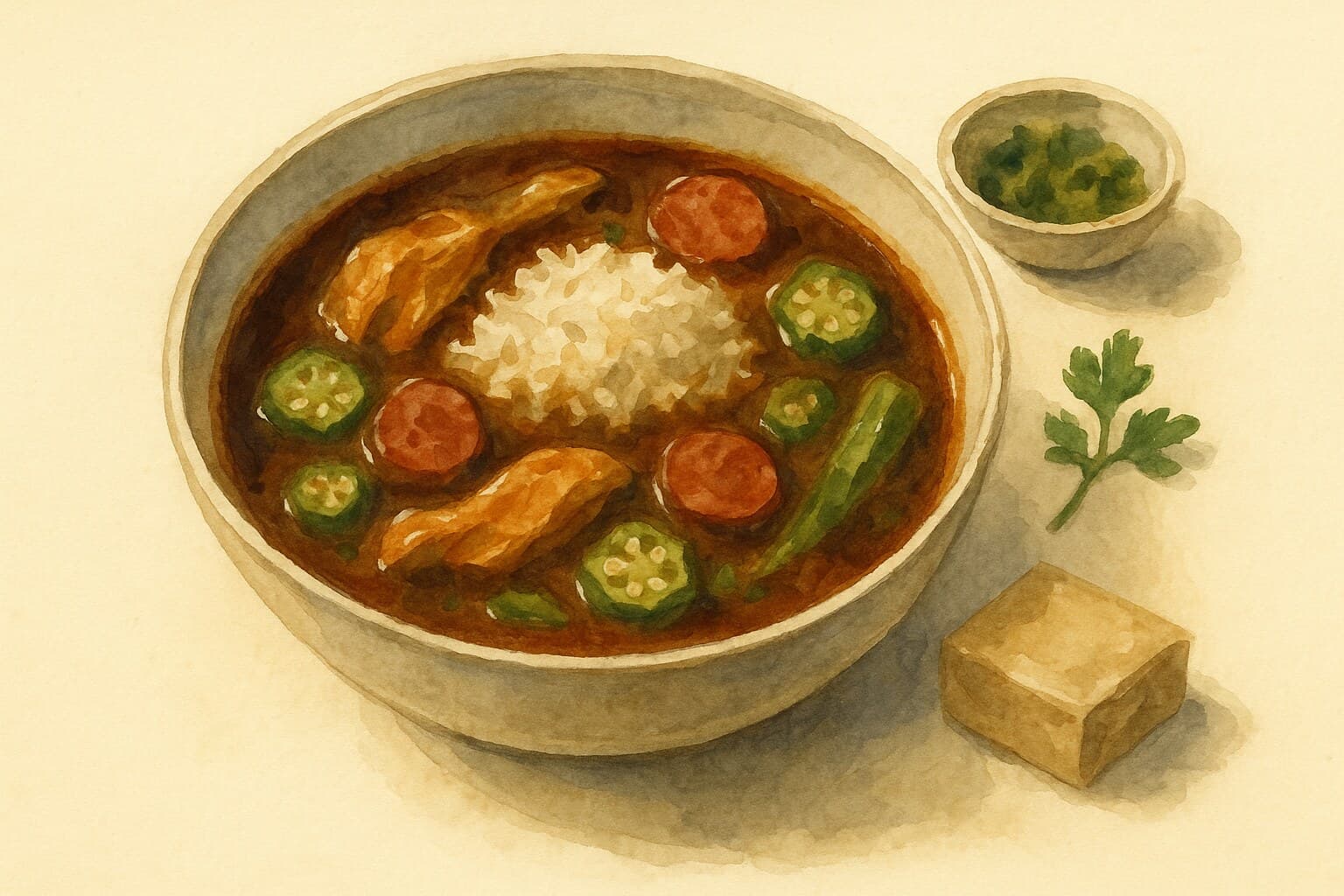
This gumbo features a richly flavored dark roux with chicken, sausage, and okra, creating a light yet satisfying stew.
Contents (5 sections)▾
Ingredients
- 1/2 cup all-purpose flour
- 1/2 cup vegetable oil
- 1 medium onion, diced
- 1 green bell pepper, diced
- 2 celery stalks, diced
- 2 cloves garlic, minced
- 1 pound chicken thighs, boneless and skinless, cut into bite-sized pieces
- 1 pound smoked sausage, sliced
- 6 cups chicken broth
- 1 tablespoon Cajun seasoning
- 1/2 teaspoon black pepper
- 1 cup okra, sliced
- 2 cups cooked white rice
- Salt to taste
- Chopped parsley for garnish
Steps
In a large heavy pot, heat the vegetable oil over medium-low heat. Gradually whisk in the flour to create a roux, stirring continuously for about 20-30 minutes until it reaches a deep brown color. This step is crucial as the roux forms the flavor foundation of your gumbo.
Once the roux is dark and fragrant, add the diced onion, bell pepper, and celery (the trinity) to the pot. Sauté for 5-7 minutes until softened, then stir in the minced garlic and cook for an additional minute.
Increase heat to medium and add the chicken and sausage, cooking until the chicken is browned, about 5-7 minutes.
Pour in the chicken broth, add the Cajun seasoning, and black pepper. Bring the mixture to a simmer, then reduce heat to low and let it simmer uncovered for 15-20 minutes, allowing the flavors to meld.
In the last 5 minutes of cooking, add the sliced okra. This helps maintain a lighter body in the gumbo, ensuring it does not become overly thick. Season with salt to taste.
Serve the gumbo over cooked white rice and garnish with chopped parsley.
Why this works
The key to a good gumbo lies in the roux, which provides the depth of flavor needed for this classic dish. Cooking the roux slowly allows it to develop complex flavors; a dark roux is particularly prized for its nutty notes and richness. If the roux seems too thick or starts to burn, you can add a little more oil to loosen it; this will also help in achieving that perfect color without compromising the flavor. The 'trinity' of onion, bell pepper, and celery creates a strong aromatic base that complements the proteins. Adding okra at the end preserves its texture and contributes to the gumbo's body without making it heavy. By managing the cooking times and temperatures carefully, you can control the thickness and flavor, ensuring a balanced and satisfying dish.
Common mistakes
Rushing the dark roux.
Target: A roux (flour cooked in fat until deep brown, for flavor and color) the color of milk chocolate to dark mahogany — 25–40 minutes of constant stirring over medium-low heat.
Why it matters: The dark roux is the soul of Cajun/Creole gumbo. It is not a thickener — at deep colors, the starch's thickening power is mostly destroyed. What you are building is flavor: a deep, toasted, nutty, almost coffee-like aroma from progressive Maillard browning (the chemistry of amino acids and starch meeting heat) and starch caramelization. Rushed on high heat, the roux scorches in patches — and a scorched roux is bitter beyond rescue. The whole pot must be discarded.
What to do: Keep heat moderate. Stir constantly with a flat-edged wooden spoon or whisk, scraping the bottom and corners. If you see black flecks appear, stop immediately — you have burnt it. Start over. There is no fixing a burnt roux.
Adding hot liquid to a screaming-hot roux — or hot trinity to a roux dropped to room temperature.
Target: Pour in the trinity (onion, bell pepper, celery — the Cajun aromatic base) when the roux is at temperature; the cold vegetables will lower the heat and stop the browning at the color you have chosen. Then deglaze (pour liquid in to loosen and lift the browned bits stuck to the pan) with warm, not boiling, broth.
Why it matters: Cold liquid hitting a hot roux can seize the starch into lumps; near-boiling liquid hitting a too-cool roux can splash. Either way, the smooth, uniform sauce you want becomes a lumpy or broken mess.
What to do: Have the chopped trinity ready before you start the roux. When the color is right, dump it in — the sizzle and immediate cooling is the goal. Then add warm broth one ladle at a time, stirring smooth between additions, until the gumbo is fully fluid.
Undercooked chicken or sausage — and seafood that turns rubbery.
Target: Chicken thighs simmered to 74°C / 165°F internal; smoked sausage simmered through; any seafood (shrimp, oysters, crab) added in the last 3–5 minutes only and cooked just until opaque/firm.
Why it matters: Gumbo is a long-simmer dish but proteins have different windows. Chicken thigh needs time at temperature to be safe and tender. Smoked andouille (a coarse-grain Cajun smoked pork sausage) is pre-cooked but needs simmering to release flavor into the broth. Seafood, by contrast, turns tough and chalky within minutes of overcooking — shrimp curl tight and squeak under the tooth.
What to do: Build chicken-and-sausage gumbo first, simmering 30–45 minutes for flavor to meld. Add seafood at the very end. Use a thermometer for chicken.
Treating okra and filé as interchangeable — or using both together.
Target: Pick one thickener: okra simmered in for the last 10–15 minutes, OR filé powder (ground sassafras leaves) stirred in off the heat just before serving.
Why it matters: Both thicken gumbo, but through different mechanisms — okra releases mucilage (a viscous plant gum) during cooking; filé thickens via the leaves' natural starches. Adding filé to a still-simmering pot turns it stringy; using both at once over-thickens the gumbo into something ropy.
What to do: Choose your style. If using okra, add sliced rounds 10–15 minutes before serving so they release body without breaking down to slime. If using filé, take the pot off the heat, sprinkle 1 tsp per serving, and stir.
What to look for
- Roux at 5 minutes: pale beige, smells like raw flour fading to mild toast. Keep going.
- Roux at 15–20 minutes: peanut-butter color, smells nutty and toasted. This is the Cajun "blonde" — fine for étouffée, too pale for traditional gumbo.
- Roux at 25–35 minutes: milk-chocolate to dark mahogany, smells deeply toasted, almost coffee-like. This is the gumbo color. Stop here. Black flecks = burnt = start over.
- Trinity hitting the roux: loud, immediate sizzle, instant aromatic cloud of onion-pepper-celery, no further deepening of the roux color. This locks in the color.
- Finished gumbo: body the consistency of light gravy, not pudding-thick. A spoon drawn across leaves a brief trail before refilling. Color is deep brown, almost umbral, with the trinity visible. Surface should glisten from the rendered sausage fat, not look greasy.
- Seafood done: shrimp curled into a C-shape (not a tight O), oysters with ruffled edges, crab claws warmed through. Tight O = overcooked.
A note on history
Gumbo is a dish of Louisiana that braids together at least four cultural lineages. The name itself comes from the West African word gombo — from a Bambara-language dialect — meaning okra, and enslaved West Africans brought both the vegetable and the stewing tradition that became gumbo's earliest backbone (Wikipedia, Southern Foodways Alliance). The Choctaw contributed filé — ground sassafras leaves — as a thickener and seasoning (Southern Foodways Alliance). The French contributed the roux technique (Southern Foodways Alliance). The Germans of Louisiana contributed smoked sausage and andouille; Spanish Caribbean influence brought peppers and spices (Southern Foodways Alliance). The first printed mention of gumbo, in fact, was in reference to food eaten not by French immigrants but by African maroons who had escaped slavery in Louisiana, and gumbo appeared at a 1803 New Orleans gubernatorial reception and at a 1804 Cajun gathering on the Acadian Coast (64 Parishes, Southern Foodways Alliance). The Creole–Cajun distinction came later, mapped roughly onto geography: New Orleans and southeastern Louisiana developed "Creole" combinations from the area's French, Spanish, and African descendants, while southwestern Louisiana developed "Cajun" combinations among the French-speaking settlers expelled from Acadia in the mid-1700s (Wikipedia).
Get the essays in your inbox — free
Weekly notes on flavor, fermentation, and food history — the writing behind the Atlas of Flavor. No spam; unsubscribe anytime.