
Gulab Jamun
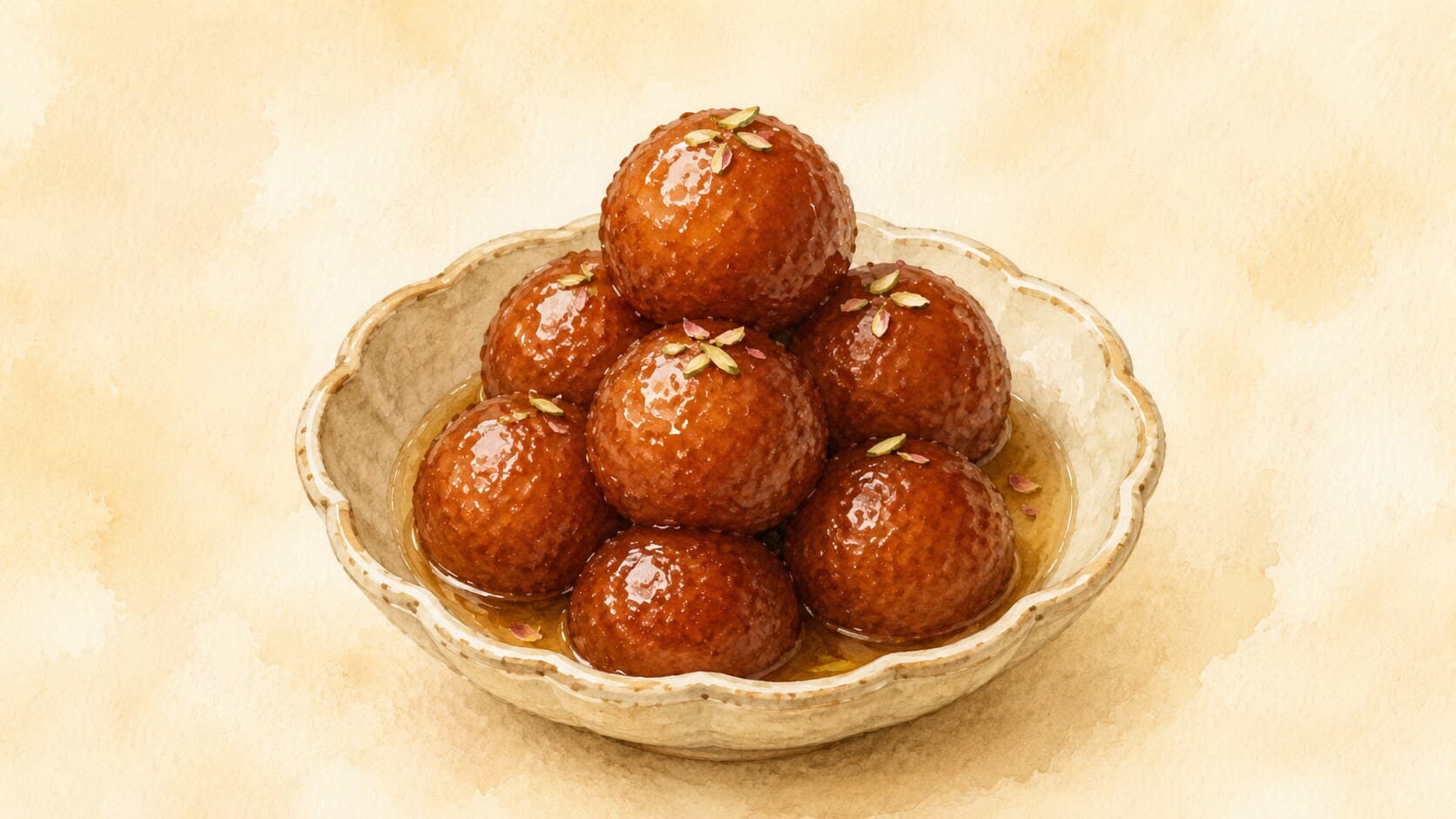
Gulab Jamun are soft dumplings made from milk solids, deep-fried, and soaked in sugar syrup flavored with cardamom and rose water.
Contents (5 sections)▾
Ingredients
- 200 g khoya (milk solids)
- 50 g all-purpose flour
- 1/4 tsp baking powder
- 1/4 tsp cardamom powder
- 1/4 cup milk
- Oil for deep frying
- 1 cup sugar
- 1 cup water
- 1 tsp rose water
- Chopped pistachios for garnish
Steps
Add milk gradually to form a soft dough. Let it rest for 10 minutes.
While the dough rests, prepare the sugar syrup by boiling sugar and water in a pan for 5 minutes until slightly thickened. Stir in rose water and remove from heat.
Heat oil in a deep frying pan over medium heat (around 180°C/350°F).
Divide the rested dough into small balls, about the size of a marble. Ensure they are smooth to prevent breaking in oil.
Carefully drop the balls into the hot oil, frying in batches to avoid overcrowding. Fry until golden brown (approximately 5-7 minutes), turning occasionally for even cooking.
Once fried, remove the dumplings and drain on paper towels briefly, then immerse them in the warm sugar syrup. Allow them to soak for at least 30 minutes before serving.
Tools you'll want
Why this works
The key to perfect Gulab Jamun lies in the balance of ingredients and the frying technique. Khoya, or milk solids, is the main ingredient and provides the rich flavor and dense texture. Mixing it with a small amount of all-purpose flour and baking powder helps bind the dough while allowing it to rise slightly during frying, resulting in a soft, airy interior. If the balls break while frying, ensure the oil is sufficiently hot (around 180°C/350°F) and the dough is well-formed without cracks. If the dough seems too sticky, add a little more flour or chill it briefly to make it easier to shape. Soaking the fried dumplings in the sugar syrup allows them to absorb sweetness, enhancing their flavor and texture.
Common mistakes
Oil too hot — dark crust, raw interior.
Target: 150–160°C (300–325°F) for frying — well below standard deep-frying temperature.
Why it matters: Gulab jamun is built from khoya (the reduced milk solid made by simmering milk down to a fudge-like paste). Khoya is dense and high in milk sugars, so it browns and burns quickly. At standard 180°C, the surface darkens fast while the center stays raw — and a raw khoya core is dense, gummy, and unpleasant. Lower oil temperature gives the heat time to reach the center before the outside turns mahogany.
What to do: Use a thermometer. Drop one test ball first — it should sink, then slowly rise over 30–45 seconds, browning gently to deep golden over 5–7 minutes. If it browns in under 2 minutes, the oil is too hot.
Cracks on the dough surface.
Target: Smooth, crack-free balls — palm-roll with a lightly greased hand until the surface is uniform.
Why it matters: Cracks open during frying and let hot oil rush into the center, exploding the ball or causing it to disintegrate in the syrup. Smooth surfaces also brown more evenly.
What to do: If you see any cracks while rolling, the dough is too dry — wet your palm with a few drops of milk and re-roll. The dough should feel like soft modeling clay, not crumbly cookie dough.
Syrup too hot or too cold when soaking.
Target: Warm syrup, about 50–60°C — hot to the touch but not boiling.
Why it matters: Boiling syrup shocks the freshly-fried balls and makes them shrink or split. Cold syrup will not penetrate — the balls stay dry inside and the syrup beads off the surface. Warm syrup creates a gentle osmotic pull (water moves from high concentration to low to balance sugar levels), drawing sweetness into the porous center over 30 minutes to several hours.
What to do: Make the syrup before frying, then keep it warm in a wide, shallow pan off the heat. Drop fried balls in directly from the oil after a brief drain on paper towels.
Hot oil and the cook's distance.
Target: Long-handled spider (a wide wire-mesh skimmer used for lifting things out of hot oil) or slotted spoon; keep your face well above the pan; lower balls in gently, never drop from height.
Why it matters: Hot oil at 150°C+ causes severe burns on contact, and any moisture on the dough surface flashes to steam and spatters. Khoya is a high-fat ingredient and the balls themselves can spit during frying.
What to do: Slide each ball in along the edge of a spoon, not from above. Keep a lid nearby for an oil fire — if oil ever ignites, smother with the lid, never water. Children and crowded counters are not compatible with this recipe.
What to look for
- Dough at rest: soft and pliable, holds a rolled ball without cracking, fingerprint impression slowly relaxes. If it cracks, it is too dry; if it sticks to your palm, it is too wet.
- First ball in oil: sinks to the bottom for 15–20 seconds, then rises slowly, pale at first, deepening to chestnut over 5–7 minutes. A ball that floats immediately suggests oil too hot; one that never rises suggests oil too cool.
- Color of finished balls: uniform deep mahogany brown across the whole surface, not blotchy, not black. The color comes from Maillard browning (the chemistry of amino acids and sugars meeting heat) plus the natural caramelization of khoya's milk sugars.
- In syrup, after 30 minutes: balls have swollen noticeably, gone from firm to softly yielding, and sit submerged with syrup beaded around them. Cutting one in half should reveal a moist, evenly soaked, dark-brown center — no dry pale core.
A note on history
Gulab jamun's lineage runs through Persia. The dish descends from luqmat al-qadi — Persian fried-dough balls soaked in syrup — and according to food anthropologist Kurush F. Dalal, it came to India via the Mughal court, specifically with the second Mughal emperor Humayun, who fled to Persia after being defeated in 1540 and is said to have brought the treat back when he returned to India in 1555 (The Better India, Swiggy). The Mughal kitchens then transformed it with khoya — reduced milk solids — adding the dense, dairy-rich character that distinguishes Indian gulab jamun from its Persian ancestor (Swiggy). The name itself records both lineages: gulab from Persian gol-ab (rose + water, for the rosewater-scented syrup), and jamun from the Hindi-Urdu name for a dark purple plum whose color and shape the fried balls resemble (Swiggy, The Better India).
Get the essays in your inbox — free
Weekly notes on flavor, fermentation, and food history — the writing behind the Atlas of Flavor. No spam; unsubscribe anytime.