
Gigantes Plaki
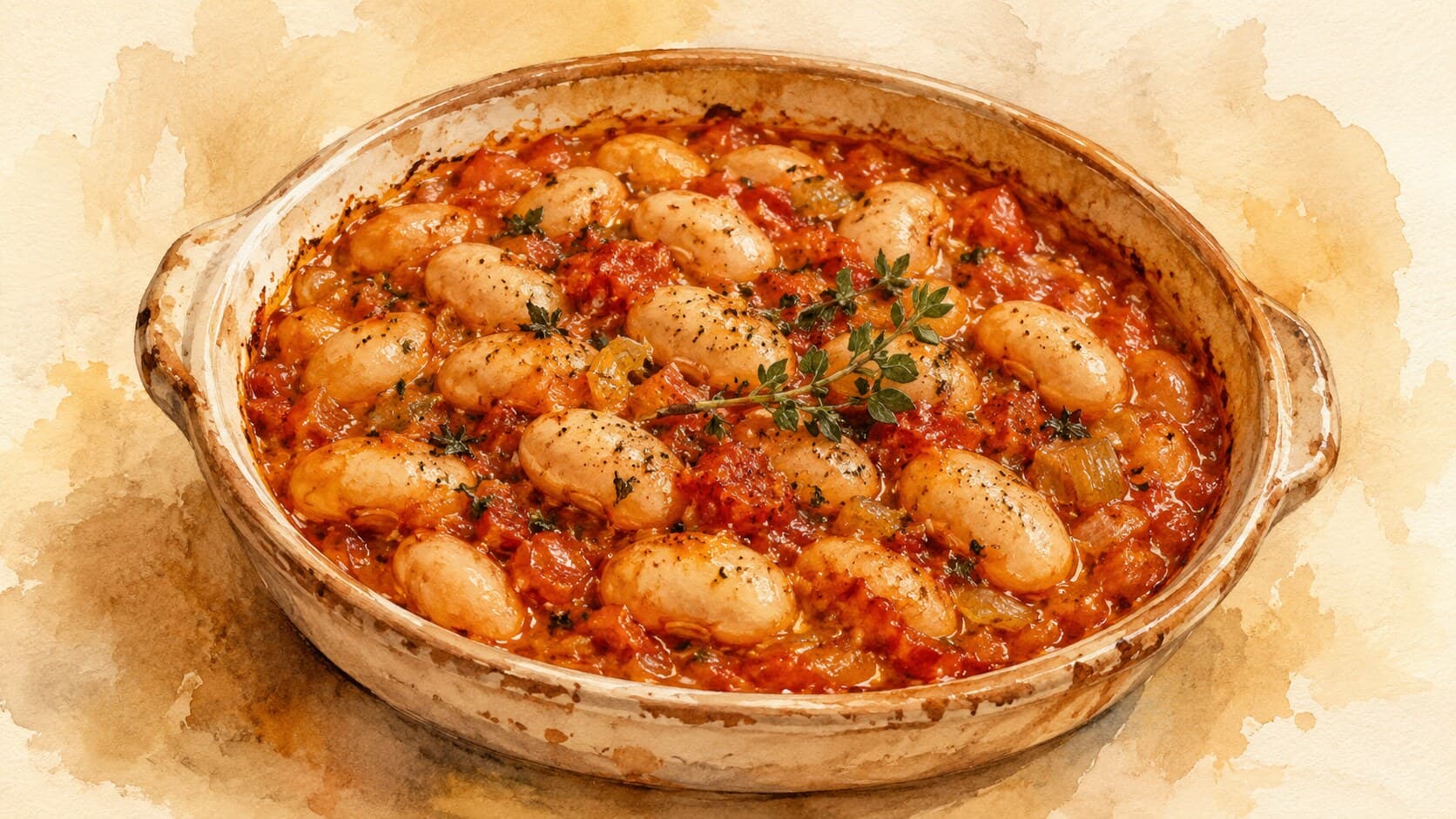
Gigantes Plaki features creamy baked giant white beans in a rich tomato-herb sauce, perfect as a mezze or a hearty vegan main dish.
Contents (5 sections)▾
Ingredients
- 500 g large white beans, soaked overnight
- 400 g canned diced tomatoes
- 1 medium onion, finely chopped
- 4 cloves garlic, minced
- 1/4 cup olive oil
- 1 tsp dried oregano
- 1 tsp smoked paprika
- Salt to taste
- Pepper to taste
- Fresh parsley, for garnish
- 1 lemon, cut into wedges
Steps
Preheat your oven to 180°C (350°F). This temperature ensures the beans will cook through while allowing the sauce to thicken and develop flavor.
In a large pot, heat olive oil over medium heat and sauté the onion until translucent, about 5 minutes. This builds a flavor base for the dish.
Add garlic, oregano, smoked paprika, salt, and pepper, and cook for another minute until fragrant.
Stir in the diced tomatoes and the soaked beans, and bring to a simmer. Allow to simmer for 10 minutes to meld the flavors.
Transfer the mixture to a baking dish and cover it with foil. Bake for 15 minutes to allow the beans to soften and absorb the sauce.
Remove the foil and bake for an additional 10-15 minutes until the top is golden brown and slightly crusty. This step enhances the flavor and texture.
Garnish with fresh parsley and serve with lemon wedges for an added zing.
Why this works
Gigantes Plaki (a Greek dish of giant white beans baked in tomato and olive oil) achieves its creamy texture and rich flavor through the combination of slow-cooked white beans and a savory tomato-herb sauce. The soaking of the beans overnight softens them and reduces cooking time, ensuring they absorb the sauce flavors effectively. The technique of baking the dish allows the beans to meld with the sauce, creating a deliciously creamy consistency. If the beans seem too hard after the initial bake, you can add a splash of vegetable broth or water to the dish and return it to the oven, covered, for a further 10-15 minutes. This will help soften them and prevent drying out. The use of smoked paprika adds depth, while the lemon at serving brightens the overall dish, balancing the richness with acidity.
Common mistakes
Stopping the bake while the beans are still firm.
Target: A bean crushed against the side of the dish with a spoon should give way completely — no chalky white core, no resistant skin. With dried gigantes, plan on at least 60–90 minutes of total cook time (boil + bake), not the 15-minute oven window alone.
Why it matters: Beans baked while still firm never soften in the sauce — the acid in the tomato (pH around 4) actually slows down bean softening because it stabilizes the pectin (the natural glue between bean cells). A bean that is firm at the start of baking will still be firm at the end.
What to do: Pre-boil the soaked beans in plain water until they are almost tender (about 50–70 minutes depending on age) before they ever meet the tomato. Only then transfer to the baking dish with the sauce. The oven step is for finishing and flavor, not for cooking the beans through.
Adding salt and tomato to the soaking or boiling water.
Target: Soak in plain cold water. Boil in plain water (or water with a small piece of onion and a bay leaf) until almost tender. Add salt and tomato only after the beans are nearly soft.
Why it matters: Calcium in hard water, acid from tomato, and a heavy dose of salt all tighten bean skins and lengthen cooking time, sometimes dramatically. Old beans can refuse to soften at all if cooked acidic from the start.
What to do: Soak and boil clean. Reserve seasoning for the braise.
Skinny, watery sauce.
Target: A sauce that coats the back of a spoon and shows a glossy film of olive oil on top.
Why it matters: Plaki (the Greek baked-vegetable method) relies on a generous slick of olive oil as both flavor carrier and texture binder. A thin tomato-water sauce evaporates in the oven and leaves the beans dry; a properly oiled sauce concentrates into a velvety glaze.
What to do: Don't skimp on the olive oil — 1/4 cup is a minimum, not a maximum, for this volume. Simmer the sauce on the stovetop before baking until it has reduced (cooked down to a thicker, more concentrated state) noticeably.
Skipping the uncovered second bake.
Target: The last 10–15 minutes in the oven with the foil off, so the top develops light golden patches and a slightly chewy edge.
Why it matters: The contrast between creamy beans below and a lightly caramelized (gently browned by sugar heat) surface is the textural signature of plaki. A wholly covered bake gives a soupy, one-note result.
What to do: Remove the foil, raise the oven if needed, and watch — you want color, not char.
What to look for
- Soaked beans, ready to boil: plump, smooth-skinned, about twice their dry size. Any beans that stay shriveled after a full overnight soak are old — discard the worst offenders.
- Beans ready for the oven: a single bean crushes to a creamy paste between thumb and finger with very light pressure. If it crumbles into chalk, keep boiling.
- Sauce before baking: thick enough that a spoon leaves a brief trail across the bottom of the pan, with droplets of orange-red oil visible on the surface.
- Finished dish: the surface has uneven golden patches, the sauce is glossy not watery, and a tilted spoon shows beans coated rather than swimming.
A note on history
Gigantes plaki is the Greek baked-bean dish in which the large white beans known as gigantes (Greek for "giants," a variety of Phaseolus coccineus, the scarlet runner bean) are cooked in tomato, olive oil, and herbs (Wikipedia). The beans most associated with the dish come from the wetlands of Prespes in northern Greece, where they hold a Protected Geographical Indication (PGI) (The Mediterranean Dish). The word plaki refers to the cooking method itself — baking or roasting vegetables and pulses with plenty of tomato and olive oil — and the dish belongs to the older Greek tradition of ladera, "olive-oil cooking," in which pulses and vegetables are slow-cooked in olive oil as a meatless main (The Mediterranean Dish).
Get the essays in your inbox — free
Weekly notes on flavor, fermentation, and food history — the writing behind the Atlas of Flavor. No spam; unsubscribe anytime.