
Ghee
Ghee, a clarified butter, enhances flavors in Asian cuisine with its rich aroma and high smoke point.
Contents (5 sections)▾
Ingredients
- 500 g unsalted butter
Steps
In a medium saucepan, melt 500 g of unsalted butter over low heat (approximately 60°C), allowing it to fully liquefy without browning.
Once melted, increase the heat to medium-low (around 80°C) and let it simmer gently for about 10-15 minutes. You will see foam forming on top.
After the simmering time, watch closely as the milk solids begin to separate and sink to the bottom, and the liquid turns a clear golden color.
Remove from heat and let it cool slightly (about 5 minutes) before carefully pouring the ghee through a fine mesh strainer or cheesecloth into a clean jar, leaving the milk solids behind.
Allow the ghee to cool to room temperature (approximately 20-25°C) before sealing the jar. Store it in a cool, dark place.
Why this works
Ghee (clarified butter with the milk solids removed, common in Indian and Middle Eastern cooking) is a staple in many Asian cuisines, valued for its rich flavor and high smoke point (the temperature at which a fat begins to smoke and break down), making it ideal for frying and sautéing. The process of clarifying butter involves slowly melting it, which separates the milk solids from the fat. This technique intensifies the buttery flavor and ensures that it can be heated to higher temperatures without burning. If the ghee begins to brown, reduce the heat immediately to avoid a bitter taste. If the consistency seems too thick due to overcooking, it may have been cooked too long; simply add a teaspoon of water and gently reheat to achieve a smoother texture. This method preserves the aromatic profile of ghee, adding its unique umami richness to dishes. By maintaining precise temperatures and times, one can ensure the perfect texture and flavor, making ghee a versatile ingredient in your culinary repertoire.
Common mistakes
Walking away from the pan during the final clarification stage.
Target: Stay at the stove from the first foam through the colour shift. The window from "ready" to "scorched" is only about 60–90 seconds.
Why it matters: Once the water has cooked out, the milk solids (proteins and lactose) drop to the bottom and start to brown via the Maillard reaction (the same browning chemistry as crusts on bread or seared meat). A few seconds of inattention takes them from golden and nutty — true ghee — to bitter, acrid, burnt. Burnt solids release sharp-tasting compounds into the fat that no straining can remove.
What to do: Treat the final 5 minutes like watching milk for steaming — eyes and nose on the pan. The smell changes first: from buttery, to nutty-popcorn, to burnt-toast. Pull from heat the instant you reach nutty-popcorn, not after.
Using high heat to speed up the process.
Target: Low to medium-low heat throughout. The whole job takes about 15–20 minutes, not 5.
Why it matters: High heat boils off the water violently and burns the milk solids before the protein has had time to coagulate and settle — you end up with a fat that is dark, harsh, and still contains scattered burnt protein bits. Slow heat lets the water evaporate cleanly, the solids gather at the bottom, and the fat clarify to a transparent golden colour.
What to do: Start on low to melt, then nudge to a gentle medium-low simmer once the butter is liquid. You want lazy bubbles, not a roaring boil. If the bubbles become aggressive, drop the heat.
Straining while the fat is still very hot, or storing into a damp jar.
Target: Cool to warm-touchable (about 60°C/140°F) before straining; strain into a clean, fully dry glass jar.
Why it matters: Pouring near-boiling fat through cheesecloth into a jar can crack the glass and risks splashing the cook. A single drop of water in the storage jar reintroduces moisture to a fat whose preservation logic depends on being water-free — moisture is what lets bacteria and rancidity take hold. Properly dry-stored ghee keeps for months at room temperature; water-contaminated ghee spoils in days.
What to do: Let the pan rest off the heat for several minutes. Use a jar that you have washed and then dried completely (a low oven for 5 minutes is the safest finish). Strain through a fine-mesh sieve lined with cheesecloth or a clean coffee filter to catch every flake of solid.
Skimming the foam off and discarding it before the solids settle.
Target: Leave the foam on top while the butter simmers — it is part of the process, not a defect.
Why it matters: The foam is water vapour pushing through whey proteins; it does work for you by sitting on the surface and protecting the fat below from over-heating. If you scoop it off too early, you remove that buffer and expose the fat directly to the hottest layer of the pan. The foam will subside on its own as the water finishes evaporating.
What to do: Resist the urge to skim until the foam has thinned to a lacy film of its own accord. At that point you can lift off any persistent film if you wish, but the milk solids you actually need to remove are the ones at the bottom of the pan — strain them out.
What to look for
- Just after melting: clear yellow fat with a thick white foam on top. No bubbling action yet — just liquid butter.
- During the slow simmer: steady stream of small bubbles through a frothy white layer, faint sweet butter smell. This is water evaporating; expect 8–12 minutes of this.
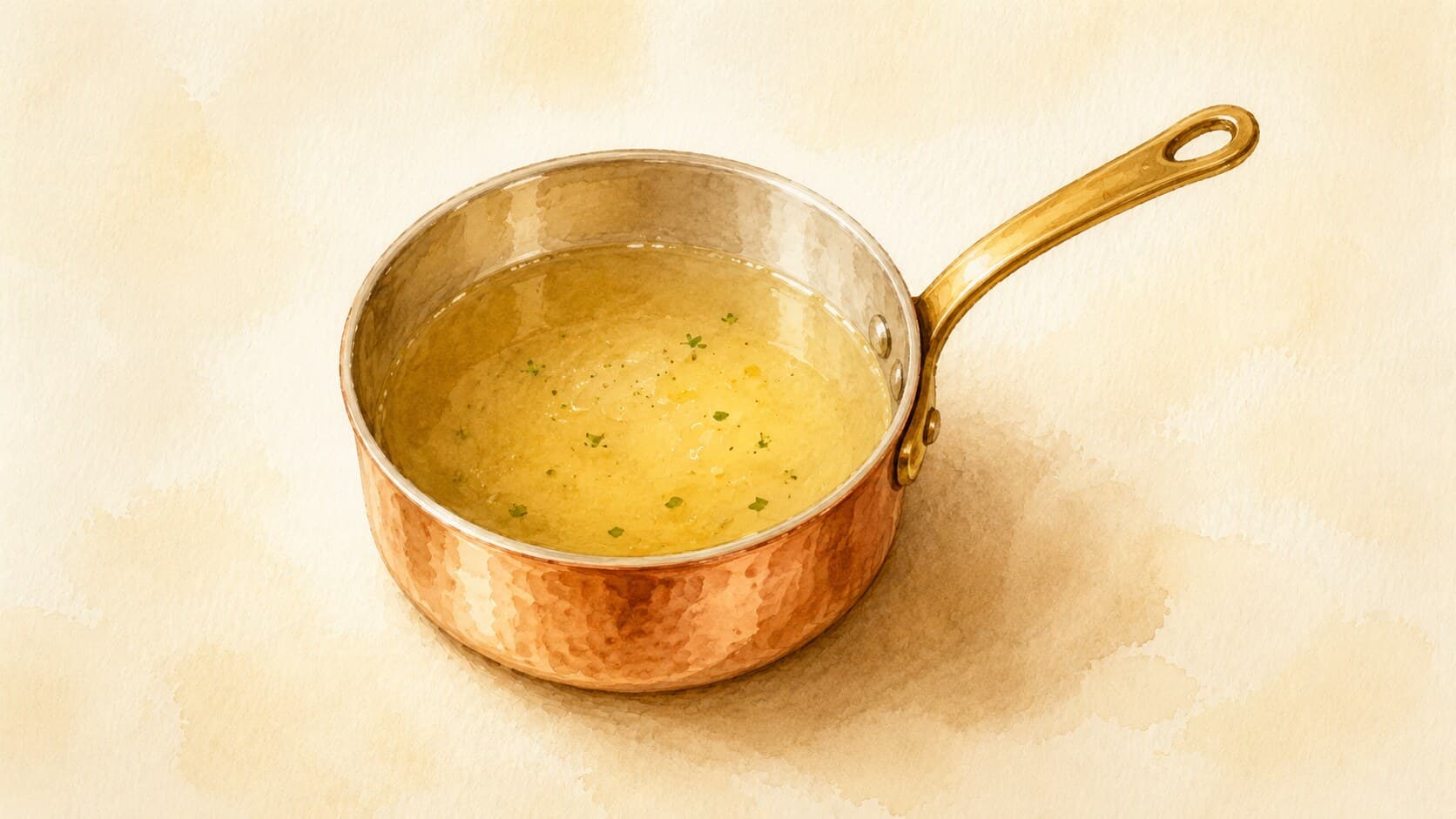
- The signal moment: the bubbling visibly slows, the foam thins to lacy patches, and the smell shifts to toasted nuts or popcorn. Through the foam you can now see a clear, transparent golden liquid; the solids at the bottom look light tan, not brown.
- In the jar, cooled: fully transparent golden liquid above (just-cooled) or pale-yellow soft solid (fully cooled), with a clean nutty aroma. Any cloudiness, any harsh burnt note, or any visible water droplets mean the batch is compromised.
A note on history
Ghee has one of the deepest documented histories of any cooking fat: clarified butter is described in the Vedic texts of ancient India, dated roughly to the 1500–500 BCE period, where ghṛta is treated as both a food and a sacred substance used in Hindu ritual (Wikipedia — Ghee, Banyan Botanicals). The practical driver was climate — fresh butter spoils quickly in Indian heat, while butter cooked down until the water and milk solids are removed keeps for months without refrigeration (Lee's Provisions). In Ayurvedic practice ghee is classed as a rasayana, a substance held to support longevity and digestion; in the modern kitchen its high smoke point and nutty aroma have made it a standard fat in South Asian and increasingly in Western cooking.
Get the essays in your inbox — free
Weekly notes on flavor, fermentation, and food history — the writing behind the Atlas of Flavor. No spam; unsubscribe anytime.