
Filet Bordelaise
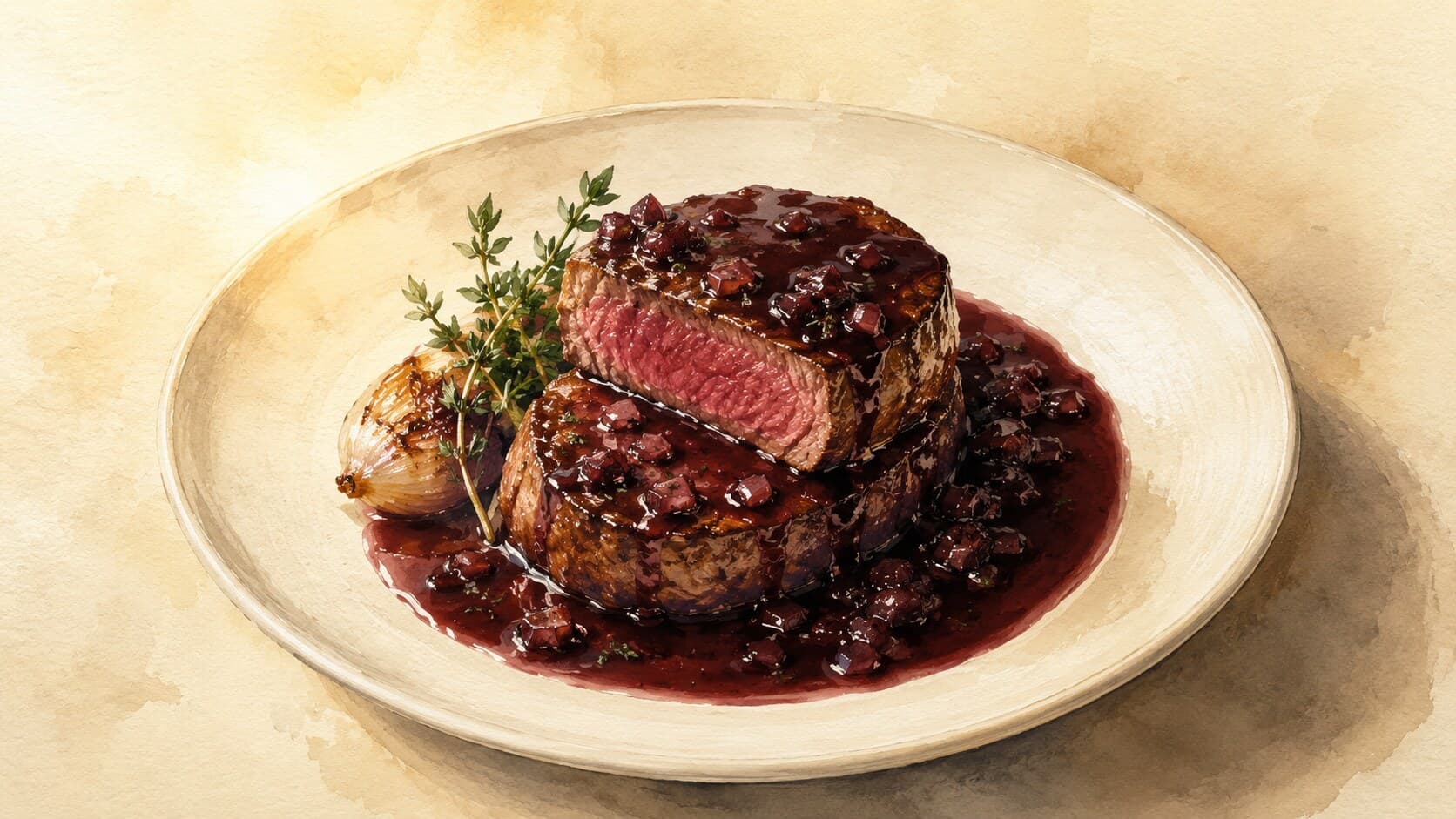
Savor the rich flavors of Filet Bordelaise, a classic French dish featuring pan-seared beef filet with a luscious red wine reduction.
Contents (5 sections)▾
Ingredients
- 2 beef filets (200g each)
- 1 tbsp vegetable oil
- 1 shallot, finely chopped
- 250ml red wine
- 100ml demi-glace
- 50g bone marrow, cut into disks
- Salt, to taste
- Black pepper, to taste
- Fresh parsley, for garnish
Steps
Heat a skillet over medium-high heat and add vegetable oil. Season the beef filets with salt and black pepper, then sear them for 4-5 minutes on each side until a deep brown crust forms.
Remove the beef filets from the skillet and let them rest. In the same skillet, add the chopped shallot and sauté for 2-3 minutes until softened.
Pour in the red wine, scraping the skillet to deglaze, and reduce by half over medium heat, about 8-10 minutes.
Add the demi-glace to the red wine reduction, stirring to combine. Continue to simmer for another 5 minutes until the sauce thickens slightly.
Stir in the bone marrow and let it melt into the sauce, stirring gently to incorporate. Adjust seasoning with salt and pepper.
Plate the rested beef filets and generously spoon the bordelaise sauce over them. Garnish with fresh parsley.
Why this works
The technique of pan-searing creates a Maillard reaction (the chemistry where heat reshapes proteins and sugars into deep, savory roasted-flavor compounds), which develops a complex flavor and appealing crust on the beef filet. The reduction of red wine with shallots intensifies the flavors and adds a touch of acidity that balances the richness of the demi-glace and marrow. This sauce is a quintessential bordelaise, with its glossy finish and depth of flavor. If the sauce seems too thin, continue to simmer it until it reaches the desired consistency; conversely, if it becomes too thick, add a splash of stock or water to adjust. Properly handling the bone marrow is crucial; ensure it is at room temperature before adding it to the sauce to allow for even melting and incorporation, enhancing the sauce's richness.
Doneness + alcohol note. The USDA consumer-safe endpoint for beef steak is 63°C / 145°F measured before removing, then a 3-minute rest. Canonical medium-rare for this dish is cooked lower — 54-57°C, as restaurant service does — which is a culinary preference below that safety endpoint, not the same thing; cook to whichever you choose knowing the difference, and rest 5 minutes. High-risk diners (pregnancy, immunocompromised, very young or old) should cook to 71°C+ — the texture will be firmer but the dish still works. Bone marrow comes from beef femur or shin bones — ask your butcher for marrow bones cut into 4-5 cm rounds, and soak overnight in cold salted water for a clean white finish. For alcohol-avoidant cooks, substitute the red wine in the reduction with equal-volume beef stock + 1 tbsp balsamic vinegar.
Common mistakes
Searing in a cool pan or on wet meat, so no crust forms.
Target: A pan hot enough that the oil shimmers and the filet hisses sharply on contact; the surface of the meat patted bone-dry first.
Why it matters: The browned crust comes from the Maillard reaction (the chemistry where heat reshapes proteins and sugars into hundreds of savory, roasted-flavor compounds). It only fires above roughly 140°C / 285°F, and surface water stalls the pan there by boiling off as steam. A wet filet in a lukewarm pan greys and steams instead of browning.
What to do: Pat the filets dry, salt them, and wait for real heat before they go in. Don't move them for the first few minutes — let the crust set.
Crowding the pan or flipping too soon.
Target: Space between the filets; a single confident flip once a deep brown crust has formed (about 4–5 minutes).
Why it matters: Cold meat dumped together drops the pan temperature, and the released moisture pools and steams rather than evaporating. Flipping before the crust sets tears it and stalls browning.
What to do: Sear in batches if your pan is small. Lift a corner to check color before turning; if it resists the spatula, it isn't ready yet.
Boiling the wine reduction hard or not reducing it enough.
Target: A steady simmer that cooks the wine down by about half, until it's syrupy and no longer smells of raw alcohol.
Why it matters: Reduction (simmering a liquid to evaporate water and concentrate its flavor) is what turns thin, sharp wine into a glossy, deep sauce — and it's also what drives off the harsh alcohol edge. Rush it on high heat and you scorch the shallots and get bitterness; stop too early and the sauce is watery and boozy.
What to do: Keep it at a lively but controlled simmer, scraping up the browned bits (fond) from the sear. Judge by texture and smell, not the clock — it should coat the back of a spoon.
Adding the bone marrow to a screaming-hot or too-cool sauce.
Target: Stir room-temperature marrow into a sauce that's hot but only gently simmering, just until it melts in.
Why it matters: Marrow is almost pure fat; folded into a warm sauce off a hard boil, it melts smoothly and enriches the body. Boiled violently it can split out as grease; added straight from the fridge it sits in cold lumps.
What to do: Soak and bring the marrow to room temperature first, lower the heat, then stir it in at the very end and serve promptly.
What to look for
- The crust before flipping: a deep, even brown that releases cleanly from the pan — this is the Maillard crust fully formed; if it sticks and tears, give it another minute.
- The reduction: glossy and syrupy, coating the back of a spoon, with no sharp alcohol smell — the wine has concentrated and the harsh edge has cooked off.
- The finished sauce: deep mahogany-red and lustrous, thick enough to nap the meat but still pourable — the demi-glace and marrow have enriched it without breaking.
- Doneness by feel: the filet springs back softly to a fingertip and the juices run clear once cut — pair this with a thermometer at your chosen target rather than guessing.
A note on history
Bordelaise sauce is named for the Bordeaux region of France, renowned for its wine, and traces back to mentions in French cookbooks of the 18th century — refined in the prosperous bourgeois and aristocratic kitchens enriched by Bordeaux's wine trade (Wikipedia). Interestingly, Escoffier's Ma Cuisine describes a bordelaise made with white wine, and early versions did use white; over time red wine became the standard choice (The Sauce Geek). The classic modern sauce is built on red wine, shallots, demi-glace, butter, and bone marrow, and is traditionally served with grilled beef or steak (Chef Billy Parisi).
Get the essays in your inbox — free
Weekly notes on flavor, fermentation, and food history — the writing behind the Atlas of Flavor. No spam; unsubscribe anytime.