
Croquetas de Jamón
Croquetas de Jamón are Spanish ham croquettes made by emulsifying a béchamel with rendered fat, then breading and frying for a crispy exterior.
Contents (5 sections)▾
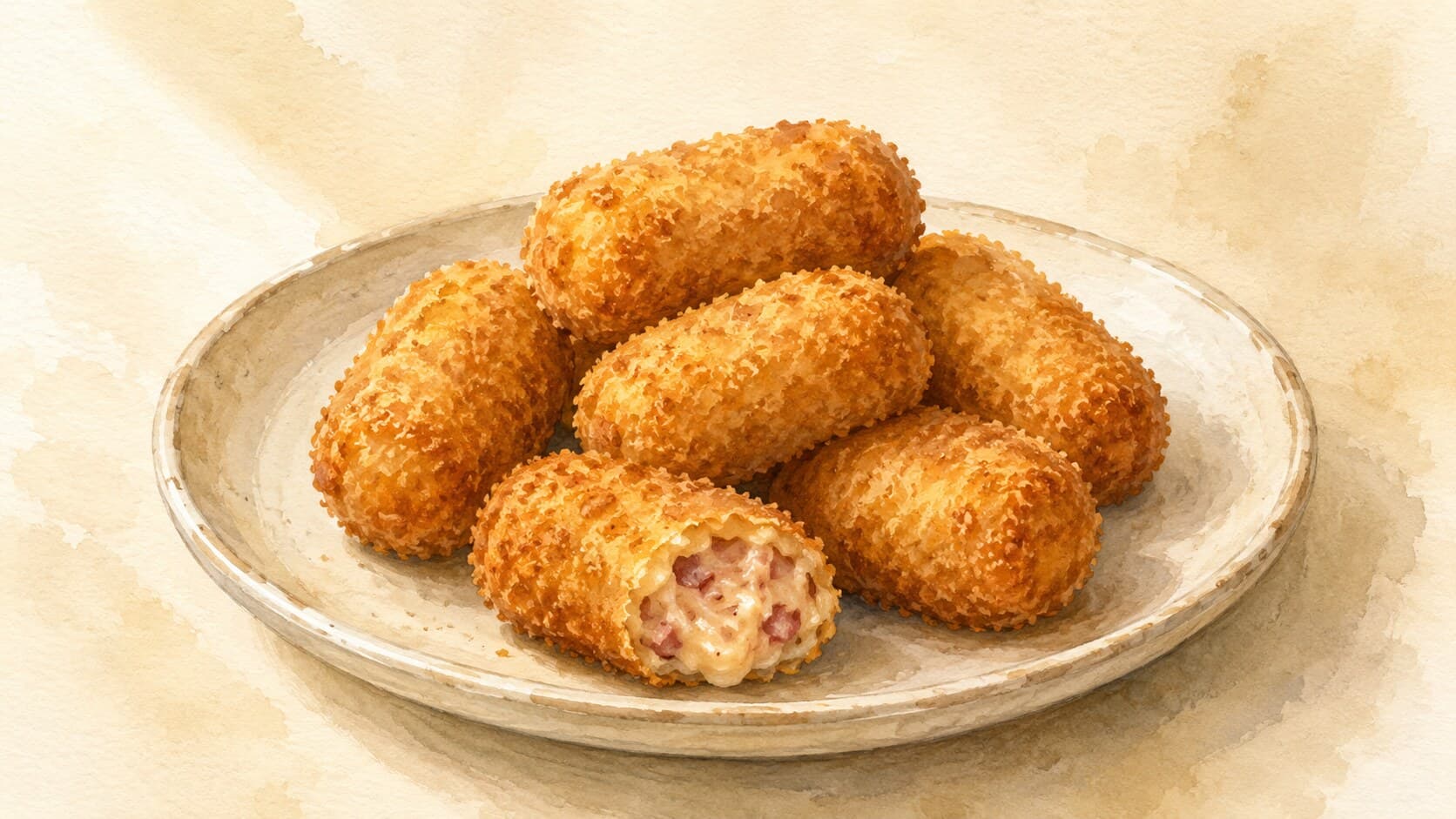
Ingredients
- 200 g of jamón serrano, finely chopped
- 50 g of unsalted butter
- 50 g of all-purpose flour
- 500 ml of whole milk
- 3 g salt (about 1/2 tsp)
- 0.5 g nutmeg (a pinch)
- 1 large egg, beaten
- 150 g of breadcrumbs
- 500 ml vegetable oil for deep frying
Steps
1. In a saucepan over medium heat, melt the butter for about 2 minutes. This creates a roux base for your bechamel.
2. Add the flour to the melted butter, stirring constantly for 2-3 minutes to avoid burning, forming a roux.
3. Gradually pour in the milk while whisking continuously to prevent lumps, cooking for 5-7 minutes until the mixture thickens to a creamy consistency.
4. Season the bechamel with 1 teaspoon of salt and a pinch of nutmeg, then stir in the chopped jamón and mix well.
5. Transfer the mixture to a dish, spread it out evenly, and refrigerate for at least 2 hours to firm up.
6. Once set, shape the mixture into small balls or oval shapes, about 2.5 cm in diameter.
7. Dredge each croquette in the beaten egg and then coat with breadcrumbs.
8. Heat the vegetable oil in a deep pan to 180°C (350°F). Fry the croquettes in batches for 3-4 minutes until they are golden brown.
9. Remove the croquettes and place them on paper towels to drain excess oil before serving.
Why this works
The key to a successful croqueta lies in the bechamel sauce, which serves as the creamy base. The roux, made from butter and flour, is cooked for 2-3 minutes to form a paste that thickens when you gradually add milk over 5-7 minutes, resulting in a smooth texture. Incorporating the jamón serrano adds depth and richness. Chilling the mixture for at least 2 hours is crucial; it firms up, making it easier to shape without breaking during frying. If the mixture seems too soft to form into shapes, refrigerate it longer or add a bit more flour to help it hold. The frying temperature is also vital; too low, around 160°C (320°F), and the croquettes will absorb oil and become greasy, while too high, above 190°C (375°F), will cause them to burn before cooking through. Achieving the right balance will yield a crispy exterior and a creamy, savory interior. Mastering this technique ensures delicious results and pays homage to the rich culinary tradition of Spanish croquetas.
Common mistakes
A béchamel (a milk sauce thickened with a flour-and-fat paste) that is too loose to shape.
Target: A paste thick enough that a spoon dragged through the pan leaves a clear, slow-closing channel — and that pulls away from the pan walls in a mass.
Why it matters: The flour's starch granules need enough time and heat to swell and lock up the milk's water. A béchamel cooked only until it "coats a spoon" is still mostly liquid inside; once chilled it firms a little, but not enough, and the croquetas slump or burst in the oil.
What to do: After the milk is in, keep stirring over medium heat for the full 5–7 minutes. The mixture should go from pourable to a dense, glossy mash that holds a ridge. Err thick — too-stiff is shapeable; too-loose is not.
Frying straight from the mixing bowl.
Target: Chilled at least 2 hours (overnight is better), until cold and sliceable all the way through.
Why it matters: This is the safety-critical step. A warm, soft béchamel has no structural skin; dropped in 180°C oil it relaxes faster than the crust can set, and the croqueta ruptures — sending creamy filling into the oil, which boils the trapped water violently and can throw hot fat. Cold filling buys the breadcrumb shell time to harden before the inside loosens.
What to do: Spread the mixture thin in a dish so it cools fast, press cling film onto the surface, and refrigerate fully. Shape and bread only once it is cold and firm.
Oil too cool, so the croquetas drink fat.
Target: 180°C (350°F), checked with a thermometer; fry in small batches.
Why it matters: Below about 160°C the crust forms too slowly and oil seeps inward faster than steam can push it out — greasy, heavy croquetas. Crowding the pan is the hidden cause: each cold croqueta drops the oil temperature, so four at a time in a small pot can stall the whole batch.
What to do: Heat to 180°C, fry 3–4 at a time, and let the oil recover between batches. A cube of bread should turn golden in about 30 seconds.
Crust cracks and filling leaks during frying.
Target: A complete, sealed coating — egg everywhere, then breadcrumbs everywhere, with no bald patches.
Why it matters: The beaten egg is glue and gasket at once: it grips the breadcrumbs and, as its proteins set in the heat, seals the seams. A gap in the egg layer is where steam escapes and filling follows.
What to do: Roll each croqueta fully in egg, let the excess drip, then coat completely in breadcrumbs, pressing gently. For fragile mixtures, a second egg-and-crumb pass makes a sturdier shell.
What to look for
- Béchamel at the right thickness: the spoon leaves a channel that closes slowly, and the mass pulls cleanly off the pan base. This is your guarantee the croquetas will hold their shape.
- Chilled filling before shaping: cold and firm enough to slice with a knife, not tacky or soft. If it smears on your hands, it is not ready — chill longer.
- Oil at frying temperature: a dropped breadcrumb sizzles immediately and rises in a steady ring of fine bubbles. Lazy, sparse bubbles mean the oil is too cool.
- Done croquetas: deep golden-brown all over, firm to a light tap, no filling weeping at the seams. Drain on paper at once so residual heat doesn't steam the crust soft.
A note on history
Croquetas feel deeply Spanish, but the technique is French: croquettes built on a béchamel base were established in French cooking by the late eighteenth century, and the dish appears to have entered Spain around the Peninsular War (1808–1814), when French occupation spread elite kitchen customs (196 flavors; SpainEats). Spanish cooks then made it their own, and the jamón version — pairing the French milk-and-flour base with Spain's cured serrano ham — became one of the country's most familiar tapas (196 flavors). Part of its enduring appeal is thrift: croquetas were, and still are, a graceful way to carry the last scraps of good ham into a second life.
Get the essays in your inbox — free
Weekly notes on flavor, fermentation, and food history — the writing behind the Atlas of Flavor. No spam; unsubscribe anytime.