
Confit de Canard
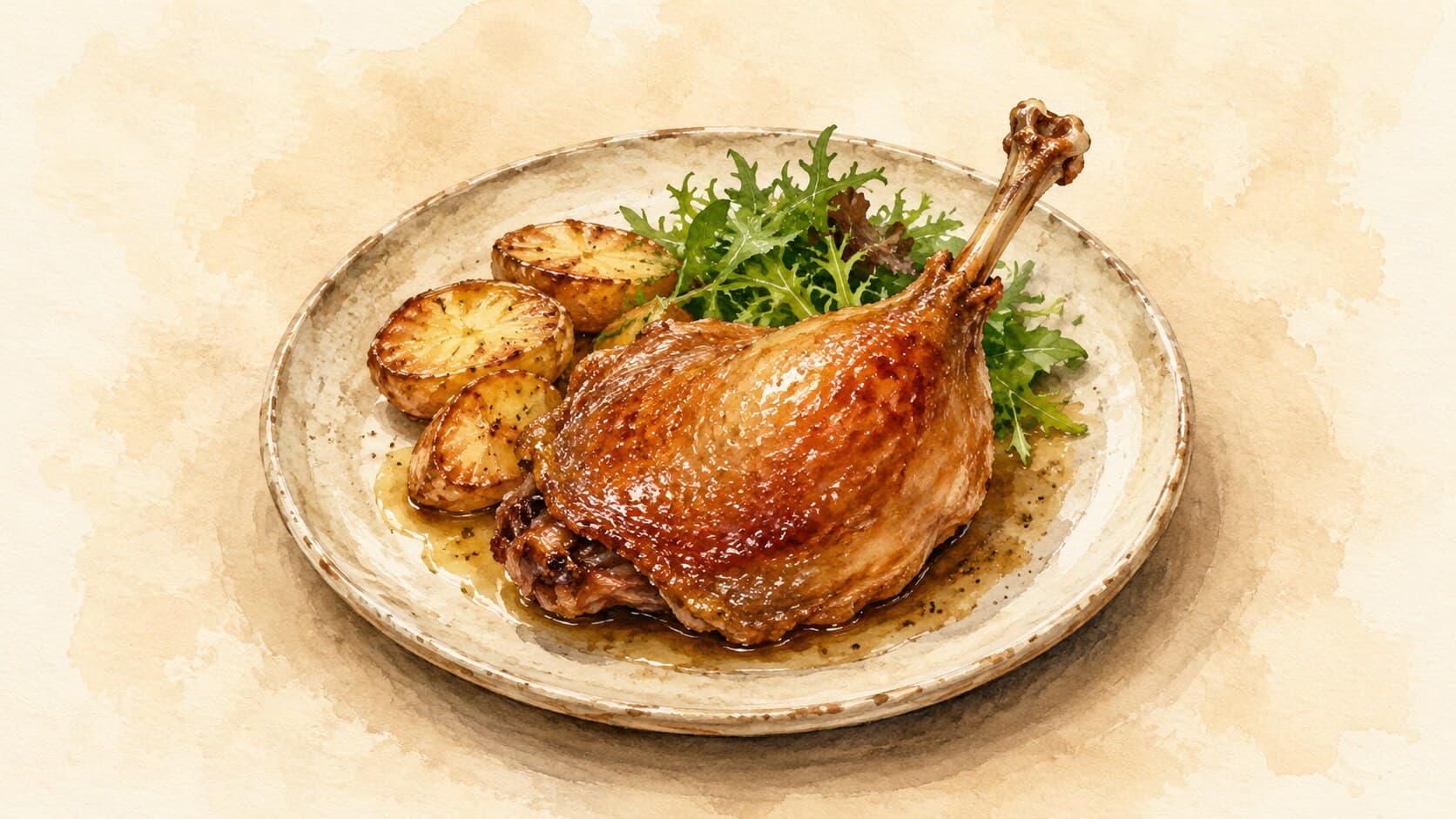
Confit de Canard is a classic French dish featuring tender duck legs slow-cooked in their own fat for a rich flavor and silky texture.
Contents (5 sections)▾
Ingredients
- 4 duck legs
- 1 liter duck fat
- 4 cloves garlic, crushed
- 2 sprigs fresh thyme
- 1 sprig fresh rosemary
- Salt, to taste
- Black pepper, to taste
Steps
1. Season the duck legs generously with salt and black pepper, then refrigerate for at least 12 hours to allow the flavors to penetrate the meat. 2. Preheat your oven to 95°C (203°F). 3. In a large oven-safe pot, melt the duck fat over low heat (around 80°C / 176°F). Add the garlic, thyme, and rosemary. 4. Submerge the seasoned duck legs in the melted fat, ensuring they are fully covered. 5. Transfer the pot to the preheated oven and cook for 2.5 to 3 hours (150 to 180 minutes), or until the duck is tender and easily pulls away from the bone. 6. Once cooked, remove the duck legs from the fat and let them cool slightly for 10 minutes before serving. 7. For a crispy skin, you can sear the duck legs in a hot skillet for 5 minutes skin-side down at medium-high heat (around 200°C / 392°F) before serving.
Why this works
The technique of confit involves cooking the duck legs slowly in their own fat at a low temperature (approximately 95°C / 203°F), which allows the meat to become incredibly tender and infused with the rich flavors of the fat and aromatics. This method makes the meat meltingly tender and flavorful. (Historically, confit was also a way to preserve the meat — see the history note — but treat your cooked confit as a cooked dish today: refrigerate it promptly, or use a tested/validated preservation method if you want to keep it; the fat cap does not make it shelf-stable at room temperature.) The low and slow cooking process ensures that the meat becomes fall-off-the-bone tender without drying out. If the skin seems too soft after cooking, searing in a hot pan (around 200°C / 392°F) for 5 minutes will achieve that desired crispy texture. Remember, if the fat seems too hot or starts to bubble violently, reduce the heat to maintain a gentle simmer; if the temperature exceeds 100°C (212°F), it can lead to tough meat instead of the desired silky texture. This careful balance of temperature and time is crucial for achieving the perfect confit, allowing the flavors to meld beautifully while ensuring the meat retains its moisture.
Common mistakes
Letting the fat get too hot.
Target: Fat held at a bare shiver — roughly 85–95°C (185–203°F), never a rolling boil.
Why it matters: Confit (meat cooked slowly while fully submerged in its own fat) is gentle by definition. Above 100°C (212°F) the muscle fibers contract hard and squeeze out moisture, so the meat turns stringy and dry instead of silky. The fat is only a heat-conducting bath; it should tremble, not bubble.
What to do: Keep the oven low (around 95°C / 203°F). If the surface ever breaks into steady bubbles, drop the temperature. A few lazy bubbles rising now and then is fine; a vigorous simmer is not.
Pulling the duck off the heat too soon.
Target: Cook until the meat yields completely — 2.5 to 3 hours, until it pulls from the bone with no resistance.
Why it matters: Duck legs are full of tough connective tissue (collagen). Collagen only melts into soft gelatin after a long stretch at low heat; rush it and the meat is both undercooked-tough and chewy. This is also the food-safety point — duck legs must be cooked fully through, not left pink at the bone.
What to do: Test with a fork or skewer near the bone. It should slide in with almost no push and the meat should want to fall apart. If it still grips, give it another 20–30 minutes.
Skipping the overnight salt cure.
Target: Season generously and refrigerate at least 12 hours before cooking.
Why it matters: Salt needs time to travel into the meat, seasoning it all the way through and drawing out a little moisture so the texture firms up (the same logic as a dry brine). Salt added only at the fat stage sits on the surface and never reaches the center.
What to do: Salt and pepper the legs the day before, cover, and leave them in the fridge. Pat off any surface moisture before they go into the fat.
Crisping the skin in a cool pan.
Target: Sear skin-side down in a properly hot skillet, around 200°C (392°F), for about 5 minutes.
Why it matters: A crackling skin comes from the Maillard reaction (the browning chemistry that builds savory, roasted flavor) plus rendering (gently melting out) the last of the surface fat. A lukewarm pan just warms the skin limp and greasy instead of crisping it.
What to do: Lift the legs out of the fat, blot the skin dry, and lay them into a hot, barely-oiled pan. Press gently for full contact and don't move them until the skin is deep gold.
What to look for
- Fat at the right temperature: a surface that shivers, with only the occasional slow bubble. A steady, noisy simmer means it is too hot and the meat will toughen.
- Doneness at the bone: a fork slides in with no resistance and the meat loosens from the bone. This is the signal that the collagen has turned to gelatin and the duck is fully cooked through.
- The skin after searing: deep gold and audibly crisp, with the fat rendered flat against the meat. A pale, soft skin needs more heat and more time, not less.
- The cooled fat afterward: it sets firm and opaque, sealing the meat beneath it. That solid cap is the traditional sign the confit is ready to store — but keep it refrigerated: the fat seal alone does not make cooked meat safe at room temperature.
A note on history
Confit de canard belongs to the rural southwest of France, above all to Gascony (the Gers, the Landes, the Dordogne), where ducks and geese were raised in large numbers. The word confit comes from the French verb confire, "to preserve," and the dish began as exactly that: a way to keep meat through the winter before refrigeration. Birds were slaughtered in late autumn at their fattest, the legs salted and slowly cooked in their own rendered fat, then packed into earthenware crocks where the solidified fat sealed out air and held them for months. The technique grew naturally from the same farms that produced foie gras — a thrifty, whole-bird ethic in which nothing was wasted. (Wikipedia: Duck confit; Tasting Table: The Historic Origins of Confit)
Get the essays in your inbox — free
Weekly notes on flavor, fermentation, and food history — the writing behind the Atlas of Flavor. No spam; unsubscribe anytime.