
Chiles en Nogada
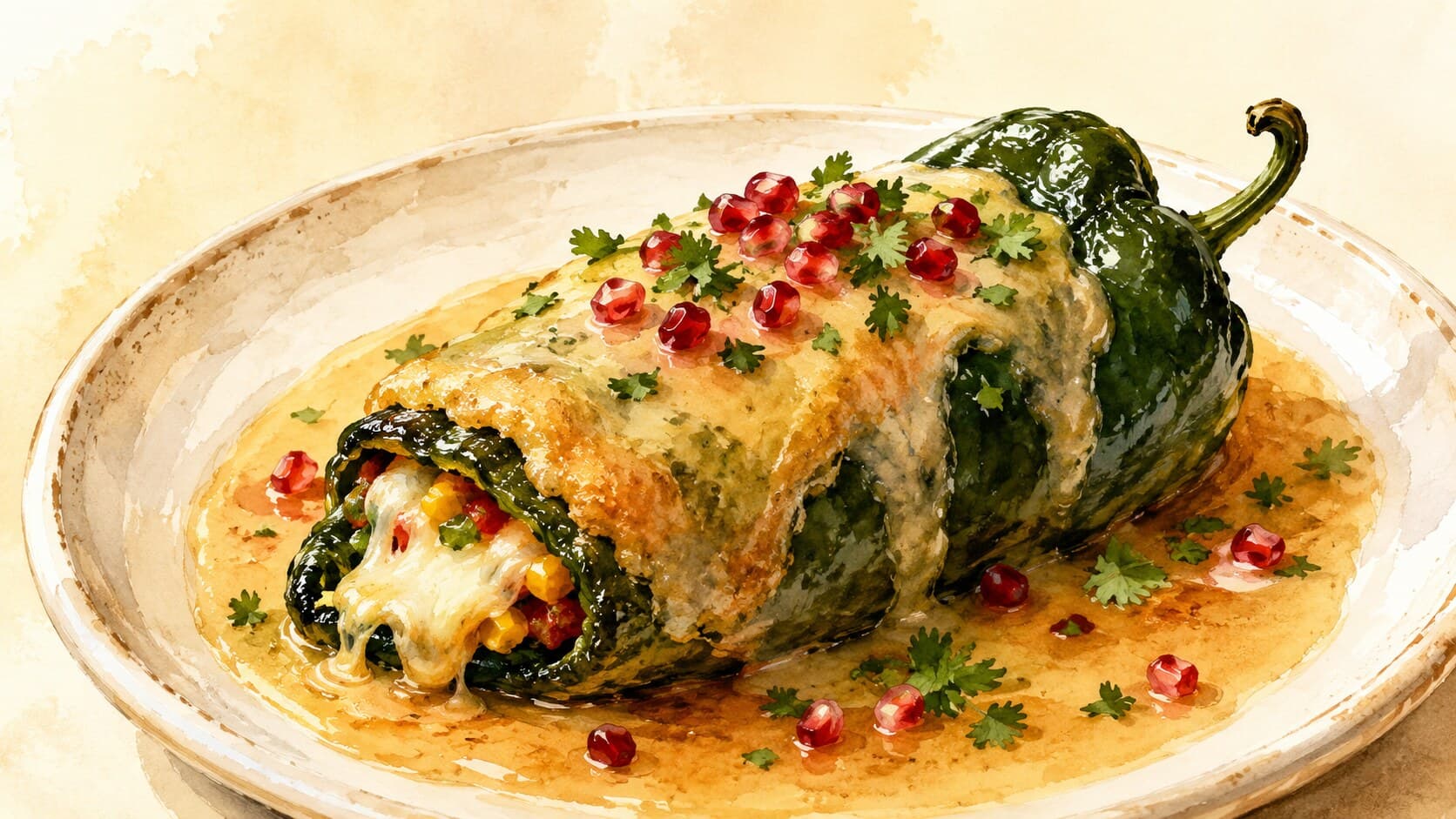
Chiles en Nogada is a festive Mexican dish featuring stuffed poblano peppers topped with a creamy walnut sauce and pomegranate seeds.
Contents (5 sections)▾
Ingredients
- 4 large poblano peppers
- 500 g ground beef or pork
- 100 g onion, finely chopped
- 2 cloves garlic, minced
- 200 g tomatoes, peeled and chopped
- 50 g almonds, chopped
- 50 g raisins
- 1 tsp cinnamon
- 1/2 tsp cumin
- Salt, to taste
- Pepper, to taste
- 3 cups walnuts, soaked in water
- 1 cup milk
- 1/4 cup sugar
- 1 tsp vanilla extract
- 2 pomegranates, seeds separated
- Fresh parsley, for garnish
Steps
Preheat your oven to 180°C (350°F). Start by roasting the poblano peppers directly over a flame or in the oven until their skin blackens and blisters. This enhances their flavor and makes them easier to peel.
In a skillet, heat some oil over medium heat. Add the chopped onion and garlic, sautéing until soft. Then, add the ground meat, cooking until browned. Incorporate the tomatoes, almonds, raisins, cinnamon, cumin, salt, and pepper. Cook for about 10 minutes until flavors meld. Cook the ground meat until it reaches 71 °C / 160 °F on an instant-read thermometer (no longer pink throughout) — colour, float and time are guides, not the safety test.
Carefully peel the roasted poblano peppers and make a slit on one side to remove the seeds. Stuff each pepper with the meat mixture, pressing gently to pack it well.
For the nogada (sauce), blend the soaked walnuts with milk, sugar, and vanilla until smooth. If the sauce is too thick, add more milk to achieve a drizzle consistency.
Arrange the stuffed peppers on a serving plate and generously pour the walnut sauce over them. Garnish with pomegranate seeds and fresh parsley just before serving.
Why this works
Chiles en Nogada is a harmonious blend of flavors and textures, showcasing the sweetness of the walnut sauce against the savory stuffed peppers. The roasting (charring the skin black over a flame or under a broiler) of the poblano peppers is crucial; it adds a smoky depth and helps the skin become tender, which enhances the overall eating experience. If the stuffed peppers seem too soggy after cooking, ensure they are fully drained before stuffing. The walnut sauce, or nogada, must be creamy yet pourable; if it breaks or becomes too oily, adding a splash of milk and re-blending can help restore its smooth consistency. The addition of pomegranate seeds not only provides a beautiful contrast but also a slight tang that cuts through the richness of the sauce, making each bite balanced and festive, perfect for celebrations such as Mexico's Independence Day.
Common mistakes
Underseasoning the picadillo (a savory minced-meat filling) because the sauce is sweet.
Target: A filling that tastes fully seasoned on its own — salt forward, warm with spice, just barely sweet from the fruit.
Why it matters: The nogada (the walnut cream sauce) and pomegranate add sweetness and richness on top. If the meat is bland, the finished plate reads as one-dimensionally sweet with nothing underneath. The savory picadillo is the floor the whole dish stands on.
What to do: Taste and adjust salt while the filling is still in the pan. It should taste slightly too savory alone — the sauce will round it out.
Pulling the meat off the heat while it is still pink.
Target: Ground beef or pork cooked through completely — no pink, no translucent pink juices, an internal temperature of 71°C / 160°F if you check with a thermometer.
Why it matters: This is the one non-negotiable. Ground meat has surface bacteria mixed all the way through during grinding, so unlike a whole steak it must be cooked fully in the center, not just seared outside. Browning the surface for flavor is not the same as cooking it safe.
What to do: Break the meat into small crumbles so heat reaches the center, cook until no pink remains and the juices run clear, then add the tomato and fruit. The 10-minute simmer that follows finishes the job.
Stuffing wet peppers, or overfilling them.
Target: Roasted, peeled poblanos patted dry inside, filled until just full and still able to close around the slit.
Why it matters: Water clinging inside the pepper dilutes the filling and makes the base soggy. Overpacking splits the pepper and lets filling leak into the sauce, muddying the clean white-over-green look the dish is known for.
What to do: After peeling, blot the inside with paper towel. Fill so the pepper is plump but the cut edges still meet.
Saucing too early.
Target: Nogada poured over the peppers at the moment of serving, not before.
Why it matters: The walnut cream is a fresh, uncooked emulsion (a smooth blend of fat and liquid that would separate on its own). Sitting on warm peppers it thins, slides off, and can start to weep. Pomegranate seeds bleed pink into white if they wait.
What to do: Hold the sauce cold and the peppers warm separately. Pour and garnish at the table or just before it leaves the kitchen.
What to look for
- Filling in the pan: fat glistening, no liquid pooling, meat in fine crumbles. When the picadillo stops releasing water and the fat goes clear, the moisture has cooked off and the flavors have concentrated — it is ready to stuff.
- Roasted poblano skin: blistered black and loose, lifting away from the flesh. Full charring is what lets the bitter skin slip off cleanly; a pepper that is only softened will fight you and tear.
- Nogada consistency: pourable like thick cream, coating the back of a spoon, no graininess. If it mounds like paste it is too thick to drape; thin with a little milk. If it runs like water it will not cling.
- The finished plate: bright white sauce, deep green pepper, scarlet seeds — three clean colors, not blurred. Sharp contrast means everything was kept separate until the end, which is also when it tastes freshest.
A note on history
Chiles en nogada is tied to the founding of independent Mexico. The most repeated account holds that Augustinian nuns in Puebla created it to honor Agustín de Iturbide, who passed through the city in August 1821 after the Treaty of Córdoba ended Spanish rule, and that the green poblano, white walnut sauce, and red pomegranate were chosen to mirror the three colors of the new Mexican flag (Wikipedia, Texas Monthly). Some food historians are skeptical of the convent legend and note that walnut-sauced chiles likely predate 1821, but the patriotic symbolism and the late-summer season — when fresh walnuts and pomegranates overlap — are why the dish is still served around Mexican Independence Day (Texas Monthly).
Get the essays in your inbox — free
Weekly notes on flavor, fermentation, and food history — the writing behind the Atlas of Flavor. No spam; unsubscribe anytime.