
Chicken Adobo
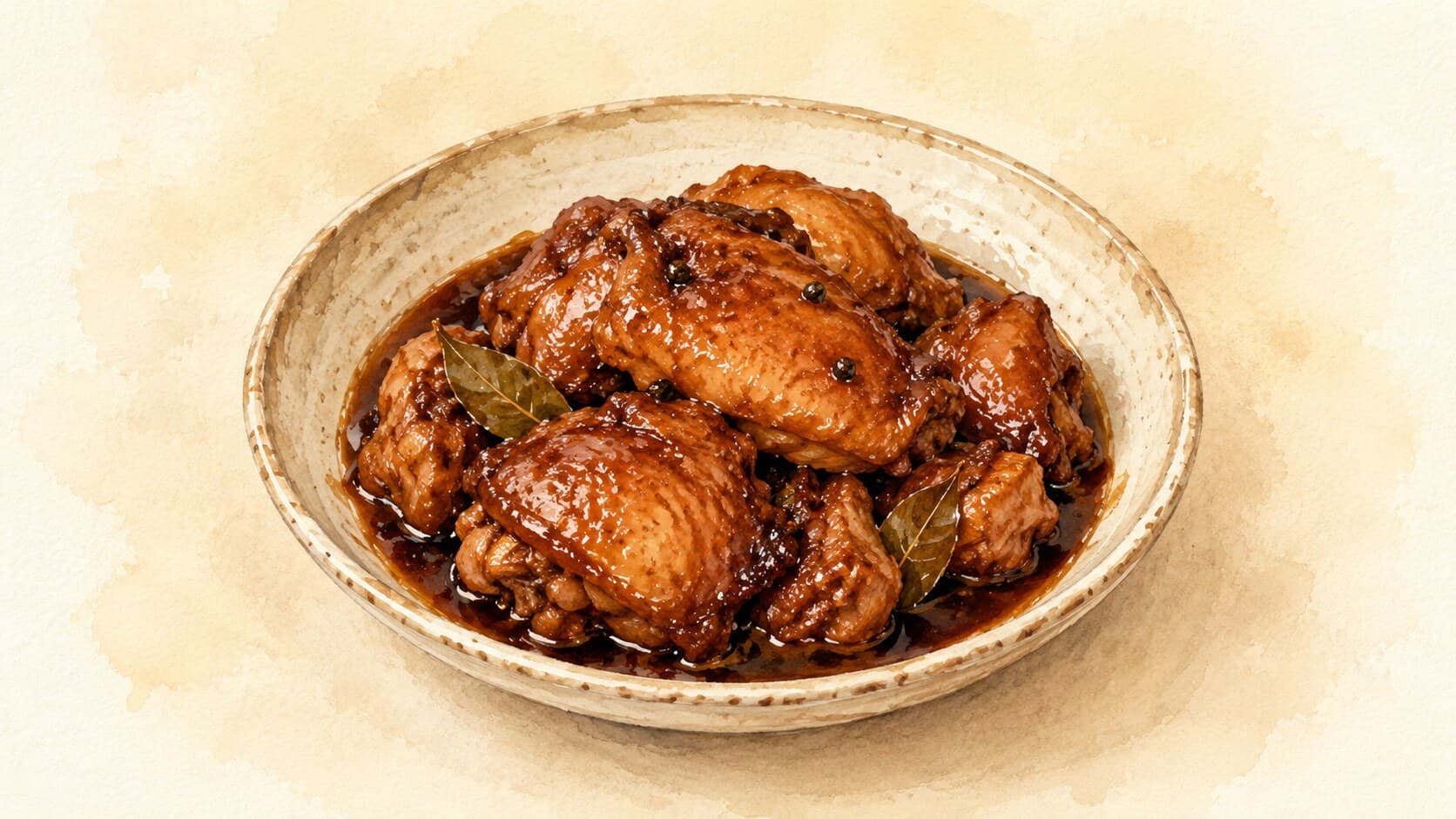
A traditional Filipino chicken adobo featuring a harmonious balance of soy sauce and vinegar.
Contents (5 sections)▾
Ingredients
- 1 kg chicken, cut into pieces
- 1/2 cup soy sauce
- 1/2 cup vinegar
- 1 cup water
- 1 medium onion, sliced
- 4 cloves garlic, minced
- 2 bay leaves
- 1 tsp black peppercorns
- 2 tbsp cooking oil
- Salt to taste
- 1 tsp sugar (optional)
Steps
In a bowl, marinate the chicken in soy sauce, garlic, and onion for at least 15 minutes to enhance flavor.
In a large pot, heat cooking oil over medium heat. Sear the marinated chicken pieces until browned on all sides (about 5 minutes). This step enhances depth of flavor.
Add vinegar to the pot and let it simmer without stirring for 2-3 minutes to cook off the strong vinegar taste.
Pour in water, add bay leaves and peppercorns. Bring to a boil, then reduce to a simmer and cover. Cook for 20-25 minutes until chicken is tender.
Taste the sauce and adjust with salt and sugar if needed. If the sauce is too thin, increase heat to reduce it until desired consistency is reached.
Why this works
Chicken adobo is a prime example of the Filipino braising technique, where the chicken is marinated (soaked in a seasoned liquid beforehand to take on flavor) in a soy-vinegar mixture that penetrates the meat, ensuring rich flavor. Searing the chicken before braising enhances the Maillard reaction (the browning that builds savory, roasted flavor), creating a complex depth in taste. The vinegar and soy sauce balance acidity and umami, making it a harmonious dish. It’s crucial to simmer the vinegar initially to avoid overpowering the dish with a raw taste. If the sauce seems too thin at the end, simply increase the heat to encourage evaporation, thickening the sauce. Conversely, if the chicken appears too dry, add a splash of water and cover the pot to steam it back to tenderness.
Common mistakes
Stirring the vinegar as soon as it goes in.
Target: Add the vinegar, then let it simmer undisturbed for 2–3 minutes before stirring or adding anything else.
Why it matters: Raw vinegar has a harsh, sharp edge. Letting it bubble briefly without stirring cooks off that volatile sourness and softens the acid (the tang from the vinegar) into a rounder, mellower flavour. Stirring straight away muddies the layers and keeps the raw bite. This is the single step that most separates a balanced adobo from a sour one.
What to do: Pour it in, leave it alone, let it come to a simmer and breathe for a couple of minutes, then proceed.
Drowning the chicken so it boils instead of braising.
Target: Enough liquid to come partway up the chicken, simmering gently — not a rolling boil that covers it.
Why it matters: Adobo is a braise (cooking partly submerged in liquid over low heat). A hard boil toughens the meat and washes flavour out into a watery sauce; a gentle simmer keeps the chicken tender and lets the sauce concentrate. The goal is a glossy, reduced sauce that coats the meat, not soup.
What to do: Keep it at a lazy simmer with the lid on, then uncover near the end to let the sauce reduce and cling. Adjust the heat so you see slow, occasional bubbles, not a violent boil.
Undercooked chicken — judging by colour or time alone.
Target: Chicken cooked right through, no pink at the bone, juices running clear; thighs reach 74°C / 165°F at the thickest part.
Why it matters: This is poultry, and partially cooked chicken is a food-safety risk, not just a texture problem. Dark soy and vinegar can stain the meat a deep colour that hides doneness, so colour is a poor guide. Bone-in pieces especially need full cooking to the bone.
What to do: Cut into the thickest piece next to the bone and check the flesh is opaque with clear juices, or use an instant-read thermometer. If any pink remains, cover and simmer a few minutes longer before reducing the sauce.
Sauce too thin or too salty at the finish.
Target: A sauce reduced to a syrupy glaze, balanced between salty soy and tangy vinegar, tasted and corrected at the end.
Why it matters: Soy sauce carries both salt and savoury depth (umami, the rounded savoury taste), and as the sauce reduces that saltiness concentrates. Reducing too far makes it harsh; not reducing enough leaves it watery and flat. The final balance of salt, acid and a touch of sweetness is what defines adobo.
What to do: Simmer uncovered to thicken, tasting as you go. If it tips too salty, add a splash of water; if it is flat, a pinch of sugar rounds the soy-and-vinegar edge. Stop reducing once it coats a spoon.
What to look for
- Vinegar going in: it bubbles up sharp and pungent, then the smell softens and rounds as it simmers. When the harsh nose-tingle fades, the raw edge has cooked off.
- During the braise: slow, lazy bubbles around the edges and the chicken half-bathed in liquid, not churning. A gentle simmer means tender meat; a hard boil means trouble.
- Doneness: flesh opaque to the bone with clear (not pink) juices when pierced. Dark sauce hides colour, so cut in and look — this is the safety check, not a guess.
- The finished sauce: glossy and slightly syrupy, coating the chicken and sliding off a spoon in a thick line. It should taste salty and tangy in balance, neither watery nor sharp.
A note on history
Adobo's roots are pre-colonial: indigenous Filipinos preserved meat and fish by cooking them in vinegar and salt, a practical defence against spoilage in a tropical climate. When the Spanish arrived in the 16th century they named the technique after their own word adobar (to marinate or pickle) — a 1613 dictionary by Pedro de San Buenaventura records it as adobo de los naturales, "adobo of the natives." The soy sauce now central to many versions came later, brought by Chinese traders, and in many households replaced salt as the seasoning. Sources: Wikipedia, The Culture Trip.
Get the essays in your inbox — free
Weekly notes on flavor, fermentation, and food history — the writing behind the Atlas of Flavor. No spam; unsubscribe anytime.