
Beef and Bean Burrito
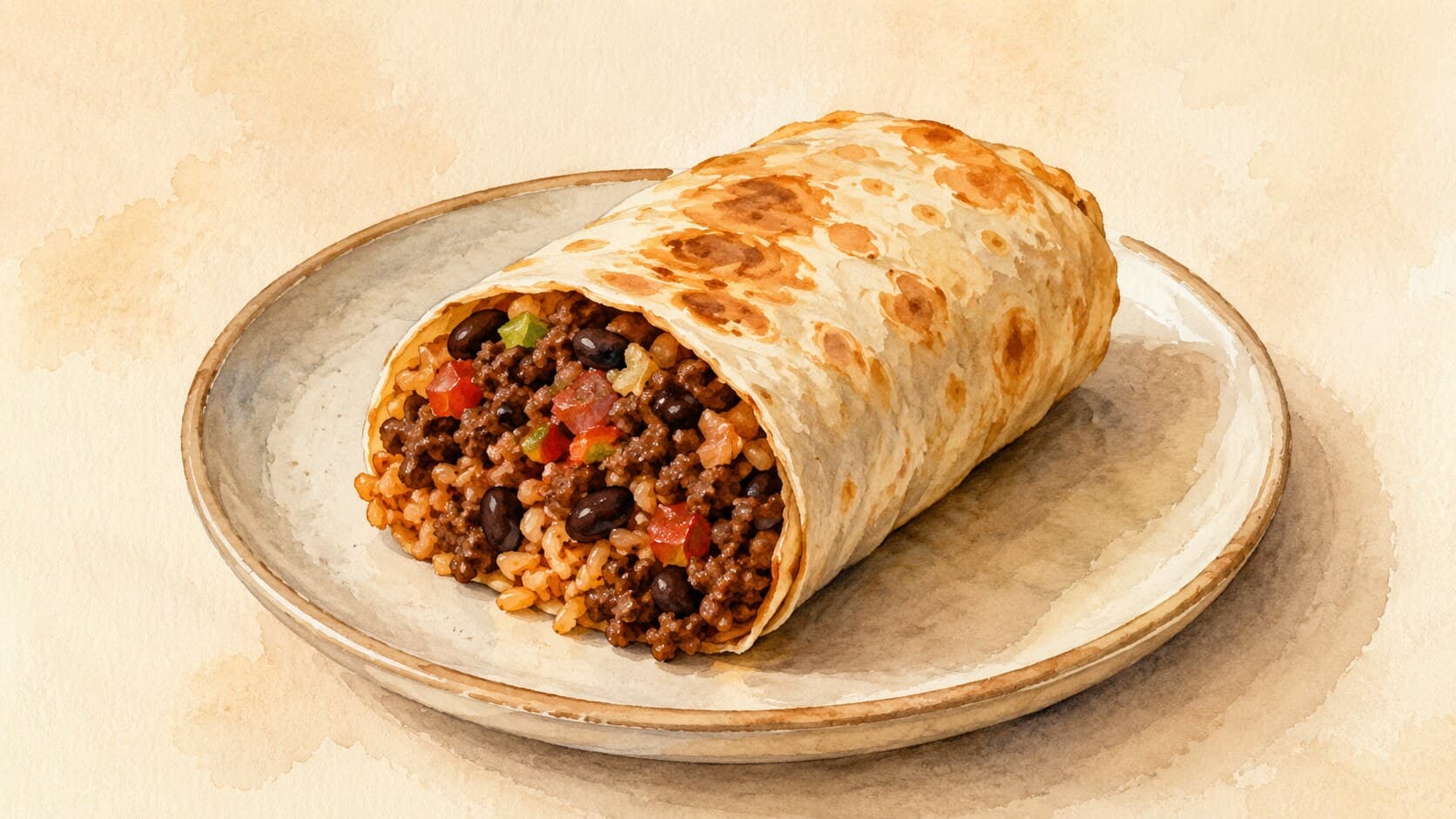
Beef and Bean Burrito consists of seasoned beef and beans wrapped in a tortilla. Focus on layering ingredients and rolling technique for best results.
Contents (5 sections)▾
Ingredients
- 500 g ground beef
- 1 can (400 g) black beans, drained and rinsed
- 1 cup cooked rice
- 1 medium onion, diced
- 2 cloves garlic, minced
- 1 tsp cumin
- 1 tsp chili powder
- 1 tsp salt
- 1/2 tsp black pepper
- 4 large flour tortillas
- 1 cup shredded cheese (cheddar or Mexican blend)
- Sour cream, for serving
- Salsa, for serving
- Fresh cilantro, for garnish
Steps
In a large skillet over medium heat, cook the ground beef for about 5-7 minutes until browned, breaking it up with a spoon. Cook the ground meat until it reaches 71 °C / 160 °F on an instant-read thermometer (no longer pink throughout) — colour, float and time are guides, not the safety test.
Add the diced onion and minced garlic to the skillet and sauté for an additional 3-4 minutes until the onion is translucent.
Stir in the black beans, cooked rice, cumin, chili powder, salt, and black pepper. Cook for another 2-3 minutes until heated through.
Remove the skillet from heat and stir in half of the shredded cheese until melted.
Warm the flour tortillas in a dry skillet over low heat for about 30 seconds on each side to make them pliable.
To assemble, place a generous portion of the beef and bean mixture on the lower third of each tortilla, top with remaining cheese, and fold the sides over before rolling tightly.
Place the burritos seam-side down in a lightly greased baking dish and bake in a preheated oven at 180°C (350°F) for 10-15 minutes until heated through.
Why this works
The combination of ground beef and black beans creates a rich, hearty filling that is both satisfying and protein-packed. Cooking the beef first allows for the fat to render (melt out of the meat as it heats), which enhances the flavor of the dish. Sautéing the onion and garlic with the beef adds depth to the overall taste profile. Adding cooked rice provides bulk and helps to bind the filling together, making it easier to wrap. The spices—cumin and chili powder—impart a classic Tex-Mex flavor that complements the ingredients beautifully. If the burrito filling seems too dry, you can add a splash of beef broth or some salsa to moisten it. Wrapping the burritos tightly ensures they hold together during cooking; if they break, try using a larger tortilla or adding less filling to make wrapping easier. Baking them at the end enhances the texture, creating a delightful contrast between the warm, soft tortilla and the savory filling inside.
Common mistakes
Under-browning the ground beef.
Target: Beef cooked past gray to genuinely browned, in patches, with no pink remaining — internal temperature 71°C / 160°F.
Why it matters: Ground beef crowded in a cool pan releases water and simmers gray, which is both a flavor loss and a safety issue. Real browning is the Maillard reaction (the browning chemistry between protein and sugar that builds deep, savory flavor) — it is most of what makes the filling taste rich rather than bland. Ground beef must also reach a safe internal temperature because grinding spreads surface bacteria throughout the meat.
What to do: Use medium-high heat, spread the beef thin, and let it sit undisturbed for a minute before breaking it up so it can sear. Cook fully — never leave ground beef pink in the center.
Wrapping a wet, sloppy filling.
Target: Filling moist but not runny — it should hold its shape on a spoon, with no liquid pooling.
Why it matters: Excess liquid is the number-one cause of a burrito that splits or goes soggy. The tortilla can only hold so much before the starch network softens and tears. A wet filling steams the wrap from the inside.
What to do: Drain and rinse the beans, and if the mixture looks loose, let it cook a minute longer to drive off moisture before you fill. Stir the cheese in off the heat so it binds rather than weeps.
Filling a cold, stiff tortilla.
Target: Tortilla warmed until soft and pliable — about 30 seconds a side in a dry pan.
Why it matters: Cold flour tortillas are brittle; the gluten and starch are set firm, so they crack along the fold instead of bending. A warm tortilla becomes elastic and rolls into a tight, sealed cylinder.
What to do: Warm each tortilla in a dry skillet (or briefly over a flame or in a damp towel in the microwave) right before rolling. Roll while it is still warm.
Overfilling so it won't close.
Target: A modest log of filling across the lower third, leaving clear borders to fold over.
Why it matters: A burrito seals because the tortilla overlaps itself; pack in too much and the edges never meet, so it bursts at the seam during baking. More filling does not make a better burrito — it makes a broken one.
What to do: Fold the sides in first, then roll tightly from the bottom, tucking as you go. If filling escapes, you used too much — scale back on the next one.
What to look for
- The browning beef: deep brown crusty patches forming, the pan sizzling rather than steaming. Sizzle means searing; a wet hiss means the beef is stewing in its own liquid and won't brown.
- The finished filling: glossy and cohesive, holding together on the spoon with no puddle of liquid underneath. That cohesion is what lets it roll cleanly without leaking.
- The warmed tortilla: soft and supple, folding without cracking at the crease. If it splits when you bend it, it needs more warming.
- The baked burrito: seam fused shut, the exterior lightly toasted and firm to the touch. A sealed, slightly crisp surface means it held together and heated through.
A note on history
The burrito traces to Northern Mexico — the wheat-growing border states of Chihuahua, Sonora, and Coahuila, and especially Ciudad Juárez — where Spanish-introduced wheat farming made the large flour tortilla, rather than the southern corn tortilla, the regional wrap (Wikipedia: Burrito). The name means "little donkey" in Spanish; the word first appears in print in an 1895 Mexican dictionary describing a "rolled tortilla with meat or other food within" (Richard Foss: Burrito History). The heavily filled, rice-and-bean-loaded burrito most people picture today is largely a later Tex-Mex and Californian elaboration of that simpler border original.
Get the essays in your inbox — free
Weekly notes on flavor, fermentation, and food history — the writing behind the Atlas of Flavor. No spam; unsubscribe anytime.