
Bobotie (South African Spiced Mince Bake)
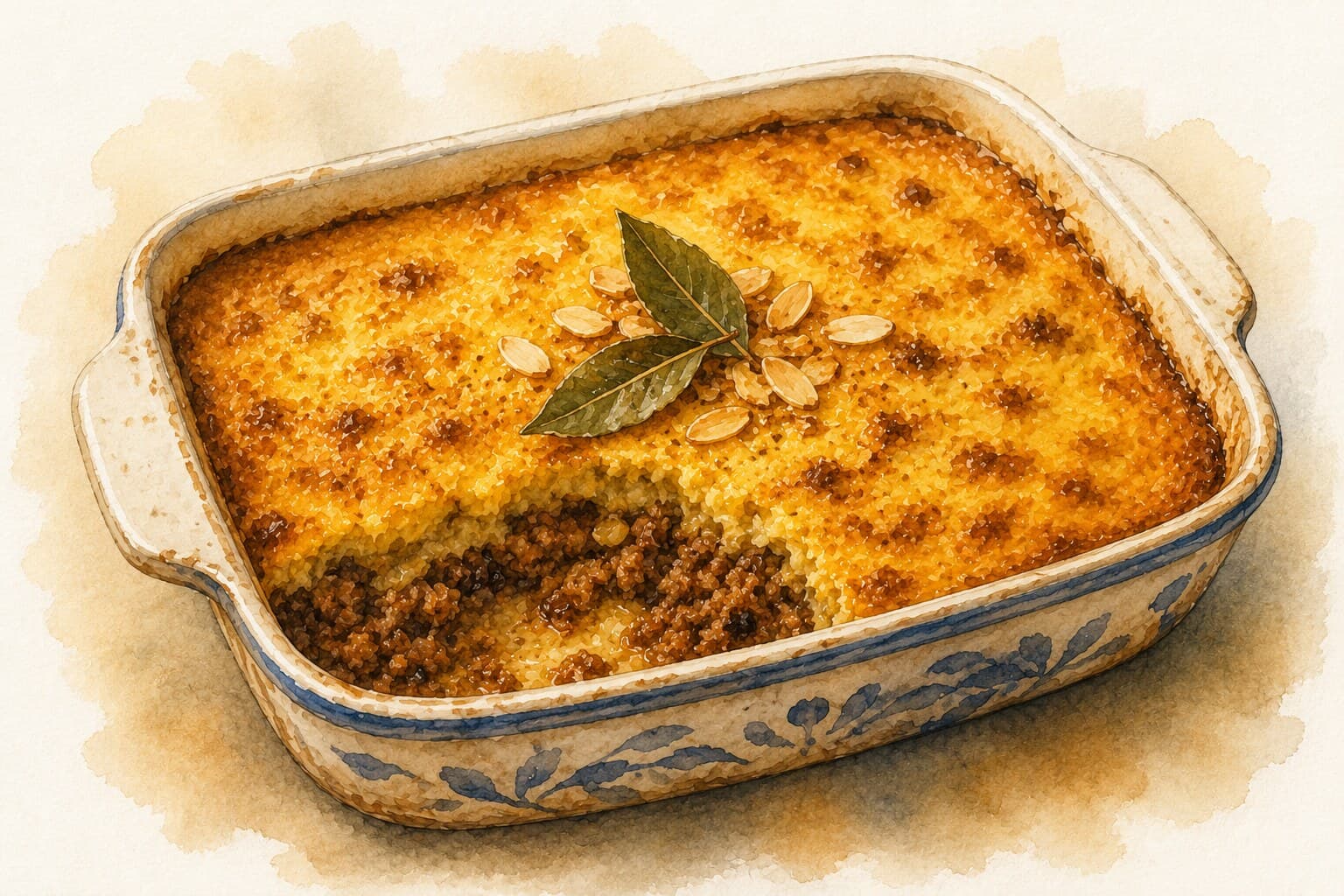
Bobotie is a comforting South African dish featuring spiced minced meat baked under a savory egg custard.
Contents (5 sections)▾
Ingredients
- 500 g ground beef or lamb
- 1 large onion, finely chopped
- 2 cloves garlic, minced
- 1 tbsp curry powder
- 1 tsp turmeric powder
- 1 tbsp sugar
- 1 cup milk
- 2 large eggs
- 1 slice white bread, crusts removed
- 1 tbsp chutney
- 1 tbsp raisins
- 1 tbsp almond slivers
- Salt and pepper to taste
- 1 tbsp vegetable oil
- 1 bay leaf
Steps
Preheat your oven to 180°C (350°F). This ensures even baking of the custard topping.
In a frying pan, heat the vegetable oil over medium heat. Add the onion and garlic, cooking until softened, about 5 minutes.
Add the ground meat to the pan and cook until browned, breaking it up with a spoon, around 8 minutes.
Stir in the curry powder, turmeric, sugar, chutney, raisins, and season with salt and pepper. Cook for another 5 minutes.
Soak the bread in milk for 5 minutes, then squeeze out excess liquid and add to the meat mixture, mixing well.
Transfer the meat mixture to a baking dish, smoothing the top. Beat the eggs with the remaining milk and pour over the meat.
Top with bay leaf and almond slivers, then bake in the preheated oven for 30 minutes or until the custard is set and golden.
Let it rest for 10 minutes before serving to allow flavors to meld.
Why this works
Bobotie is a delightful blend of flavors, with the spiced minced meat providing a savory base balanced by the sweetness of chutney and raisins. The egg-milk custard topping is crucial as it adds a rich texture that contrasts beautifully with the spiced filling. Baking the dish allows the flavors to meld and the custard to set properly, creating a golden crust. If the custard seems too runny, ensure to bake it longer until firm, as this prevents it from breaking apart when served. If you notice the top browning too quickly, cover the dish with foil to prevent burning while the inside finishes cooking.
Common mistakes
Skipping the browning and just simmering the mince.
Target: Cook the meat over medium-high until the bottom of the pan shows brown fond (the tasty browned film that sticks to the pan) before you add the wet ingredients.
Why it matters: Bobotie's savory backbone comes from the Maillard reaction (the browning of meat that creates deep, roasted flavor). If the mince only ever stews in its own grey liquid, the filling tastes flat no matter how much curry powder you add.
What to do: Spread the meat out, let it sit and brown, then break it up. If it's swimming in liquid, raise the heat and let that water boil off — browning can't begin until the pan is dry.
Adding the curry powder raw at the end.
Target: Stir the curry powder and turmeric into the hot onions and fat and let them cook for about a minute until fragrant.
Why it matters: Ground spices carry their aroma in oil-soluble compounds. Warming them in fat (called blooming) releases that aroma and cooks off the dusty, raw edge; stirred in cold at the end they taste flat and powdery.
What to do: Once the onions are soft, make a space in the pan, add the spices to the oil, and stir for 30–60 seconds until they smell toasty before the meat goes back in.
Pouring the custard over a piping-hot filling and baking too hot or too long.
Target: Let the filling settle to just warm, pour over the egg-milk mix, and bake at 180 °C / 350 °F only until the top is set with a slight wobble in the center.
Why it matters: A custard is egg protein gently coagulating (setting from liquid to soft solid) around 70–80 °C. Too much heat and the proteins seize and squeeze out their water — the topping turns grainy and weeps a watery puddle, like overcooked scrambled eggs.
What to do: Bake until just set and golden, then stop. If the top browns before the center sets, tent loosely with foil. A barely-jiggly center will firm up as it rests.
Slicing it straight out of the oven.
Target: Rest the bake 10 minutes before cutting.
Why it matters: Hot from the oven the custard and mince are still loose, so a cut slice slumps and slides apart. Resting lets the proteins firm and the layers re-settle, so it holds a clean shape on the plate.
What to do: Set it on a rack for 10 minutes. Use that time to cook rice or warm chutney for serving.
What to look for
- Onions gone soft and translucent, not browned hard, before the spices go in. They should look glassy and smell sweet — that gentle base lets the curry come forward without a scorched, bitter note.
- A dry, sizzling pan once the mince is browned. If liquid is pooling, the meat is steaming, not searing; cook it off until you hear a fry, not a simmer, and see brown sticking to the pan.
- A custard top that is set at the edges with a faint wobble in the very center. That slight jiggle means the egg is just cooked through — wait for a fully rigid, puffed top and you've gone too far.
- A golden, lightly browned surface — not deep brown or cracked. Even gold says the custard set gently; dark patches or a cracked, risen top signal the oven ran too hot.
A note on history
Bobotie's lineage runs from Europe to Southeast Asia and into the Cape: a recipe of the same family appears in a Dutch cookbook as early as 1609, and the dish as we know it was shaped by the Cape Malay community — people brought enslaved to the Cape of Good Hope from Java and other parts of the Indonesian archipelago beginning in 1658, who married imported spices to local ingredients. The name's origin is debated, traced variously to the Indonesian bobotok or to the Malay boemboe, meaning curry spices (Wikipedia; Crush Mag).
Get the essays in your inbox — free
Weekly notes on flavor, fermentation, and food history — the writing behind the Atlas of Flavor. No spam; unsubscribe anytime.