
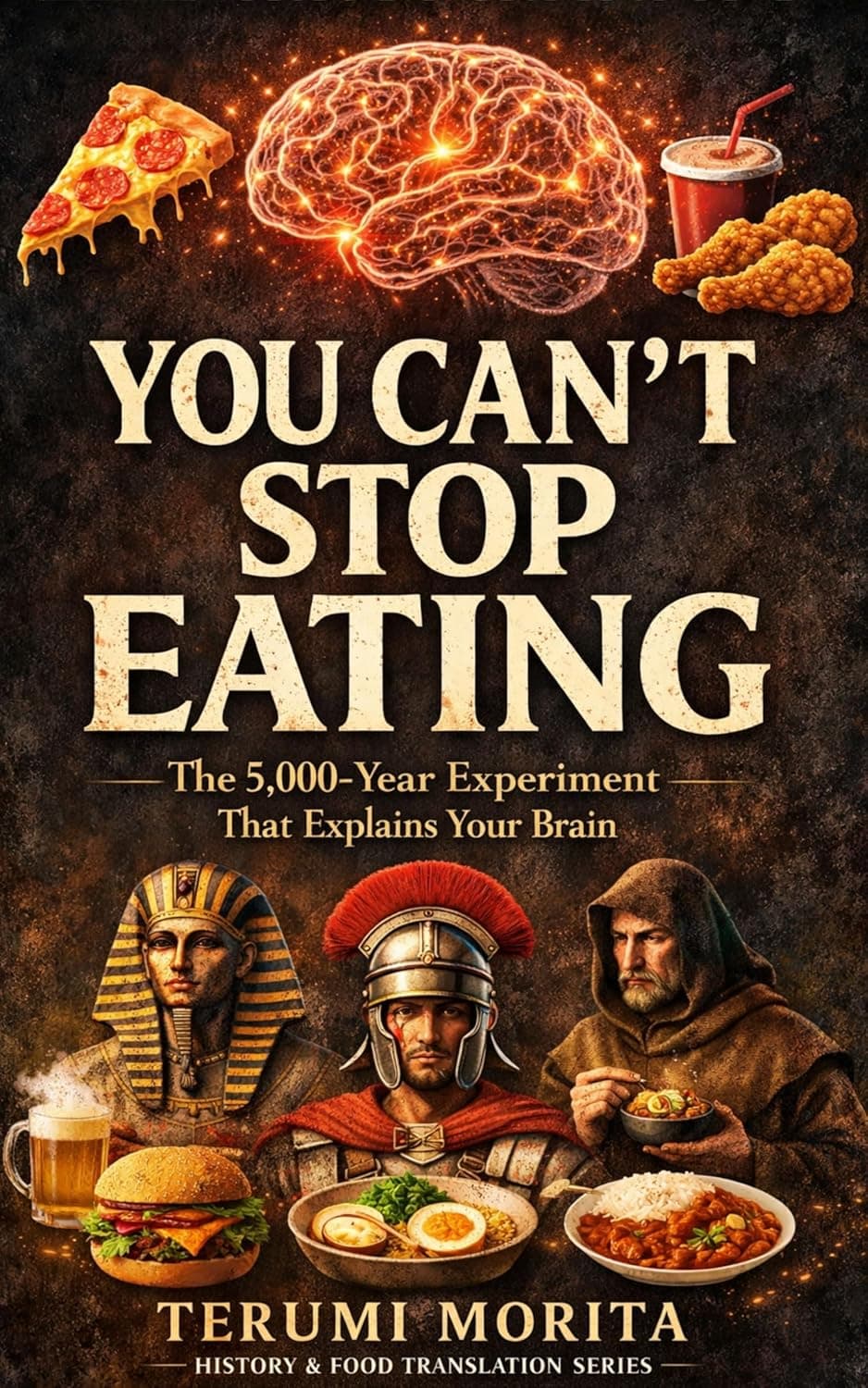
YOU CAN'T STOP EATING
The 5,000-Year Experiment That Explains Your Brain
About the book
Modern snacks didn't invent the craving — they finished an engineering project that started 5,000 years ago. From Mesopotamian beer to Roman garum to industrial potato chips, each civilization pushed one variable further: more salt, more fat, more umami, shorter time between bite and reward. This book traces that long arc, and shows why your brain is not losing a battle with food — it is doing exactly what five millennia of cooks, traders, farmers, and chemists designed it to do.
What you’ll take away
- 01
Why every civilization independently re-engineered the same flavor structure — and why your brain reads modern snack food as five thousand years of accumulated craft.
- 02
How Mesopotamian fermentation, Roman fish sauce, medieval refined sugar, and the modern snack aisle are different solutions to the same neurological equation.
- 03
Why hyperpalatability is not a defect of modern food but the explicit goal every cook has worked toward since the earliest cities.
- 04
How to read a Doritos chip and a Roman garum jar as the same artifact, separated by two thousand years of refinement.
- 05
Why food science, food history, and kitchen craft each describe the same phenomenon — and what becomes visible when you let the three vocabularies speak together.
- 06
How to look at your own appetite without shame, by understanding it as cumulative design rather than personal failure.
Inside the book
Why this book
I spent twenty years in kitchens watching people eat things they did not want to be eating. Cooks call it “it just works.” Neuroscientists call it hyperpalatability. Food historians call it convergence. Nobody had put the three stories on one timeline. This book is that timeline.
— Terumi Morita
Who this is for
Readers who want to understand their own appetite — not as a failure of willpower, but as the expected output of a long, collective design project. Useful for anyone interested in food science, food history, behavioral economics, or simply the question of why modern eating feels so different from eating a decade ago.
Readers looking for a meal plan, a diet protocol, or a set of recipes. This book treats appetite as a historical and scientific phenomenon — not as a problem to be fixed.
From the book
Your appetite is not a personal failing. It is the output of a 5,000-year R&D program, and you are the user, not the engineer.
Every bite of a modern snack is the result of a small war between what humans can taste and what humans can afford. For most of history, affordability won. In the last hundred years, taste has pulled ahead.
The brain does not distinguish between food that is nourishing and food that is engineered. It only knows what to chase.
Frequently asked
- Is this a recipe book?
- No. There are no recipes inside. The book is closer to a long essay on why certain flavors work — written by a chef, for readers curious about why they eat the way they do.
- Do I need a science background to read this?
- No. The book uses the language of cooking, history, and biology side by side, but assumes no specialist knowledge. If you've ever wondered why a chip is impossible to put down, you already have the prerequisites.
- How is this different from books like Salt, Fat, Acid, Heat or The Dorito Effect?
- Those books work brilliantly inside one frame — culinary craft, or food science, or industry critique. This book's bet is that those frames describe the same phenomenon, and that the picture only resolves when you put them on the same timeline.
Also available in
From the same series
- What Happens When Ancient Egyptians Eat Modern Pizza?Book 1
- What Would Happen If Romans Ate Modern RamenBook 2
- What Happens When a Medieval Monk Eats Fried Chicken?Book 3
- What Happens When Ancient Greek Philosophers Drink Cola?Book 5
- What Would a Mayan Priest Do with a Chocolate Parfait?Book 6
- What Happens When a Tang Dynasty Poet Eats Curry Rice?Book 7