
The Fermentation Notebook
The failure-decision manual for home fermentation.
“The scariest thing about home fermentation isn’t failing — it’s eating something you should have thrown away.”
This Notebook is how a home cook decides — with numbers, not intuition — whether to wait, adjust, refrigerate, or discard. Salt in grams, temperature in °C, and the discard rules that make years of practice safe.
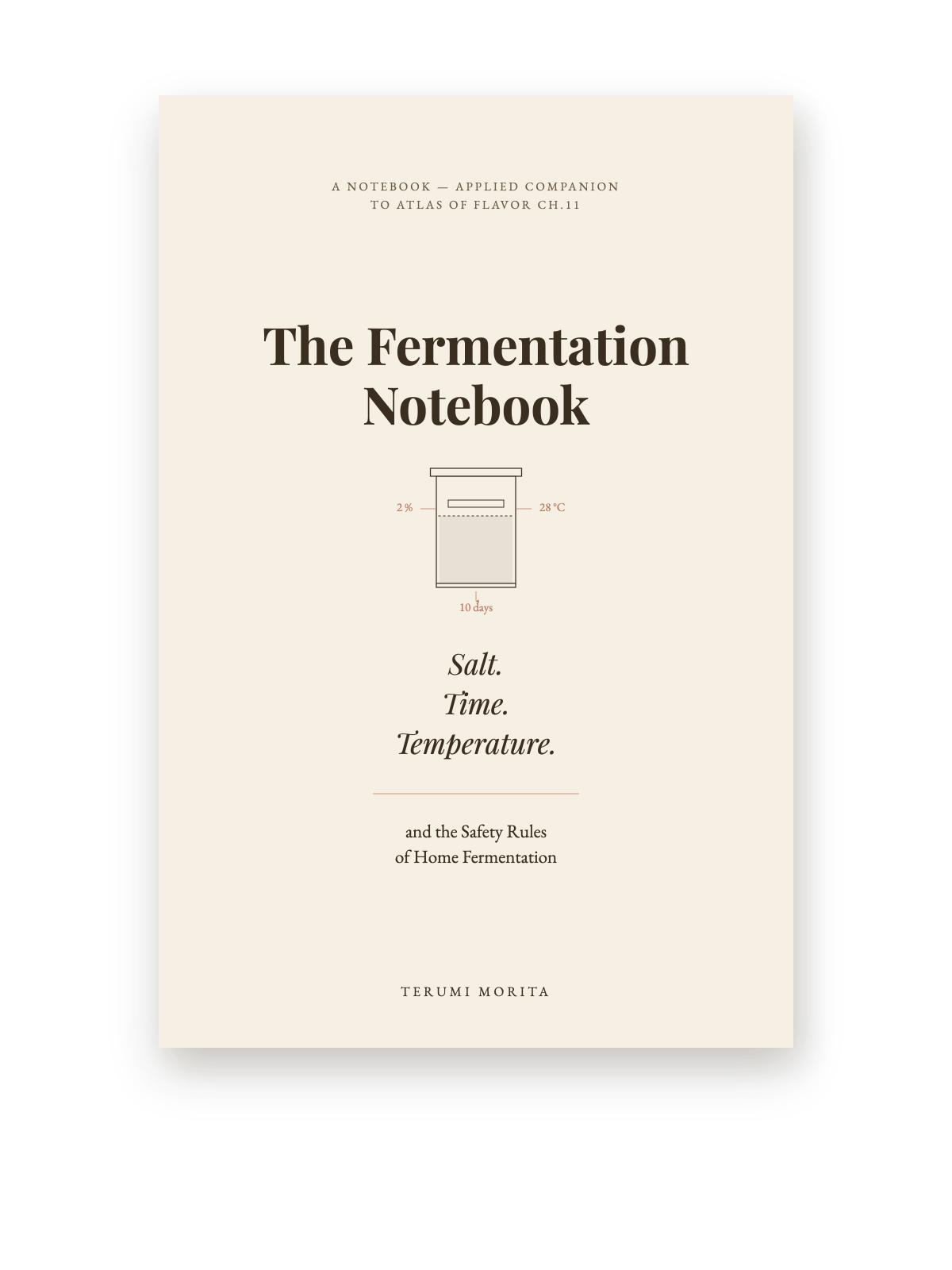
Fermentation is not a flavor pursuit.
It is environment design. Every important decision is made before the ferment begins.
The cook does not choose which bacteria win the cabbage by tasting and adjusting along the way. By the time taste is meaningful, the population has already been decided — by the salt percentage, the temperature of the room, the size and shape of the jar, and whether the cook will remember to check on it tomorrow.
This Notebook is an operating manual for the small ecosystems a cook chooses to start. It is also a safety document. Of all the cooking systems a home cook can pursue, fermentation has the longest list of things that can go badly wrong if the cook ignores certain rules. Each rule is stated in one sentence, followed by the reason, followed by the operational test.
It makes no health claim. It teaches ratios in grams, temperature windows in °C, day-by-day observation, and the discard-first frame that keeps the practice safe over years.
Three pages, from the pages that decide
A page from Chapter 2 (the Safety Doctrine that Chapters 3–6 cite by label), a page from Rule 1 (why colored mold is a discard signal, not a scrape-and-continue signal), and a page from Chapter 5 (the failure-and-recovery reference).
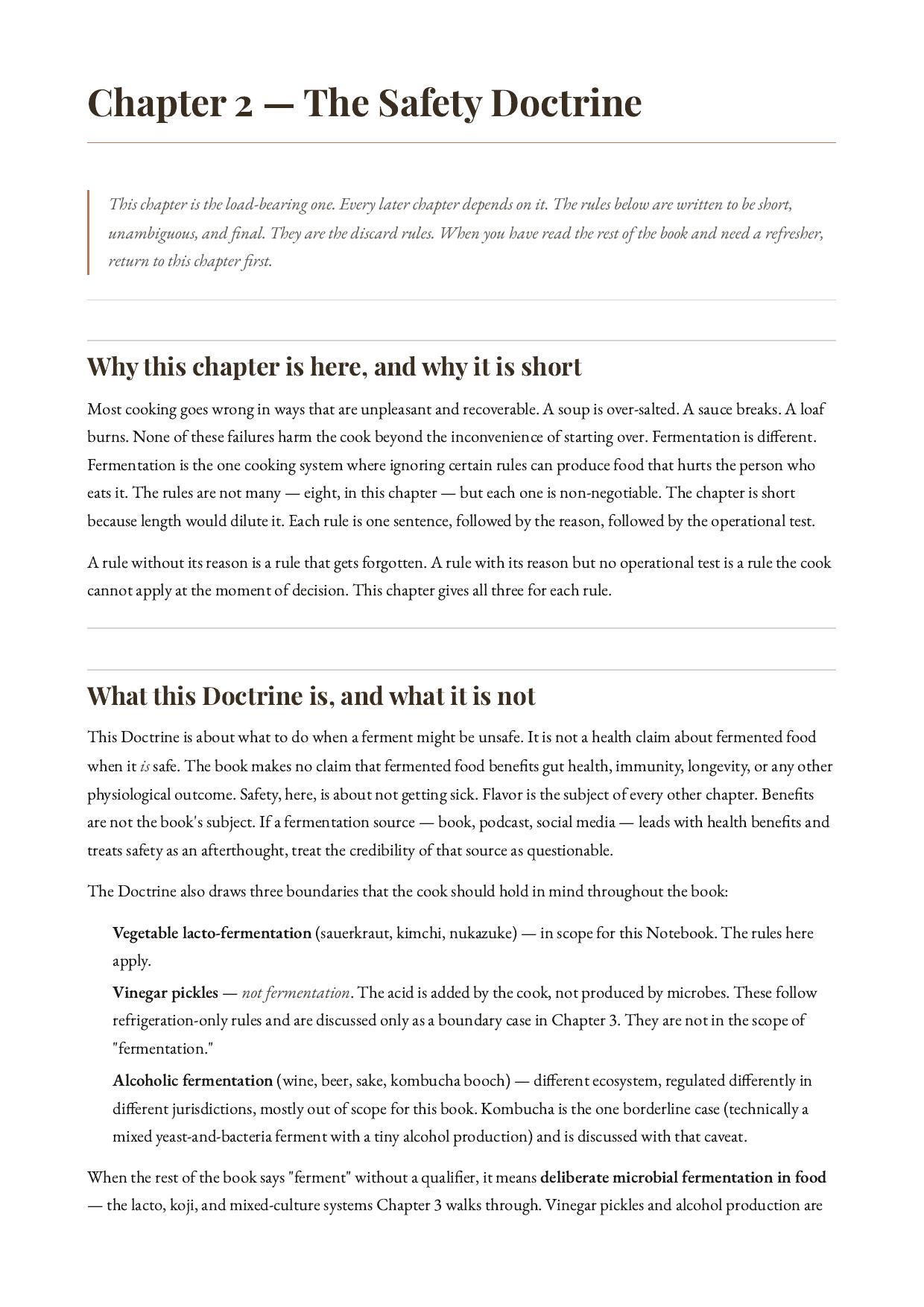 Chapter 2 · The Safety Doctrine
The load-bearing chapter. Every later chapter cites §SD-1 through §SD-8 by label.
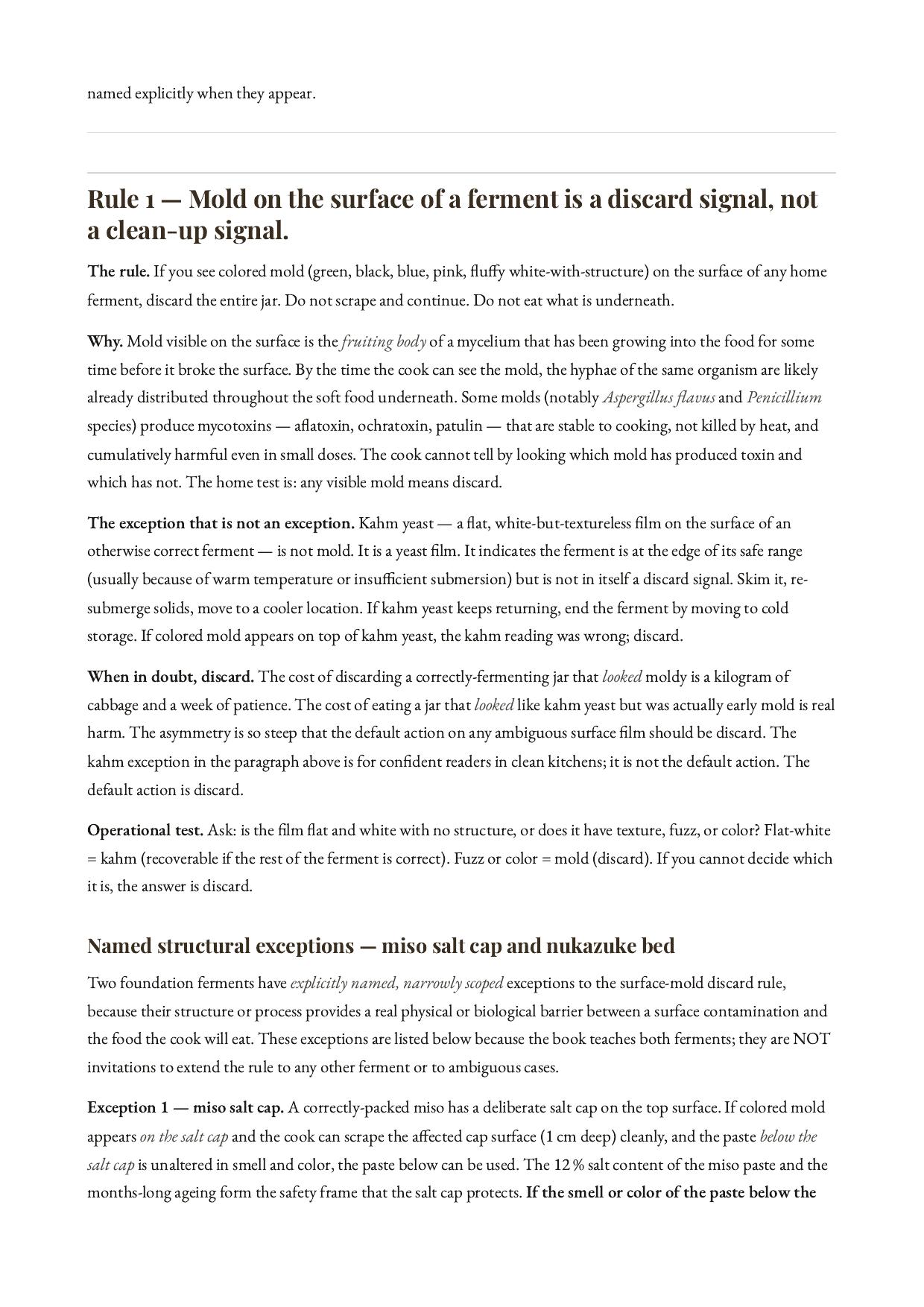 §SD-1 · Discard, not clean-up
Colored mold on the surface is a discard signal, not a scrape-and-continue one.
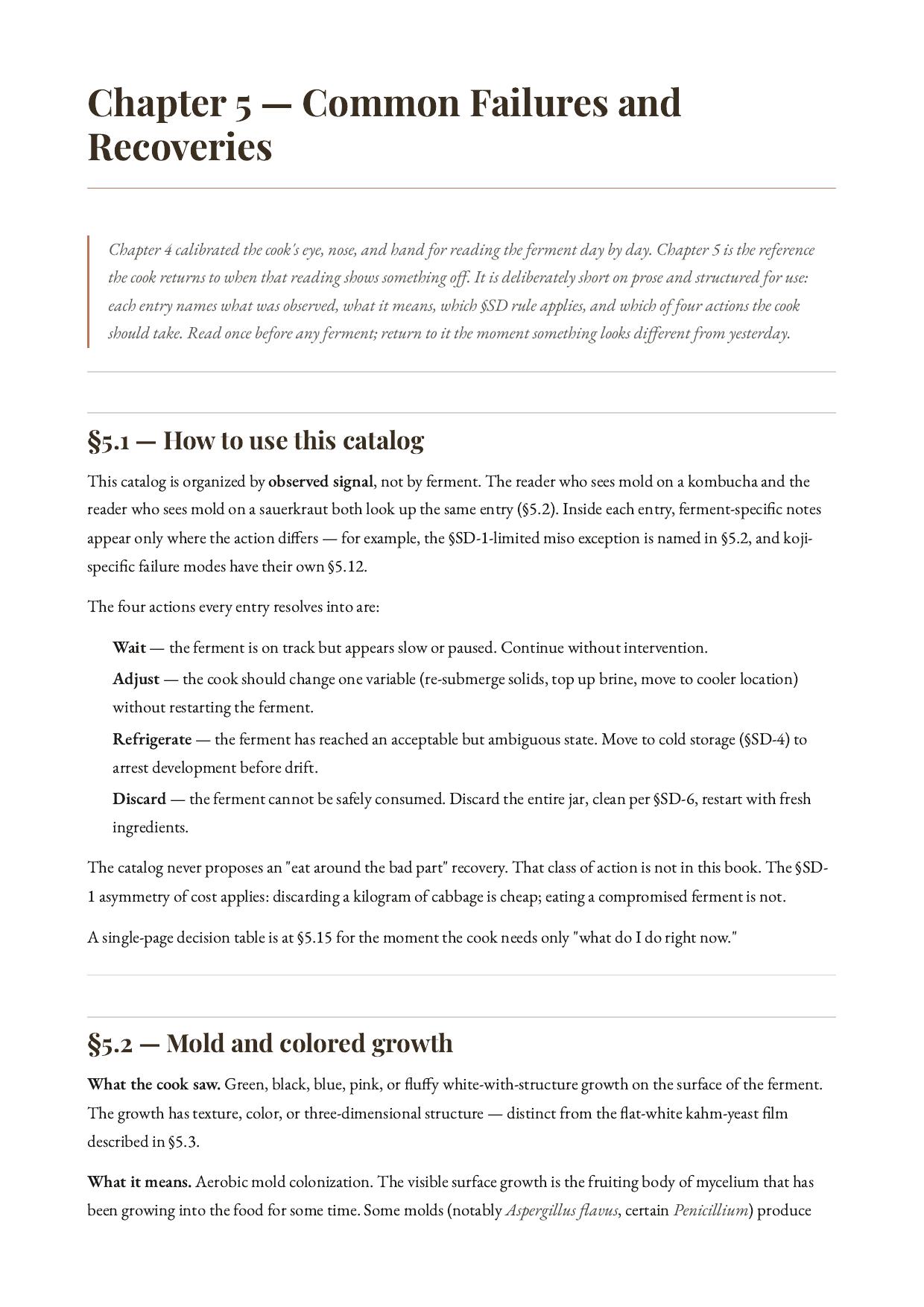 Chapter 5 · Common Failures and Recoveries
Every entry: what was observed, what it means, which §SD rule applies, and which of four actions.
Full print preview available in the browser · open preview →
Six Foundation Ferments
The six that span every axis fermentation offers — salt, koji-enzymatic, patient, boundary case, alcohol-adjacent, living relationship. Learn these and any other ferment becomes readable in the same frame.
- Microbial + saltSauerkraut
- Salt
- 2.0 %
- Temp
- 18–22 °C
- Time
- 10–14 days
Sulfur smell within 48 hours — salt below 1.5 % or temperature above 28 °C.
- Microbial (enzymatic)Shio-koji
- Salt
- 11.1 %
- Temp
- 22–35 °C · opt 28–30 °C
- Time
- 7–10 days
Pink or grey discoloration — exposure above 35 °C, Bacillus contamination.
- Microbial (enzymatic) + patientMiso
- Salt
- 12 %
- Temp
- 15–25 °C ambient
- Time
- 6–24 months
Ammonia smell — kitchen exceeded 30 °C for an extended period.
- Boundary case — NOT fermentationVinegar pickle
- Salt
- n/a
- Temp
- 0–4 °C · always cold
- Time
- 24 h – 2 weeks
Cloudy brine or off-smell — jar was left at room temperature.
- Microbial + acid + (small) alcoholKombucha
- Salt
- 0 % salt
- Temp
- 22–26 °C
- Time
- 7–14 days
Mold on SCOBY — starter liquid insufficient (< 10 %) or SCOBY compromised.
- Microbial + salt + relationship (§SD-7)Nukazuke
- Salt
- 7–10 % bed
- Temp
- 15–22 °C ambient
- Time
- Daily · open-ended
Off-smell after two weeks unstirred — the bed is compromised (§SD-7).
The same six, at a glance
Salt percentage, working temperature (°C), active time, and the first signal to discard — for the six foundation ferments. Numbers, not intuition; food-safety and technique, no health claims.
| Ferment | Salt | Temperature | Time | First signal to discard |
|---|---|---|---|---|
| Sauerkraut | 2.0 % | 18–22 °C | 10–14 days | Sulfur smell within 48 hours — salt below 1.5 % or temperature above 28 °C. |
| Shio-koji | 11.1 % | 22–35 °C · opt 28–30 °C | 7–10 days | Pink or grey discoloration — exposure above 35 °C, Bacillus contamination. |
| Miso | 12 % | 15–25 °C ambient | 6–24 months | Ammonia smell — kitchen exceeded 30 °C for an extended period. |
| Vinegar pickle | n/a | 0–4 °C · always cold | 24 h – 2 weeks | Cloudy brine or off-smell — jar was left at room temperature. |
| Kombucha | 0 % salt | 22–26 °C | 7–14 days | Mold on SCOBY — starter liquid insufficient (< 10 %) or SCOBY compromised. |
| Nukazuke | 7–10 % bed | 15–22 °C ambient | Daily · open-ended | Off-smell after two weeks unstirred — the bed is compromised (§SD-7). |
Temperature quick-reference
| Ferment | Working | Upper risk |
|---|---|---|
| Vegetable lacto-ferment | 18–22 °C | > 28 °C |
| Shio-koji activation | 25–28 °C | > 35 °C · §SD-3 |
| Kombucha | 22–26 °C | > 28 °C |
The full table covers ten ferments. Koji at 28 °C is at optimum; sauerkraut at 28 °C is at the failure edge — the two windows are not interchangeable (§SD-3).
Mold and colored growth
- Observed
- Colored mold on the surface (green, black, blue, pink, fuzzy)
- Rule
- §SD-1
- Action
- Discard the entire jar. Do not scrape and continue. Wash vessel and tools per §SD-6.
What the book teaches
- IntroWhy fermentation is environment design, not flavor
The three variables the cook sets before the ferment begins.
- Ch. 1Salt, Time, Temperature
The three variables that decide most of what happens in the jar. Ratios in grams. Temperature windows in °C. Time as the depth variable.
- Ch. 2The Safety Doctrine
Eight non-negotiable rules — §SD-1 through §SD-8 — that Ch. 3–6 cite by label. Discard-first, mold, botulism boundary, koji temperature, submersion, cross-contamination, nukazuke daily-stir, salt-floor.
- Ch. 3Six Foundation Ferments
Sauerkraut · Shio-koji · Miso · Vinegar pickle (boundary) · Kombucha · Nukazuke — grams, temperature windows, day-by-day observation, failure modes, recovery rules.
- Ch. 4Reading the Ferment
Six channels: smell, surface, texture, brine, temperature, decision dates. The observation log template.
- Ch. 5Common Failures and Recoveries
15 sections + a wait / adjust / refrigerate / discard decision table. Every entry cites the §SD rule that applies.
- Ch. 6Living Relationships
Daily / weekly / long / absence rhythms. Discard as maintenance, not failure. Passing a culture forward.
- AppendixTools · Ratios · Glossary · Sources
Printable observation log + decision table. Ratio and temperature quick-reference. Safety source notes (NCHFP, OSU Extension, FDA 21 CFR 114, USDA).
The full manuscript is 79 pages EN and 82 pages JA, A4 PDF, designed to be readable on screen and printable at the kitchen counter.
View print preview →Preview is a full-length print-styled render of the manuscript for browser reading.
Read next
The foundational essay that positions fermentation as a cooking system — four axes: salt, acid, dehydration, microbes. Free PDF · 8,398 EN words.
The applied companion for the six French mother sauces. Ratios, temperature windows, failure modes. Same discipline as this book, different subject.
This Notebook makes no health claim about fermented food. It does not claim benefit to gut health, immunity, longevity, or any other physiological outcome. It is not a defence of wild fermentation; every ratio in the book is a number, not a feeling.
Payment · Live purchase via Stripe. Instant email delivery with signed download links for both PDFs (7-day expiry). Digital products are non-refundable once downloaded; write to support@terumimorita.com if the download fails.
Common questions
- What will I learn from The Fermentation Notebook?
- How to decide — with numbers, not intuition — whether a ferment should keep waiting, be adjusted, refrigerated, or discarded. It works through six foundation ferments with exact salt percentages, temperature windows in °C, and timing, plus the failure patterns that tell you what went wrong and what to do next.
- Can I use it if I've never fermented before?
- Yes. It is written as a decision manual: every ratio is a specific number and every step names what to look for, so a first-time fermenter can follow it without prior experience. It needs no special equipment beyond a jar and a kitchen scale.
- What format is it — is it a PDF?
- Yes. It is a PDF eBook (about 79 pages in English, 82 in Japanese), delivered by email as an instant download after purchase — both the English and Japanese editions. There is no physical edition.
- Can I read it on my phone?
- Yes. It is a standard PDF, so it opens on a phone, tablet, or computer, and prints cleanly on A4 if you prefer paper. You keep the file — no app or account is required to open it.
- Does it cover safe fermentation?
- Yes — food safety is the spine of the book. It gives the discard rules, salt percentages, and temperature windows that keep home fermentation safe, including when to throw a batch out. It is a food-safety-and-technique manual, and it makes no health claims about fermented food.
- How is it different from a regular cookbook?
- A cookbook gives you recipes to follow; the Notebook gives you the decision framework behind them. Instead of one fixed recipe per ferment, it teaches the three variables — salt, time, and temperature — so you can read your own jar and adjust, rather than hoping a single recipe works in your kitchen.