
Yoshokuya Omurice
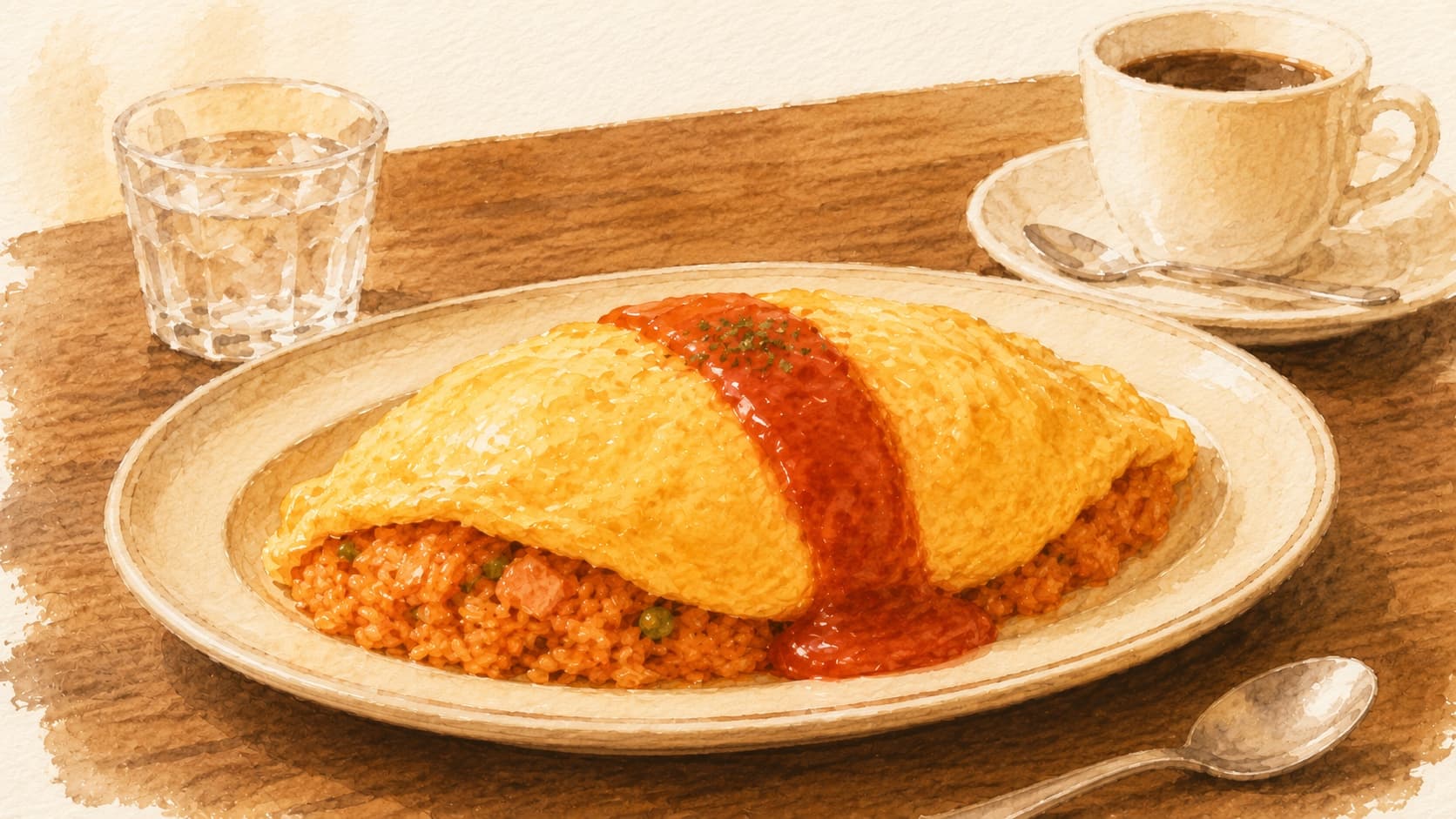
Butter-rich chicken rice, soft custardy eggs, ketchup. Build the three layers separately and stack them at the end — 'that taste' is not made by mixing, but by leaving the boundaries between layers intact.
Contents (8 sections)▾
Ingredients
- Warm cooked rice, 2 rice-bowls' worth (about 400 g; if using day-old cold rice, reheat in the pan first)
- Chicken thigh, 100 g, cut into 1 cm cubes
- Onion, 1/4, finely chopped
- Mushrooms, 4, sliced thin (canned sliced mushrooms also fine)
- Ketchup, 4 tbsp + 2 tbsp for finishing
- Butter, 30 g (20 g for the chicken rice + 10 g for the eggs, kept separate)
- Eggs, 4 (2 per serving)
- Milk, 2 tbsp
- Salt and white pepper, to taste
- Neutral oil, a little
Steps
Make the chicken rice. Heat a skillet over medium heat and melt 20 g of butter. Sauté the onion for 2 minutes until translucent, add the chicken and cook until the thickest cubes reach 74 °C / 165 °F on an instant-read thermometer (no longer pink), about 3 minutes — colour and time are cues, not the safety test; then add the mushrooms and toss briefly. Push everything to one side, drop 4 tbsp of ketchup into the empty space, and fry the ketchup alone for 2 minutes — until the color turns to a dark red-brown and the sharp acidic note dissipates. This is the same principle as kissaten-style Naporitan: ketchup is treated as an ingredient to be cooked, not as a finishing sauce.
Mix the cooked-down ketchup back into the chicken and vegetables, then add the warm rice. Using a wooden spoon, cut-and-fold the rice so that every grain gets a thin coating of ketchup — do not mash, do not knead. Adjust with salt and white pepper. Properly made chicken rice has independent grains and no gummy clumping. Mound it into an oval shape on the serving plate.
Prepare the eggs, one portion (2 eggs) at a time. Crack 2 eggs into a bowl, add 1 tbsp of milk and a pinch of salt, and break up the whites with chopsticks. Do not whisk to full homogeneity — leave a faint marbling between yolk and white.
Cook the eggs. Heat a 20 cm pan over medium heat and melt 5 g of butter. As soon as the butter begins to bubble, pour in the egg mixture all at once and stir with chopsticks in 5 large swirls — about 5 seconds. How you finish depends on the egg: with an egg pasteurized in the shell (treated through to the contents) or a pasteurized egg product, you may take the pan off the heat while the surface is still half-set and flowing in the center — the classic fuwa-toro finish, where a soft center is the point. With an ordinary, non-pasteurized egg, keep it on the heat until the egg is fully set throughout (no flowing center) before removing. High-risk diners (pregnancy, immunocompromised, very young or old) should use a pasteurized egg or cook it fully set. The flowing texture is a culinary choice; carryover heat does not make an undercooked egg safe.
Drape the egg over the chicken rice. Slide the egg out of the pan onto the rice with the softer side facing up. Adjust the shape quickly. Finish with 1 tbsp of ketchup drawn in an S-curve across the surface. For the open-egg 'toro-fuwa' style — only with the pasteurized soft finish from the previous step — slit the egg lengthwise with a knife now so the soft custard inside flows down over the rice.
Tools you'll want
Where this recipe sits
The second entry in the "Recreate the Logic" (再現レシピノート) series. The point is not full reproduction, but breaking flavor into its elements — sweet, salt, acid, fat, aroma, texture — and reassembling them in a home pan. These notes are a working memo for that reassembly.
Yoshokuya omurice is the omelette-and-rice dish you find in a Japanese "yoshokuya" — a Western-style restaurant translated into a Japanese register. The French omelette is, in some sense, only about eggs. The Japanese omurice converts that idea so eggs become a container for rice. This note unpacks why the layers matter more than the technique.
Why "that taste" works
The yoshokuya omurice looks simple on paper too. Wrap chicken rice in eggs. But follow the obvious steps and you do not reach that taste. As with kissaten Naporitan, what blocks the home cook is not information — it is order and temperature.
Structural decomposition
Reading that taste through six elements:
- Sweetness — sugar in the ketchup, sweetness drawn out of sautéed onion, and the slight sweetness of the eggs themselves (which is why milk goes in). Three layers of sweet.
- Salt — chicken, ketchup salt, finishing salt, the residual saltiness of butter.
- Acid — fry off the ketchup's acid inside the chicken rice, then place fresh ketchup only on top at the finish. A two-layer structure of cooked acid and raw acid.
- Fat — butter. Split between the chicken rice and the eggs, for a total of 30 g. This is what builds the richness.
- Aroma — Maillard aroma from the fried ketchup on the chicken-rice side, plus the just-before-browning butter aroma on the egg side.
- Texture — independent grains of rice, half-set custardy egg, a viscous touch of ketchup on top. Three distinct textures that should still be distinguishable on the tongue.
The break from traditional Italian and French omelettes is the design principle: keep the layers intact. The chicken rice and eggs are not mixed. They are stacked. The ketchup goes on top only at the end. That arrangement lets each flavor register in sequence on the palate.
Safety note. This omurice is finished deliberately soft — the center of the egg is left flowing and never fully set. That soft, custardy look (and the brief carry-over heat on the plate) is not by itself proof the egg is safe: the method has no validated Salmonella kill step. Because the egg is beaten, you can keep the soft-custard finish with pasteurized egg — pasteurized in the shell, or a pasteurized liquid egg product; ordinary freshness, or a "raw-eating" (生食用) egg label, is not the same as pasteurized through the contents. High-risk diners (pregnancy, immunocompromised, very young or old) should use pasteurized egg, or cook the egg fully through — the texture changes, but the layered idea still reads.
Common mistakes
Mushy, gummy chicken rice. Target: Warm rice (reheat cold rice first), folded in the pan with a "cutting" motion, until each grain is independent. Why it matters: Cold rice or over-mixing crushes the grains, lets ketchup moisture soak in, and gives you a sticky paste. Each grain should remain independent with the ketchup as a thin surface coating — that is the structure of proper chicken rice. What to do: Use freshly cooked rice or rice reheated in the microwave. Mix it in the pan with a cutting motion; do not turn it in a bowl. Workarounds:
- Only have leftover rice — reheat it in the pan for 2 minutes first and let the surface moisture evaporate.
Overcooked eggs. Target: Take the pan off the heat while the center is still flowing. Residual heat will carry it forward another 1.5 to 2 °C on the plate. Why it matters: This is the most common failure mode. You hesitate, check whether the eggs are "done," and during that hesitation they set hard. Carry-over cooking continues on the plate, so the moment to stop the pan comes earlier than instinct suggests. What to do: To the plate while it is still moving. Hesitation is fatal. Workarounds:
- For an even more flowing finish, pull it earlier — while the surface in the pan still looks wet.
Eggs tear. Target: Properly melt the 5 g of butter; once the egg goes in, stir with chopsticks for only 5 seconds. Why it matters: Too little butter and the eggs grip the pan and tear. Too much stirring and the egg's structure breaks down, making tears more likely. What to do: Fully melt the butter (until it foams), pour the egg in, gently stir 5 seconds, then leave it alone. Workarounds:
- Non-stick pan — you can use slightly less butter, but the traditional butter aroma will be quieter.
Not finishing with ketchup on top. Target: The ketchup inside the chicken rice (cooked, deepened) and the ketchup on top of the eggs (raw, sharp) — both are required to make the layered effect work. Why it matters: The cooked ketchup is round and deep; the raw ketchup is bright and acidic. Both have to be present for the palate to register the layers in sequence. Mixed together, the flavors flatten. What to do: Fry the ketchup into the chicken rice (firmly), then drizzle raw ketchup on top at the end. Workarounds:
- For the demi-glace school — finish with demi-glace sauce instead of ketchup; the older classical yoshokuya register.
Too much milk in the eggs, chasing creaminess. Target: No more than 1 tbsp of milk per 2 eggs. Why it matters: Too much milk and the eggs tear easily and the flavor goes thin. The creamy effect only needs a small amount of milk. What to do: Measure. Do not exceed 1 tbsp. Workarounds:
- No milk at all — the older yoshokuya style; less creamy, but the unadulterated egg character comes through.
Pan temperature too low when mixing the chicken rice. Target: Keep the pan at strong medium heat and work with warm rice and hot ketchup. Why it matters: At low heat the ketchup's moisture does not evaporate, and the rice grains never become independent. The aim is to drive moisture off while you fold. What to do: Heat the pan first, then add the rice. Listen for the hissing sound of moisture flashing off as you mix. Workarounds:
- Sauté the chicken and onion long enough that the pan is fully hot before the rice goes in.
What to look for
- After frying the ketchup: The color turns a dark red-brown, the surface dries, and oil begins to separate. Same cue as kissaten Naporitan.
- Chicken rice finished: Grains are independent, ketchup forms a thin even coating on each one. No gummy clumping.
- As the eggs cook: Butter foams, and just before the edges go brown, the egg mixture goes in. The egg begins setting within 5 seconds.
- When to pull the eggs: The surface in the center is still "moving" — still flowing slightly. Stop here.
- At plating: The egg surface is smooth and glossy, with no wrinkles. When opened down the middle with a knife, soft-custard liquid flows out.
Author's view
Omurice is a canonical example of postwar Japan's "translation cuisine." Where the French omelette is a dish about eggs alone — where the quality of the egg and the technique decide everything — Japanese omurice uses the egg as a vessel for rice. The center is rice — the literal center of a Japanese meal — and ketchup and butter are added to give it a yoshoku register. This is not a translation of an egg dish; it is a translation of the very concept of Western food.
When yoshokuya kitchens in Yokohama, Ginza, and Tokyo built this dish in the early 1900s, they did not decide to "feed French cooking to Japanese diners." They decided to "fit yoshoku into the logic of a Japanese meal." That is why the center of an omurice must be rice. Eggs alone are not, in this register, a meal. That was their intuition.
The fuwa-toro omurice (soft-custard eggs draped over the top of the rice) is a 1990s-onward evolution; before that, the standard was the classic wrapped-omurice with thin-cooked eggs fully enclosing the rice. Both versions are correct, and both preserve the same underlying idea — keep the layers intact.
Test notes
I compared three doneness levels for the eggs:
- Properly half-set (5 seconds of stirring): smooth surface, flowing center. Ideal.
- More flowing (3 seconds): hard to handle, the shape collapses on transfer. Plating becomes a skill question.
- More set (10 seconds): the "soft-custard" quality is lost; the result is closer to an ordinary thin-egg omelette.
Ketchup-frying time (for the chicken rice):
- 1 minute: acid still present, the ketchup separates from the rice.
- 2 to 3 minutes: color deepens, ketchup integrates into the rice. Ideal.
- 5 minutes: bitterness emerges. Too far.
Butter quantity:
- 20 g / 10 g (total 30 g): balance between the chicken rice's richness and the egg's flavor.
- 10 g / 5 g (total 15 g): too light to reach yoshokuya density.
- 30 g / 20 g (total 50 g): too heavy; crosses out of the home-cooking register.
Related terms
- Maillard reaction — the source of the fried-ketchup and chicken-rice aroma
- Caramelization — the browning of the sugars in ketchup
- Protein denaturation — the phenomenon of eggs setting with heat; the science behind half-set custard
"Recreate the Logic," entry two. Next up: old-school hayashi rice.
Get the essays in your inbox — free
Weekly notes on flavor, fermentation, and food history — the writing behind the Atlas of Flavor. No spam; unsubscribe anytime.