
Old-School Hayashi Rice
Brown the beef hard, build a brown roux from butter and flour, deglaze with red wine, marry the elements late. The dish lives or dies on three pivots: roux color, beef tenderness, and keeping the rice and sauce as distinct layers.
Contents (8 sections)▾
Ingredients
- Beef (sirloin or ribeye, sliced 3-4 mm thick), 250 g
- Onion, 1 medium, sliced 5 mm thick along the grain
- Button mushrooms, 6, sliced 4-5 mm thick (canned sliced mushrooms also workable — same yoshoku register as Naporitan)
- Butter, 30 g (15 g for browning the beef, 15 g for the roux)
- All-purpose flour, 2 tbsp (about 18 g) — for the brown roux
- Red wine, 60 ml (any dry red — small bottle leftover is fine)
- Beef stock (homemade or low-sodium store-bought), 300 ml
- Whole peeled tomatoes (canned), 100 g, crushed by hand
- Tomato ketchup, 1 tbsp
- Worcestershire sauce, 1 tbsp
- Soy sauce, 1 tsp (the salt anchor — Japanese hand on a French sauce)
- Bay leaf, 1
- Salt, to taste
- Black pepper, to taste
- Neutral oil, 1 tsp (for the initial beef sear)
- Warm cooked rice, 2 rice-bowls' worth (about 400 g, plated alongside, not under the sauce)
Steps
Salt and pepper the beef lightly. Heat a wide heavy skillet over medium-high heat with 1 tsp neutral oil and 5 g of butter. When the butter foams and just starts to brown, sear the beef in a single layer — about 30 seconds per side. The goal is hard surface browning, not cooking through. Remove the beef to a plate (it should still be pink at the center) and reserve. Do not wash the pan.
Lower the heat to medium. Add another 10 g of butter to the same pan, then the onions. Cook the onions slowly — 10 to 12 minutes — until they collapse and the edges turn a light amber. Add the mushrooms and cook for 2 more minutes. The pan should now carry the brown fond from the beef plus the sweetness drawn out of the onions. This is the base of the sauce.
Push the onion-mushroom mixture to the side. In the cleared center, add the remaining 15 g of butter and let it melt. Sprinkle the flour over the butter and stir continuously with a wooden spoon, keeping the roux isolated from the vegetables. Cook the roux until it shifts from pale to a hazelnut brown — about 4 to 6 minutes. The smell will move from raw flour to toasted bread crust to roasted nut. Stop just before it goes dark chocolate; that is the limit.
Deglaze the pan with the red wine. Stir to dissolve the roux into the wine — the mixture will thicken into a paste almost immediately. Add the beef stock in two pours, stirring smooth between each. Add the crushed tomatoes, ketchup, Worcestershire sauce, soy sauce, and bay leaf. Bring to a gentle simmer, stirring to integrate the onions and mushrooms back in.
Simmer uncovered for 15 to 20 minutes, stirring occasionally, until the sauce coats the back of a spoon. The color should deepen to a glossy mahogany. Taste — adjust salt and pepper. The ketchup's raw acidity should be gone, but the sauce should not taste flat; the Worcestershire and soy carry it forward.
Return the seared beef to the pan in the last 1 to 2 minutes — only long enough to warm it through. The beef should finish medium and stay tender. Cooking the beef into the stew is the most common failure point; treat it instead as something that joins the sauce at the end. Discard the bay leaf.
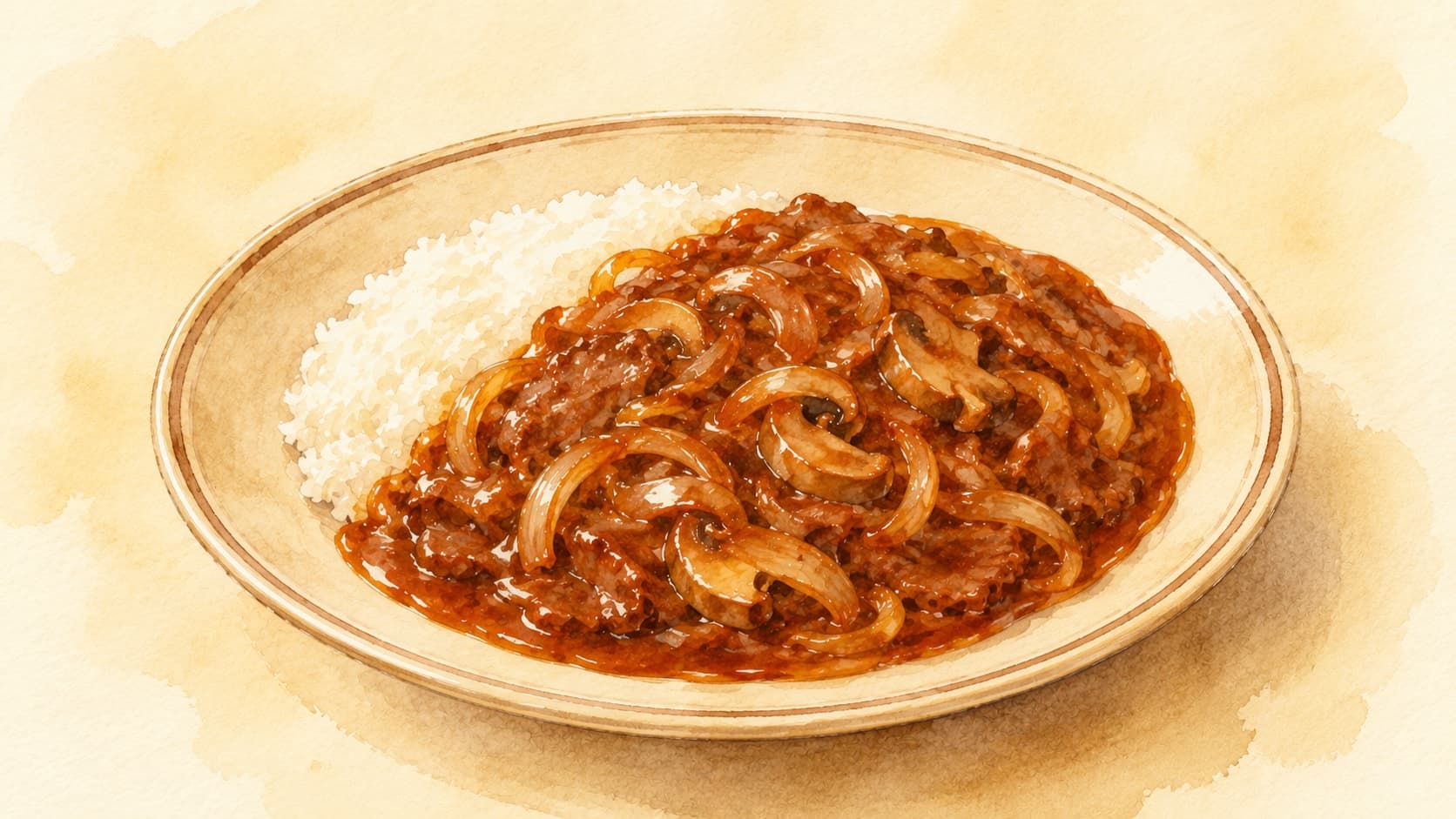
Plate. Mound the warm rice on one side of an oval plate; pour the sauce with beef and mushrooms over the other side, leaving a visible boundary between rice and sauce. This is the structural choice of yoshoku — rice and sauce as distinct layers, mixed only on the eater's spoon.
Tools you'll want
Where this recipe sits
The third entry in the "Recreate the Logic" (再現レシピノート) series. The point is not full reproduction, but breaking flavor into its elements — sweet, salt, acid, fat, aroma, texture — and reassembling them in a home pan. These notes are a working memo for that reassembly.
Hayashi rice is one of the oldest dishes in Japan's yoshoku canon. It looks, on a plate, like a Western beef stew over rice. It is not. It is a Meiji-era translation: a French brown-sauce technique folded into the rice-meal logic of the Japanese table. Writing a recipe that reaches that taste — neither a generic beef stew nor a modern roux-from-a-cube cheat — is the work of this note.
Why "that taste" works
On paper, hayashi rice looks simple. Brown beef, brown a roux, add stock and tomato, simmer. Follow the obvious version and you get something thin and unfocused — closer to a school-cafeteria beef stew than to the deep, glossy hayashi of an old yoshokuya. Why not?
The answer is in the roux and in how the beef joins the sauce. What blocks the home cook is not a missing ingredient list; it is a question of roux color and timing. The beef must brown hard, leave, and come back at the end. The flour must cook into the butter long enough to lose the raw-flour edge and short enough to keep its thickening power.
Structural decomposition
If you break that taste into six elements, the structure becomes visible.
- Sweetness — the sugar caramelized out of slow-cooked onion, plus the gentle sweetness inside the tomato and the trace sugars in ketchup. You need all three; onion alone reads as French onion soup, tomato alone reads as Italian.
- Salt — four layers: salt seared into the beef, salt from the Worcestershire sauce, the soy sauce as the Japanese hand on a Western frame, and a final adjustment with table salt at the end.
- Acid — red wine reduced down to its mineral edge, plus the tomato's cooked acid. The brightness must survive the simmer. This is what stops the sauce from going muddy.
- Fat — butter. Not olive oil, not neutral oil alone. The dairy fat in the butter binds the roux and emulsifies into the sauce, giving the round, slightly heavy mouth-feel that defines yoshoku.
- Aroma — Maillard from the hard beef sear, caramelization from the slow onion, the toasted-nut note of brown roux. Three browning reactions stacked on each other.
- Texture — sliced beef tender, mushrooms with a slight bite, sauce glossy and pourable, rice grains independent on the other side of the plate. Four textures that should not collapse into one.
The break from a Western beef Bourguignon is the design principle: the rice is plated beside the sauce, not under it. The rice does not become part of the sauce; the rice waits beside it. Only on the spoon do they meet. This is the yoshoku move — Western technique landing on Japanese plating logic.
Common mistakes
Skipping the brown roux, thickening with a stock cube or store-bought demi-glace alone. Target: A brown roux (butter + flour cooked to hazelnut color) built fresh in the pan after the onions cook down. Why it matters: A flour slurry stirred into stock thickens but stays raw-tasting. A store-bought demi-glace concentrate runs thin and tastes commercial. Brown roux is what gives hayashi its body: butterfat carrying browned flour proteins, which thicken the sauce and add a toasted-nut depth at the same time. The dish's structural backbone is here. What to do: Push the cooked onions to the side, melt 15 g of butter in the cleared space, sprinkle the flour evenly over the butter, and stir for 4 to 6 minutes until the roux smells like roasted hazelnut and looks like milk chocolate. Workarounds:
- No time for fresh roux — use a Japanese-market "hayashi roux brick" (S&B, House) as the thickener but add 10 g of cold butter at the very end to restore the dairy fat the brick has lost in shelf-storage.
Cooking the beef into the stew. Target: Sear hard, remove, return in the final minute. The beef should finish medium and stay tender. Why it matters: Thin-sliced beef simmered in sauce for 20 minutes goes tough and gray. Hayashi is not a long-braise like beef Bourguignon — the sauce builds without the beef. The beef comes back at the end as a quick warm-through, so it stays tender. What to do: Sear 30 seconds per side over medium-high heat, remove to a plate, build the entire sauce, then return the beef in the last 1 to 2 minutes of simmering. Workarounds:
- Using chuck or stew meat (tougher cut) — cube it small and simmer for 1 hour in the sauce. Different dish entirely; closer to a true beef stew.
Onion cooked too fast. Target: 10 to 12 minutes of slow medium-heat cooking until the onions collapse and the edges go amber. Why it matters: Onion is one of the three sweetness layers. Rushed onion is grassy and sharp; slow onion gives up its sugars and turns the sauce sweet from the inside. This is the same principle as Naporitan — kissaten ketchup needs the onion's sweetness, not just its own sugar. What to do: Slice the onion 5 mm thick along the grain (against-the-grain collapses too fast). Cook over medium heat with patience. Listen for the sizzle dropping to a soft hiss as the water cooks out. Workarounds:
- Need to shortcut — caramelize the onions separately in advance and freeze in 50 g portions; pull one out for the dish.
Using only canned demi-glace, with no fresh aromatic build. Target: A working sauce built from brown roux + beef stock + red wine + crushed tomato + Worcestershire + soy, not a single jar of concentrate. Why it matters: True French demi-glace is a 24-hour reduction nobody makes at home. A canned demi-glace is a useful base, but used alone it tastes thin and shelf-stable. The dish needs a fresh aromatic build over it: red wine for the mineral edge, crushed tomato for fresh acidity, Worcestershire for the spice-and-vinegar undertone, soy as the Japanese anchor. What to do: Build the roux in the pan, deglaze with red wine, pour in stock, add the rest. If you must lean on a canned demi-glace, use it as part of the stock liquid (mix 100 ml demi-glace with 200 ml beef stock) and still build a fresh roux on top. Workarounds:
- No red wine in the kitchen — substitute 60 ml of brewed black tea + a teaspoon of balsamic vinegar; gives a similar tannin-plus-acid profile.
Wrong beef cut — chuck or pre-marinated thin-sliced "stew beef" instead of sirloin or ribeye. Target: Sirloin or ribeye, sliced 3-4 mm thick, with visible fat marbling. Why it matters: Hayashi rice's beef texture is a tender quick-sear, not a long-simmered braise. Chuck and the "stew beef" packs designed for low-and-slow cooking go tough at the temperatures hayashi runs. A small fat cap and visible marbling are what carry the beef through the quick sear and the brief warm-back-in. What to do: Sukiyaki-cut sirloin (Japanese-market thin-sliced sirloin) is the ideal. If using American supermarket sirloin, freeze it for 20 minutes and slice it yourself. Workarounds:
- Only chuck available — slow-braise it 1 hour first in part of the beef stock, then build the sauce over that braising liquid. Reaches a different but valid dish.
Plating the rice under the sauce, drowning it. Target: Rice on one side, sauce on the other, with a clear visible boundary on the plate. Why it matters: This is the structural choice of yoshoku — the rice stays independent. If the rice is buried under sauce, the grains soak up moisture and turn into porridge; the layered structure (rice as one texture, sauce as another) collapses. This is also why curry rice is plated the same way. What to do: Use an oval plate. Mound the rice on one half; pour the sauce only on the other half, letting it lap slightly against the rice. The diner mixes them on the spoon. Workarounds:
- Only round plates — same principle: rice on one half, sauce on the other; do not pour the sauce over the whole.
What to look for
- End of beef sear: deep brown spots on the slices, a sticky brown layer on the pan bottom (the fond), beef still flexible and pink at the center. That fond will lift into the sauce when the wine hits.
- Onion finish: the slices have collapsed by about two-thirds in volume, edges are light amber, the sizzle has dropped to a soft hiss. The aroma will have shifted from sharp to sweet.
- Roux color: milk-chocolate brown, smells like roasted hazelnut, no white flour visible, glossy from the butter. Push it any further and it goes bitter; pull it too early and it stays pale and pasty.
- After the wine deglaze: the roux dissolves into the wine to make a thick paste, the alcohol smell flashes off within 30 seconds, the pan smells of toasted bread. This is the structural moment of the sauce.
- Mid-simmer: the sauce has darkened to a glossy mahogany and coats the back of a wooden spoon in an even film. Drag a finger across the spoon — the trail should hold for a second before closing.
- At plating: the sauce pours smoothly without separating, the beef is just-cooked-through (pink-gone, gray-not-yet), the mushrooms still have shape, the rice on the other side of the plate stays distinct.
Author's view
Hayashi rice sits at one of the foundational moments in Japan's yoshoku canon — the Meiji opening, when Western kitchens were being translated into Japanese rice meals for the first time. Its origin is contested. The most-told story credits Yuteki Hayashi, founder of the Maruzen bookstore, who reportedly improvised a beef-and-vegetable hodgepodge over rice for visiting friends and had it stuck with his name. Other accounts trace it to a Meiji-era chef named Hayashi at the Western-style Seiyoken restaurant in Tokyo, or to a port-side bistro in Moji whose fast beef-and-ketchup rice was nicknamed hayai (fast) rice. The name "hayashi" itself has multiple readings — a person's surname, or hayashi (林) meaning a "group" of mixed ingredients. The honest answer is that no single origin story is verified.
What the accounts share is a fingerprint: a Western brown-sauce technique — demi-glace or roux-thickened gravy — folded into the rice-bowl shape of the Japanese meal. This is the same translation move that gives us Naporitan and omurice. It is not "Western food cooked in Japan." It is Japanese food built around Western structure.
This is why the roux matters so much. Strip the roux out and you get something closer to a stew. Keep it, and you keep the trace of the French technique that defined yoshoku in 1900. Cooking hayashi rice at home is, in this sense, an act of carrying forward a 120-year-old translation — not perfectly, not from scratch, but enough that the structure stays legible.
Test notes
I compared roux cook times:
- 2 minutes (pale roux): no toasted aroma, pasty mouth-feel, the sauce stayed shallow.
- 4 to 5 minutes (hazelnut roux): toasted-nut aroma comes forward, the sauce gains depth and gloss. Ideal.
- 7 to 8 minutes (dark chocolate roux): bitter notes start to dominate, the dish loses its sweetness balance.
I compared with and without red wine:
- No wine, only stock: the sauce is softer, sweeter, more "home-cook" in register. Workable but flatter.
- 60 ml red wine: mineral edge comes through, the sauce reads as having structure. The yoshokuya signature.
- 120 ml red wine: the wine starts to dominate; the sauce reads as a French wine sauce instead of yoshoku.
Butter quantity (total across the dish):
- 20 g total: too light; the sauce lacks the round mouth-feel.
- 30 g total: balanced; the roux carries depth and the sauce closes with the dairy roundness yoshoku needs.
- 50 g total: crosses into French-bistro territory; too heavy for a home meal.
Beef cut comparison:
- Chuck (sliced 3 mm): went tough at the brief warm-back-in; the dish needs a longer braise to make sense of chuck.
- Sirloin (sliced 3-4 mm): tender at the warm-through, holds shape, marbling carries flavor. Ideal.
- Ribeye (sliced 3-4 mm): richer than sirloin, slightly too fatty for a sauce-heavy dish; lands well if the sauce is leaner.
Related terms
- Maillard reaction — the source of the toasted aroma in the beef sear and the brown roux
- Caramelization — the slow browning of sugars in the onion
- Brown roux — butter plus flour cooked to color; the structural backbone of the sauce
- Emulsification — the reaction that lets butter and water bind, giving the sauce its roundness
"Recreate the Logic," entry three. Next up: undecided.
<!-- beginner-glossed v1 -->Get the essays in your inbox — free
Weekly notes on flavor, fermentation, and food history — the writing behind the Atlas of Flavor. No spam; unsubscribe anytime.