
Kissaten-Style Naporitan
Decompose the dish into sweetness, salt, acid, fat, aroma, and texture, then reassemble it in a home pan. Not al dente but soft and chewy; the ketchup must be fried so the acid burns off — this is the structure behind 'that taste.'
Contents (8 sections)▾
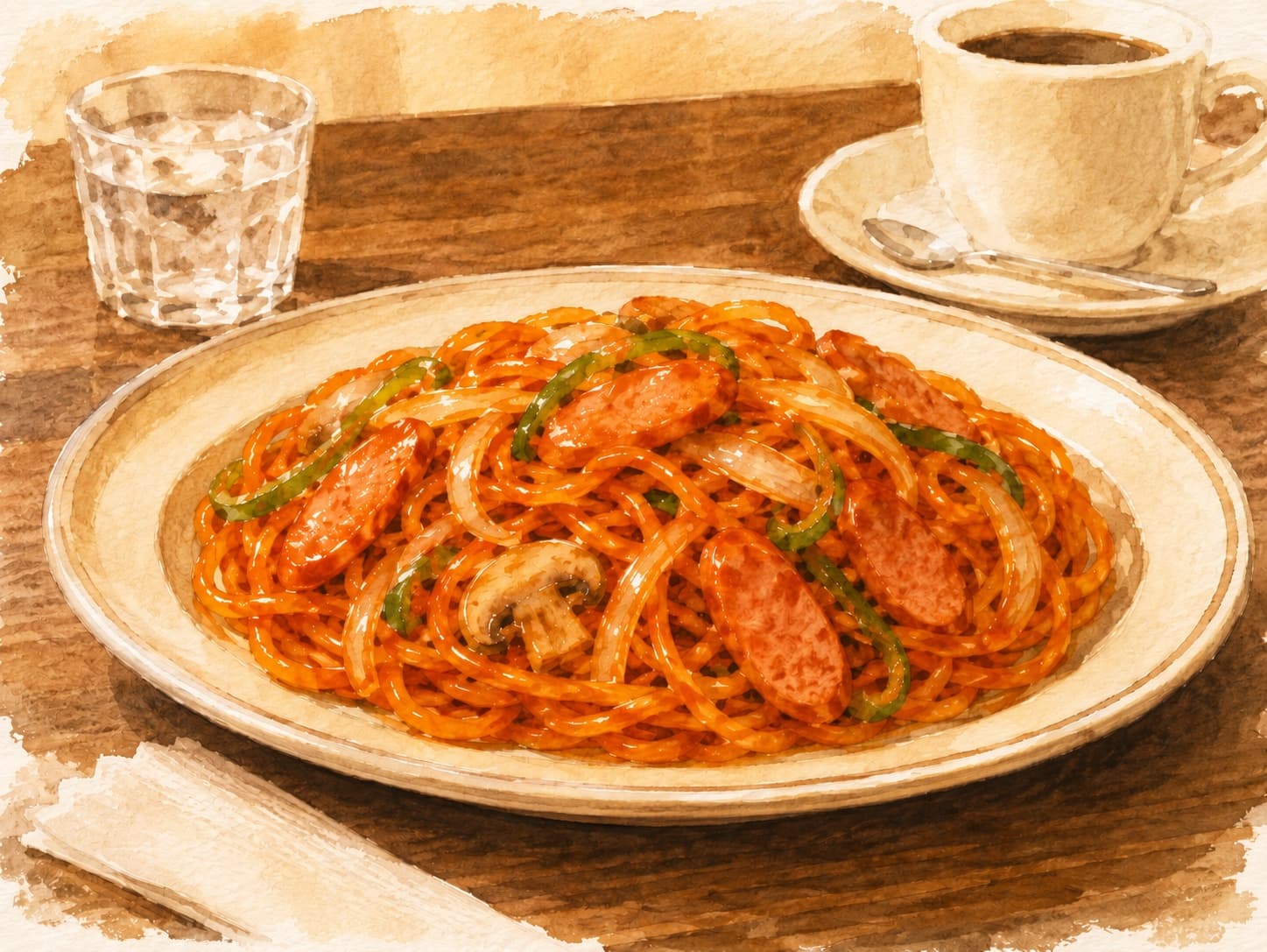
Ingredients
- Spaghetti (thick, 1.8mm or larger), 200 g
- Wiener sausages (or bacon), 4 (about 80 g), sliced diagonally
- Onion, 1/2, sliced thin against the grain
- Green peppers (piiman), 2, julienned
- Mushrooms, 4, sliced thin (canned sliced mushrooms also fine — actually canned gives a more 'authentic' yoshoku aroma)
- Ketchup, 6 tbsp (90 g — do not hesitate, more is correct)
- Butter, 20 g
- Salt, a pinch
- Black pepper, to taste
- Grated cheese (canned Parmesan), to taste
- For pre-boiling rest: olive oil or neutral oil, 1 tsp
- Tableside: Tabasco
Steps
Boil the spaghetti in salted water for 2 to 3 minutes longer than the package time. Do not aim for al dente. There should be no bite left — soft and yielding. Drain, toss with a teaspoon of oil, spread out, and let cool. If possible, refrigerate for 30 minutes or more; ideally, hold overnight. This step — called yude-oki (pre-boiled-and-rested noodles) — is the core of kissaten Naporitan texture.
Heat a skillet over medium heat and melt half the butter (10 g). Sauté the Wiener sausages, then the onion, then the green peppers in that order, until the onion turns translucent and the green pepper edges just begin to char and release their aroma. Add the mushrooms and cook for 30 seconds.
Push the ingredients to the side of the pan, and in the empty center add all 6 tbsp of ketchup. Keeping the heat at medium, fry the ketchup alone for 2 to 3 minutes. At first it is a bright red; gradually the color deepens, the sharp acidic note softens, and tomato umami and sweetness come forward. When the surface looks slightly dry and the oil starts separating around the edges, that is the cue. Skip this step — just tossing raw ketchup in at the end — and you end up with the thin, acidic taste of a school-lunchbox pasta.
Mix the sautéed ingredients back into the fried ketchup and add the remaining butter (10 g). Add the cooled, rested spaghetti and toss with tongs or chopsticks until the color is even throughout. Let the noodles warm through in the pan and let the ketchup on their surface caramelize lightly — 1 to 2 minutes.
Adjust with salt, grind black pepper, plate up, and shower with grated cheese. Serve with Tabasco on the side. Tabasco is not part of the dish itself — it is the diner's own adjustment of acid and heat onto the existing structure.
Tools you'll want
Where this recipe sits
The first entry in the "Recreate the Logic" (再現レシピノート) series. The point is not full reproduction, but breaking flavor into its elements — sweet, salt, acid, fat, aroma, texture — and reassembling them in a home pan. These notes are a working memo for that reassembly.
Kissaten-style Naporitan is the spaghetti dish that defines a Japanese Showa-era kissaten — a kind of mid-century coffee shop. It looks Italian, but it isn't. It was reverse-engineered from American ketchup and the scarcity of postwar Yokohama hotel kitchens, and the result became one of Japan's most loved nostalgic foods. Writing a recipe that reaches that taste — not generically Italian, not modern — is the work of this note.
Why "that taste" works
On paper, Naporitan looks simple. Boil pasta, fry it with ketchup. But follow the obvious version of those steps and you never reach the dish you remember. Why not?
The answer is in the texture and in how the ketchup is cooked. What stops the home cook from reaching that taste is not a lack of information; it is a question of order and time.
Structural decomposition
If you break that taste into six elements, the structure becomes visible.
- Sweetness — the sugar already in the ketchup, plus the sweetness drawn out of onion as it sautés. You need both; either alone is too thin.
- Salt — three layers: salt from the Wiener sausages, salt inside the ketchup itself, and a final pinch at the end.
- Acid — ketchup is sharply acidic. Burning that acid off is the heart of this recipe. Unlike the acid of fresh tomato, the acid in ketchup is volatile and dissipates under heat, so the length of the fry decides where on the spectrum the dish lands.
- Fat — butter. Not olive oil. The moment you "make it healthier" with olive oil, you have crossed over into another cuisine.
- Aroma — Maillard reaction on the ketchup and caramelization of its sugars. This is the actual outline of the dish's nostalgia.
- Texture — thick noodles, pre-boiled and rested, soft. This is the dish's true identity.
Italian pasta defines its texture through al dente. The texture of kissaten Naporitan runs in the opposite direction. Boil, cool, reheat. In the pan the noodles drink up the ketchup, develop a slightly chewy outside, and stay yielding inside.
Common mistakes
Cooking the pasta al dente. Target: Soft — boil 2 to 3 minutes longer than Italian-standard timing, then toss with oil and rest. Why it matters: The modern common-sense equation of "good pasta = al dente" does not apply here. Kissaten Naporitan is structurally a soft-noodle dish. The cycle of boil → cool → reheat is what creates the chewy outside and the yielding core. What to do: Use a thick spaghetti (about 1.7 to 1.9 mm), boil it long, drain, toss with oil, and rest at room temperature for at least 30 minutes. Workarounds:
- If you must cook immediately, toss with oil and skip the cold-water shock; just sauté while still lukewarm.
Just tossing in raw ketchup at the end. Target: Cook the ketchup with the ingredients for 2 to 3 minutes, until it turns a dark red-brown. Why it matters: Raw, tossed-in ketchup tastes sharp and thin — the flavor of a children's lunchbox. Fried in the pan, the sugars caramelize, the acid mellows, and a real depth emerges. What to do: Push the cooked ingredients to one side, drop the ketchup directly onto the hot pan, and fry it until the color deepens. Then mix back with the noodles. Workarounds:
- For even more depth, fry 1 tsp of tomato paste alongside the ketchup. More complex than ketchup alone.
Using olive oil. Target: Butter — a defining element of Showa-era yoshoku weight and roundness. Why it matters: Olive oil pulls the dish toward Italian. The dairy fat in butter binds with ketchup's acid and sugar in a way oil cannot, creating the round, slightly heavy flavor that defines yoshoku. What to do: Melt 20 g of unsalted butter at the start. Use only a tiny amount of oil for the initial vegetable sauté if needed. Workarounds:
- Margarine was actually used in some Showa-era kissaten kitchens; it gives a slightly lighter finish than butter.
Not enough ketchup. Target: For 2 servings, 6 tbsp (90 g) — the amount that feels like "is this too much?" is the right amount. Why it matters: A pale-looking Naporitan is not a Naporitan. The dish is visually defined by being red. What to do: Measure. The first time, you will doubt the quantity; once it fries down and the color deepens, you will understand. Workarounds:
- To compensate with natural sweetness, sauté the onion longer to draw out more of its sugar; you can then drop the ketchup by 5–10%.
Skipping mushrooms or using only fresh. Target: Canned sliced mushrooms are ideal — they carry the characteristic aroma of Showa-era yoshoku. Why it matters: The "stewed-canned" aroma is one of the elements that draws the outline of yoshoku. Fresh mushrooms smell different and pull the dish toward a different cuisine. What to do: Drain canned slices and add them. If you use fresh, sauté them hard in oil first to drive off the water. Workarounds:
- No canned mushrooms — sauté fresh ones well, set them aside, and return them at the end. Not "canned aroma," but workable.
Adding too much milk. Target: For a fuwa-toro (soft-and-creamy) variant, no more than 1 tbsp of milk per 200 g of noodles. Why it matters: Excess milk dilutes the ketchup and breaks the acid-sweet balance. The creamy variant only needs a small amount. What to do: If you do add milk, take the pan off the heat first and drizzle in a small amount at the very end. Workarounds:
- No milk at all — the classical kissaten style does not use milk; you lose the modern creamy effect, but it is the more authentic register.
What to look for
- After frying the ketchup: The color shifts from a deep orange to a dark red-brown. The surface looks slightly dry, and oil starts separating at the edges.
- After tossing with the noodles: The ketchup clings to the noodles, and a faintly toasted aroma rises from the bottom of the pan where the ketchup is catching slightly.
- At plating: The noodles are soft, but they carry the toasted aroma of caramelized ketchup on their surface. The plate has a soft sheen of oil when you set it down.
Author's view
Kissaten-style Naporitan is one of the canonical examples of "the West converted into Japanese home cooking" that postwar Japan produced. It was not born in Naples — the strongest theory traces it to a Yokohama hotel kitchen, where what was available locally (spaghetti, ketchup, onions, green peppers) was assembled into something that read as "Italian-style."
Which is to say: from the very start, this was not reproduction. It was translation.
The reason the dish feels nostalgic is not really the taste itself; it is that the structure of the taste carries a cultural memory — a Showa kissaten, an oval silver dish, a bottle of Tabasco, the sound of a record player — and tongue-level structure (sweet, salt, acid, fat, aroma, texture) activates at the same time as memory-level structure (place, era, people). When both fire together, we call the feeling "nostalgia."
Cooking this dish at home is an act of opening that memory again. Not full reproduction; a translation of structure. So you do not need top-grade tomatoes, and you are not building a proper Italian sauce. Fry the ketchup, pre-boil and rest the thick noodles. From that, the structure of that taste can be recovered.
Test notes
I compared rest times for the yude-oki step:
- No rest (boil and immediately fry): too much surface water, the ketchup separates, the noodles stick to each other, and the pan loses temperature on contact.
- 30-minute rest: moisture has gone, an oil film forms, and the ketchup clings well. The practical minimum.
- Overnight in the fridge: the surface is dry, each noodle stays independent, ketchup absorption is at its best. You can feel the rationality of the kissaten's "prepare the day before" routine in your hands.
I also compared ketchup-frying times:
- 1 minute: acid is still present, the dish lands somewhere closer to tomato juice.
- 2 to 3 minutes: acid is gone, sweetness and umami come forward. Ideal.
- 5 minutes or more: the sugars caramelize too far, bitterness emerges, the color turns excessively brown.
Related terms
- Maillard reaction — the source of the toasted aroma when ketchup is fried
- Caramelization — the browning of the sugars in ketchup
- Emulsification — the reaction that lets butter and water bind, giving the sauce its roundness
"Recreate the Logic," entry one. Next up: yoshokuya omurice.
<!-- beginner-glossed v1 -->Get the essays in your inbox — free
Weekly notes on flavor, fermentation, and food history — the writing behind the Atlas of Flavor. No spam; unsubscribe anytime.