
Rendang
Authentic Indonesian beef rendang simmered to a rich, dry finish with aromatic spices.
Contents (5 sections)▾
Ingredients
- 1 kg beef (chuck or brisket), cut into 5 cm cubes
- 400 ml coconut milk
- 150 g kerisik (toasted grated coconut)
- 3 tbsp vegetable oil
- 2-3 sticks lemongrass, smashed
- 5-6 lime leaves
- 3-4 kaffir lime leaves
- 2-3 red chilies, deseeded and chopped
- 1 onion, chopped
- 6 cloves garlic, minced
- 1 thumb-sized piece of ginger, minced
- 1 thumb-sized piece of turmeric, minced
- 2 tsp ground coriander
- 1 tsp ground cumin
- 2 tsp salt
- 1 tbsp sugar
- 1-2 tbsp tamarind paste, to taste
Steps
In a large pot, heat the vegetable oil over medium heat. Add the onion, garlic, ginger, turmeric, and chilies, sautéing until fragrant (about 5-7 minutes).
Add the beef to the pot and brown it on all sides, which helps develop a deeper flavor (about 10 minutes).
Stir in the ground coriander, cumin, salt, and sugar, and cook for another 2 minutes to activate the spices.
Pour in the coconut milk along with the smashed lemongrass, lime leaves, and tamarind paste. Bring to a gentle boil, then reduce heat to low.
Cover the pot and let it simmer for 2-3 hours, stirring occasionally, until the beef is tender and the liquid reduces significantly. Uncover for the last 30 minutes to achieve a dry consistency.
Once reduced, stir in the kerisik and cook for an additional 10-15 minutes until the beef is evenly coated and dark in color.
Why this works
The slow simmering process is crucial for tenderizing the beef while allowing the flavors to meld beautifully. The combination of coconut milk and spices creates a rich, aromatic base that infuses the meat over time. Kerisik (toasted, ground coconut, folded in at the end) gives the finished dish its signature dark gloss. By reducing the liquid towards the end, you achieve a thick, dry coating that clings to the beef, enhancing its flavor and texture. If the mixture seems too watery, continue to simmer uncovered; this encourages evaporation and concentrates the flavors. On the other hand, if the rendang gets too dry too quickly, you can add a splash more coconut milk or water to maintain moisture without losing the essence of the dish.
Cultural note. Rendang is a Minangkabau dish from West Sumatra, Indonesia, recognized as UNESCO Intangible Cultural Heritage. The canonical finish is rendang kering — dry, dark, paste-clinging — not a curry-wet stew. Lengkuas (galangal — a piney, citrusy cousin of ginger common in Southeast Asia) and toasted-coconut kerisik are structural to the dish; don't substitute them out. This recipe honors the kering preparation rather than offering a 'quick' version.
Common mistakes
Pulling the rendang off the heat while it's still saucy and the meat still chewy. Target: simmer until each cube of beef can be pressed against the side of the pot with a wooden spoon and the meat yields with almost no resistance — typically 2.5–3 hours of total cook time, beef internal temperature held well above 90°C / 195°F. Why it matters: beef chuck and brisket are full of collagen (the connective tissue between muscle fibres). Below about 70°C / 160°F the meat is just hot and tight; from roughly 80°C / 175°F upwards, the collagen slowly hydrolyses into gelatin, which is what makes long-cooked beef pull-apart tender. Stopping early — at the point where the sauce is reduced but the meat is still firm — undercooks the connective tissue and gives you tough, chewy cubes in a flat, watery gravy. It also leaves you in the danger zone for any meat that hasn't reached safe internal temperatures for long enough. What to do: treat the dryness of the sauce and the tenderness of the meat as two separate finish lines. The meat needs to be fully tender first (3 hours of gentle simmering, fully covered, never a hard boil). Only when you can crush a cube under spoon pressure do you uncover and start the reduction phase. If you find the sauce is gone but the meat is still tight, add a splash of water and keep going — the meat is the gate, not the sauce.
Stirring constantly during the long simmer, breaking the cubes apart. Target: stir gently every 15–20 minutes during the wet phase; stir continuously only in the final 15–20 minutes once the sauce thickens to a paste. Why it matters: in the wet, gulai phase, fat from the coconut milk is gradually rendering and the spice paste is hydrating into the cooking liquid. Aggressive stirring tears the still-fragile cubes apart. In the late, dry phase, by contrast, the coconut milk has reduced past the point where water and fat want to stay emulsified; the oil "cracks" out and the paste sticks. Now constant stirring is what stops the bottom from burning and helps the paste glaze the meat evenly. What to do: keep one wooden spoon, lift the lid every 15–20 minutes in the wet phase, slide the spoon along the bottom to release anything stuck, then lower the heat if you see scorching. Switch to constant stirring only after you see oil glistening separately on the surface (cracked coconut oil), which is the signal the dry phase has started.
Skipping the kerisik (toasted grated coconut) and lengkuas (galangal). Target: include both. Kerisik is the toasted-and-ground coconut paste folded in at the end; galangal sits in the spice paste from the start. Why it matters: kerisik is structural, not decorative. The fat and toasted-aroma compounds in the dark coconut paste are what bind the dry sauce to each cube and what give rendang its characteristic dark mahogany colour. Galangal is the resinous, pine-citrus note that distinguishes a Minangkabau rendang from a generic coconut curry; ginger is not a one-for-one substitute. What to do: dry-toast freshly grated (or unsweetened desiccated) coconut in a dry pan over medium-low heat until it goes from white to deep amber, then grind it into a paste in a mortar or processor. Use proper lengkuas — fresh, frozen, or vacuum-packed; if unavailable, accept the dish will be a variant rather than a substitute.
Pushing the heat to "speed it up". Target: lowest steady simmer in the wet phase — small lazy bubbles around the edge — and only medium-low in the dry phase. Why it matters: rendang depends on long, low evaporation. A hard boil shatters the coconut emulsion early, sticks the spice paste to the bottom of the pot and scorches the sugars in the onion and tamarind. Burnt sugars taste acrid, and once they're in the paste they cannot be hidden behind more coconut. What to do: if you can hear the pan instead of barely seeing it move, you're too high. Use a heavy-bottomed pot. If you smell a sharp toasty edge on the steam (not the rounded toasty smell of late-stage kerisik), pull the heat down by a step immediately.
What to look for
- Oil glistening separately on the surface, like polished mahogany. When you see distinct droplets of clear coconut oil sitting on top of the dark paste, the coconut milk has "cracked" and the dry phase has begun — this is the visual signal to switch to constant stirring.
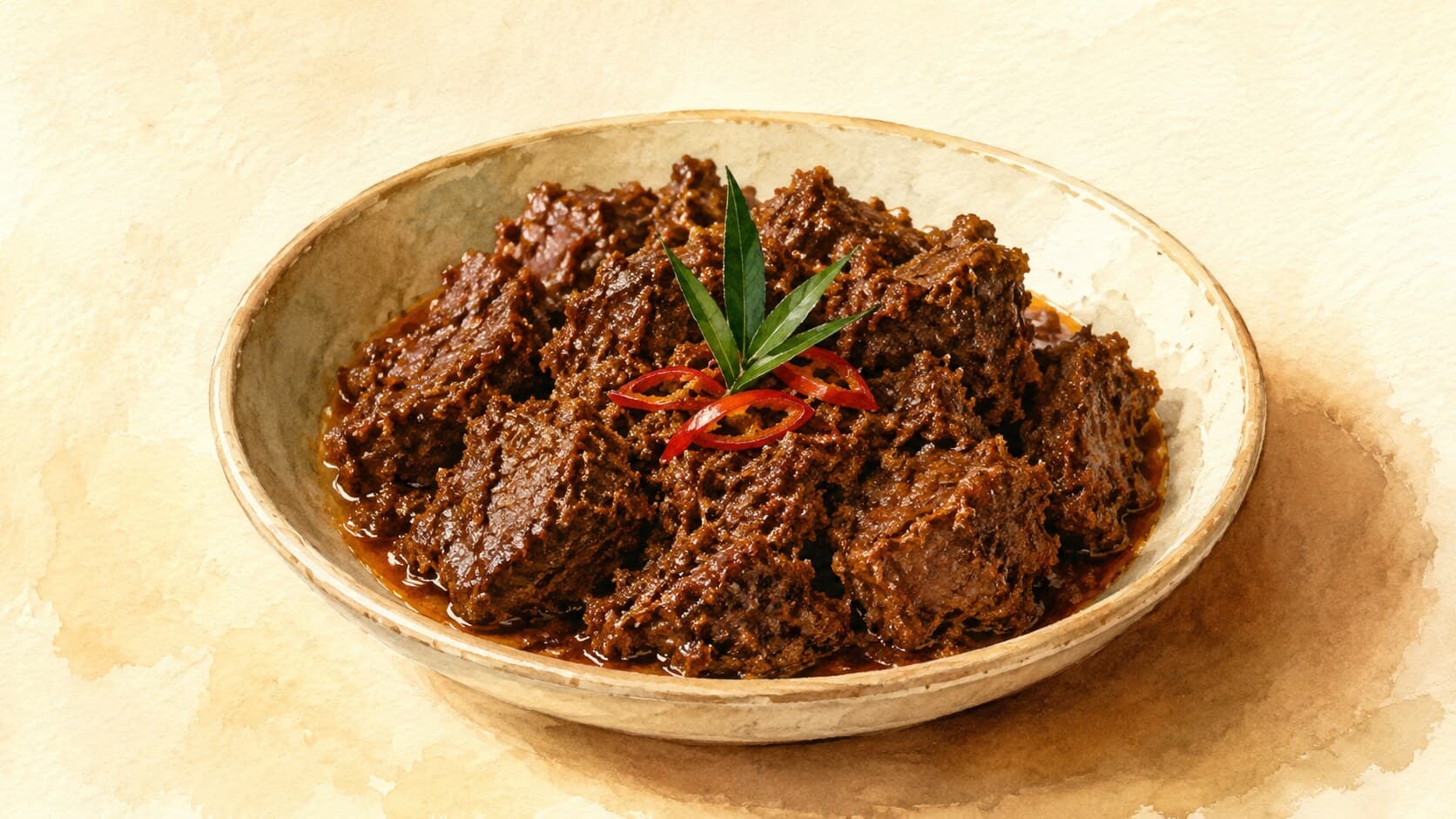
- A dark mahogany, not a chocolate brown. Rendang kering should look like polished wood — deep red-brown with reddish glints from the chilli and tamarind, not a flat dark brown. Flat brown usually means too much soy or fish sauce was added; rendang traditionally uses tamarind and salt for its savouriness.
- A spice paste that clings to the meat rather than pooling around it. Tilt the pan: if liquid runs to one side, you're still in the gulai (wet curry) stage; if the paste stays glued to each cube and only oil moves, you're done.
- An aroma that opens with toasted coconut, then galangal-pine, then warm chilli. Lean over the pot at the end and you should pick out distinct layers, not a single muddled curry smell. A muddled smell usually means heat was too high or kerisik was added too early.
A note on history
Rendang is a Minangkabau dish from West Sumatra, Indonesia; its development as a long-keeping, slow-cooked beef preparation is generally dated to the 16th century, though related coconut-and-spice preparations in the region are older still (Indonesia.travel, ScienceDirect on Minangkabau treasure). The long reduction was a practical answer to a hot climate without refrigeration — well-made rendang kering keeps for weeks because the water has been driven out and the meat is sealed in a stable coat of spice and rendered coconut fat (Seasia). Indonesian rendang was officially listed by UNESCO as Intangible Cultural Heritage of Humanity in 2018, and the dish remains central to Minangkabau ceremonial meals — weddings, religious feasts, community gatherings (Indonesia.travel).
Get the essays in your inbox — free
Weekly notes on flavor, fermentation, and food history — the writing behind the Atlas of Flavor. No spam; unsubscribe anytime.