
Qatayef
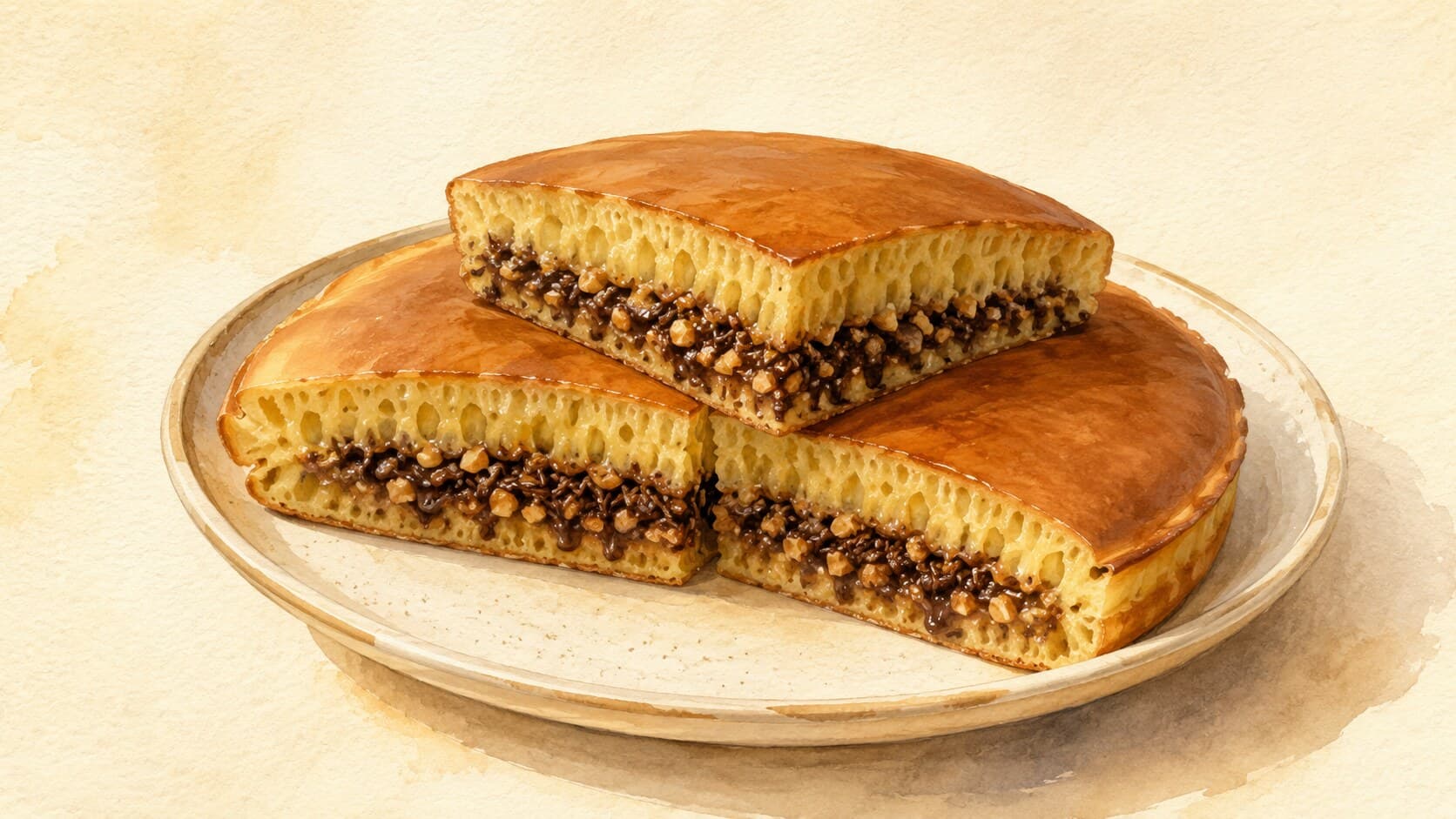
Qatayef are yeasted pancakes filled with nuts or cheese, commonly prepared during Ramadan and other festive occasions.
Contents (5 sections)▾
Ingredients
- 250 g all-purpose flour
- 2 tsp granulated sugar
- 1 tsp instant yeast
- 1/2 tsp salt
- 300 ml warm water
- 100 g finely chopped nuts (walnuts or pistachios)
- 100 g ricotta cheese
- 1/4 cup orange blossom water
- oil for frying
- 300 g sugar for syrup
- 200 ml water for syrup
- 1/2 tsp lemon juice for syrup
Steps
In a bowl, mix flour, sugar, yeast, and salt. Gradually add warm water and whisk until smooth. Let it rest for 30 minutes to activate the yeast.
Heat a non-stick skillet over medium heat (about 180°C). Pour 1/4 cup of the batter onto the skillet, cooking until bubbles form on the surface (about 2-3 minutes). Do not flip.
Remove the pancake and place it on a clean surface. While still warm, spoon a filling of chopped nuts or ricotta cheese onto one half and fold over, pressing the edges to seal.
Heat oil in a pan over medium heat. Fry the stuffed pancakes for about 2 minutes on each side until golden brown. Alternatively, bake in a preheated oven at 200°C for 10 minutes.
For the syrup, combine sugar, water, and lemon juice in a saucepan. Bring to a boil, then reduce heat and simmer for 10 minutes. Add orange blossom water and stir.
Soak the fried or baked qatayef in the syrup for a few moments before serving, allowing them to absorb the sweetness.
Why this works
Cooking the pancakes on one side only is key for texture; it creates a slightly crispy exterior while keeping the inside soft for folding. The yeast contributes to a light and airy pancake, suitable for rich fillings. If pancakes are too thick or undercooked, adding more water to the batter can help achieve a smoother consistency. Maintaining proper frying temperature is crucial; if the oil is too hot, the pancakes may burn before cooking through. This method emphasizes yeasted batter control and contrasts between the crispy exterior and the rich filling.
Common mistakes
Pouring batter onto a pan that's too hot or too cold. Target: the pan reads steady at about 180°C / 350°F; a drop of batter sizzles softly but doesn't brown in under 30 seconds, and bubbles appear across the surface within a minute. Why it matters: qatayef batter is leavened by yeast (a microscopic organism producing CO₂ — those bubbles you see). If the pan is too hot, the bottom sets before the gas can rise through, and you get a closed, dense surface that won't fold. Too cold, and the bubbles collapse without setting, leaving a pale, gummy pancake. What to do: test with one small spoonful first. If it browns before the bubbles open, lower the heat; if the surface stays slick and pale, raise it. Cook on one side only — that open, bubbled top is what receives the filling.
Folding while the pancake is too hot or too cold. Target: the pancake is warm and pliable but no longer steaming, with a dry-feeling bubbled top. Why it matters: the open bubbled surface (the "lace side") is what seals onto itself when folded. Too hot, and the surface is wet from condensation and refuses to bond, springing open; too cold, the starch network has set and it cracks instead of folding. What to do: cook the batches, let them rest 30–60 seconds, then fill and fold while still pliable. Press the edges firmly between thumb and finger, and the lace surface should weld shut.
Frying in oil at the wrong temperature, or soaking syrup that's the wrong temperature. Target: frying oil at about 170–180°C / 340–355°F; syrup served warm (about 50–60°C / 120–140°F), not boiling. Both vessels stay back from hands and counter edges. Why it matters: hot oil at this temperature is a real burn hazard — splashes from too-cold or wet qatayef cause sudden bubbling. Soaking syrup that is too hot can scald, and if it's too cold the syrup just sits on the surface without absorbing. This is a BLOCK-level safety guard: keep small children and loose sleeves clear of the fryer. What to do: dry the surface of the qatayef before frying, lower them in gently with tongs (not fingers), and let the syrup cool slightly off the heat before dipping. Never leave hot oil unattended.
Soaking too long and getting a soggy pancake. Target: a brief dip — about 20–30 seconds in warm syrup, just long enough to coat both sides and let a thin film glaze on. Why it matters: sugar syrup soaking is a balancing act between sweetness and structure. The crisp fried surface should hold up just long enough that the first bite shatters before yielding to the soaked interior. Over-soaked qatayef collapses into a wet, cloying lump. What to do: dip, lift, set on a rack or shallow plate. The syrup will continue to penetrate as the pastries rest. Serve within an hour for the best contrast.
What to look for
- A pancake top that looks like a lace doily — densely pitted with small, open bubbles all the way across, not just a few near the edge. That open lattice is what holds nut filling and absorbs syrup evenly.
- A folded pancake that holds its half-moon shape without re-opening — if the pinched edge springs back, the surface was too damp, or the lace side touched the pan too long.
- A glossy, lacquered finish after the syrup dip — that visible shine means the sugar has crystallized very lightly on the surface; matte means under-dipped, sticky means over-dipped.
- A fresh wave of orange blossom or rose water aroma when you bring it close to your face — those floral waters are heat-sensitive, so they're added at the end of syrup-making. If the syrup smells only of sugar, the aromatics were boiled away.
A note on history
A recipe for qatayif appears in a 10th-century Arabic cookbook by Ibn Sayyar al-Warraq, who was compiling dishes that already went back to the 8th and 9th centuries (Wikipedia: Qatayef). Across the Arab world it is most strongly associated with Ramadan: it is sold almost exclusively during the holy month and eaten after iftar (the sunset meal that breaks the daily Ramadan fast) and at suhoor (the pre-dawn meal eaten before fasting begins) — earning the popular nickname "Queen of Ramadan sweets" (The Arab Weekly). Different historians link its rise to the Abbasid, Fatimid, or late Umayyad periods (overlapping Islamic dynasties of the 7th–13th centuries that ruled large parts of the Middle East and North Africa), but its survival across a millennium of changing Middle Eastern kitchens is the consistent story (Egyptian Streets).
Get the essays in your inbox — free
Weekly notes on flavor, fermentation, and food history — the writing behind the Atlas of Flavor. No spam; unsubscribe anytime.