
Pyttipanna
Pyttipanna is a traditional Swedish hash that repurposes leftover ingredients into a satisfying one-pan meal.
Contents (5 sections)▾
Ingredients
- 300 g potatoes, diced
- 150 g cooked sausage, diced
- 100 g onion, chopped
- 2 tbsp vegetable oil
- Salt to taste
- Pepper to taste
- 2 large eggs
- 100 g pickled beets, sliced
Steps
In a large skillet, heat vegetable oil over medium heat. Add diced potatoes and cook for about 10 minutes, stirring occasionally, until they begin to brown and soften.
Add the diced sausage and chopped onion to the skillet, season with salt and pepper, and cook for an additional 5 minutes, stirring frequently until the onions are translucent and the sausage is heated through.
In a separate frying pan, cook the eggs sunny-side up over medium heat. For ordinary (non-pasteurized) eggs, cook until the yolks are fully set, no longer runny; for runny yolks, use eggs pasteurized in the shell (through to the contents) — for everyone, not only high-risk diners.
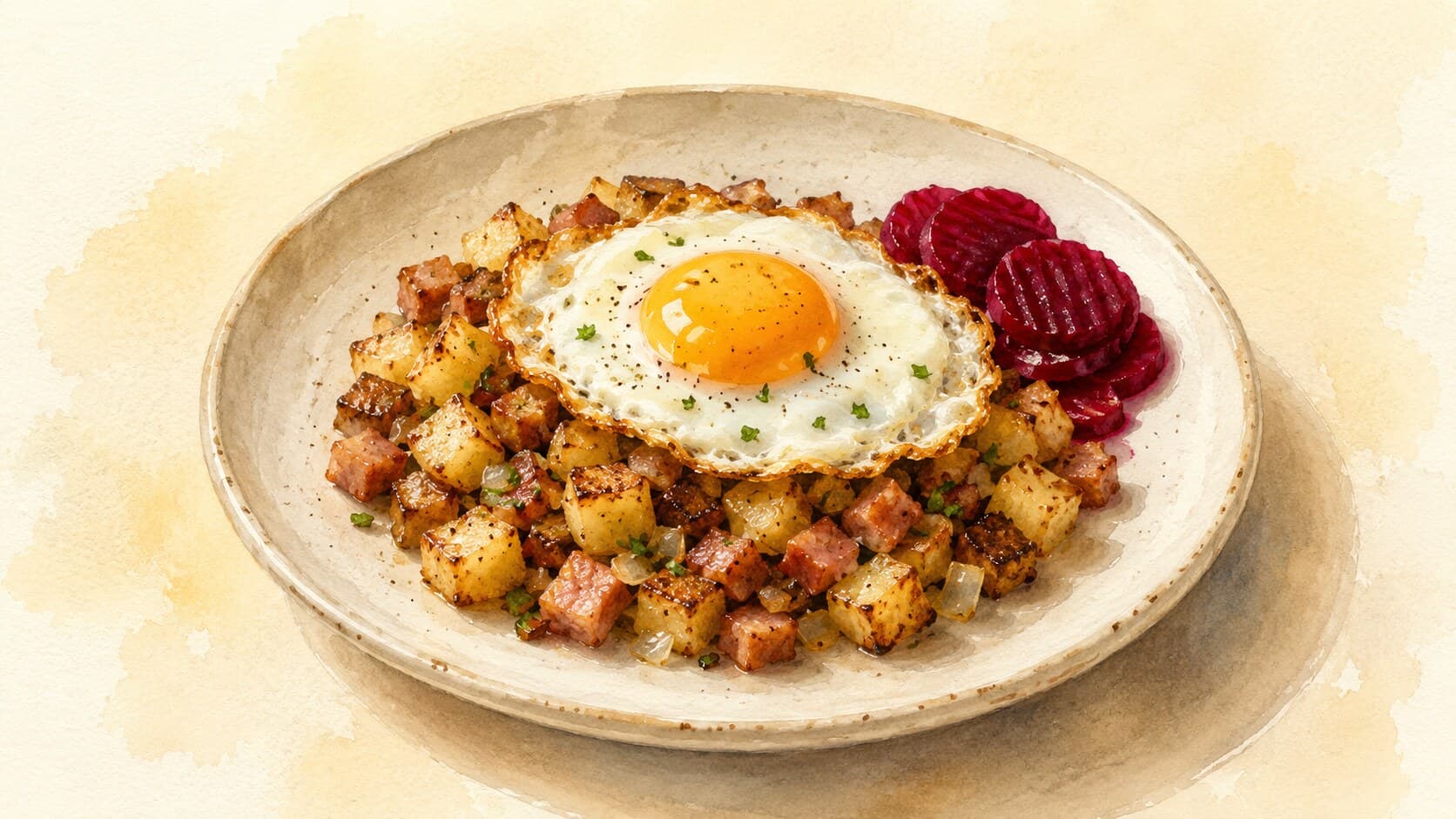
Serve the pyttipanna hot, topped with a fried egg and garnished with pickled beet slices.
Why this works
Pyttipanna is a great example of utilizing leftover ingredients to create a hearty meal, which is a staple in Swedish cuisine. The technique of frying potatoes ensures they get crispy on the outside while remaining soft inside, creating an ideal texture contrast. Adding the sausage and onion enhances the flavor, making it savory and satisfying. The key is to ensure the potatoes are cooked thoroughly before adding the other ingredients; if they seem too firm, cover the skillet for a few minutes to steam them. If the mixture appears too dry, adding a splash of broth or water can help. The fried egg on top adds richness, while the pickled beets provide acidity, balancing the dish perfectly. This dish can be customized based on available leftovers, making it versatile and resourceful.
Common mistakes
Stirring the potatoes too soon and too often. Target: the potato cubes sit on the hot pan for at least 3–4 minutes before the first turn; a brown crust forms on the down-facing side. Why it matters: the dark-gold crust is the Maillard reaction (amino acids and starches rearranging at high heat into hundreds of new savory compounds — the brown-crust flavor). Stirring breaks contact between potato and pan before that crust can set, so the potatoes steam gray and limp instead of frying crisp. What to do: spread the potatoes in a single layer in a hot pan with enough fat to coat the bottom, leave them alone, and only turn once a clear crust has built up. Then leave them again.
Crowding the pan so the hash steams instead of frying. Target: a single, loose layer of potato + onion + meat across the pan; you hear an active sizzle, not a hiss of steam. Why it matters: pyttipanna only tastes "right" when the surfaces are crisp and a little caramelized. A heaped-up pan traps moisture, the surface temperature drops, and you get a damp gray hash instead of the toasted edges that carry the flavor. What to do: use a wider pan, or cook in two batches and combine at the end. If your pan has a layer more than about 1.5 cm deep, it's too full.
Reheating leftover meat from cold straight into the warm hash. Target: any pre-cooked diced meat (beef, sausage, ham) reaches piping hot all the way through — steaming in the center, not just warm at the edge. Why it matters: pyttipanna is famously a leftover-rescue dish, and that's the point where most home-cooked food safety failures happen. Cooked meat that has been refrigerated needs to come back through the danger zone (the 4–60°C / 40–140°F band where food-poisoning bacteria multiply fastest) fast and hit hot. This is a BLOCK-level safety guard: don't serve lukewarm reheated meat. What to do: keep the diced meat aside, get the potatoes properly browned and hot first, then add the meat to the hottest part of the pan and toss until each piece is steaming inside. If in doubt, taste a piece — it should burn slightly on the tongue.
Cooking the egg in the same pan and ending up with a tough white. Target: a fried egg with set whites, just-soft yolks if you eat eggs that way, and no brown lace edge. Why it matters: the same heat that crisped the potatoes will scorch egg white in seconds. Egg proteins set at much lower temperatures than potato browning needs, and a too-hot pan turns the white rubbery and the yolk dusty. What to do: fry the eggs in a separate, cooler pan in butter or a little oil. Use medium-low heat and tilt-baste the whites with the fat. Add the egg on top of the hash at serving.
Safety note (fried egg): A runny yolk is an undercooked egg — set whites, cooking time, and residual heat are not by themselves proof it is safe, and sunny-side-up frying has no validated Salmonella kill step. To keep the yolk soft, use an egg pasteurized in the shell (treated through to the contents); ordinary freshness or a "raw-eating" (生食用) label is not the same. Otherwise cook the yolk through. High-risk diners (pregnancy, immunocompromised, very young or old) should use a pasteurized egg or a fully cooked yolk.
What to look for
- Edges that crackle when you press a wooden spoon against them — that crisp resistance means the surface has dehydrated and Maillard-browned, which is the whole texture point of the dish.
- A clean, nutty smell rather than a sweet steamy one — sweet steam means the potatoes are still releasing water; nutty toast means the surfaces are caramelizing.
- A thin film of fat pooled at the edge of the pan, not soaked into the hash — that means the potatoes have crisped and stopped absorbing oil; if the hash still looks oil-thirsty, give it more time.
- The pickled beets bleed a magenta ring onto the plate when you serve — that vivid acidic contrast is the whole point. If you skip the pickle, the dish reads flat and one-note: it needs the sour beet to wake the savory hash up.
A note on history
Pyttipanna — literally "small pieces in a pan" in Swedish — is a classic example of husmanskost, the resourceful Swedish home-cooking tradition built around using what's already in the kitchen (Wikipedia: Pyttipanna). Its rise as a national everyday dish is closely tied to the wartime and post-war frugality of the 1940s, when nothing edible was thrown away (Stockholm Museum). Related hash preparations (a "hash" being any dish where leftover meat and potato are chopped small and pan-fried together) appear across Scandinavia and northern Europe, but the Swedish version is recognizable by its dice, the runny fried egg, and the bracing pickled beet on the side.
Get the essays in your inbox — free
Weekly notes on flavor, fermentation, and food history — the writing behind the Atlas of Flavor. No spam; unsubscribe anytime.