
Poulet Chasseur
Poulet Chasseur features bone-in chicken braised in a rich sauce of mushrooms, shallots, and tarragon, exemplifying classic French cuisine.
Contents (5 sections)▾
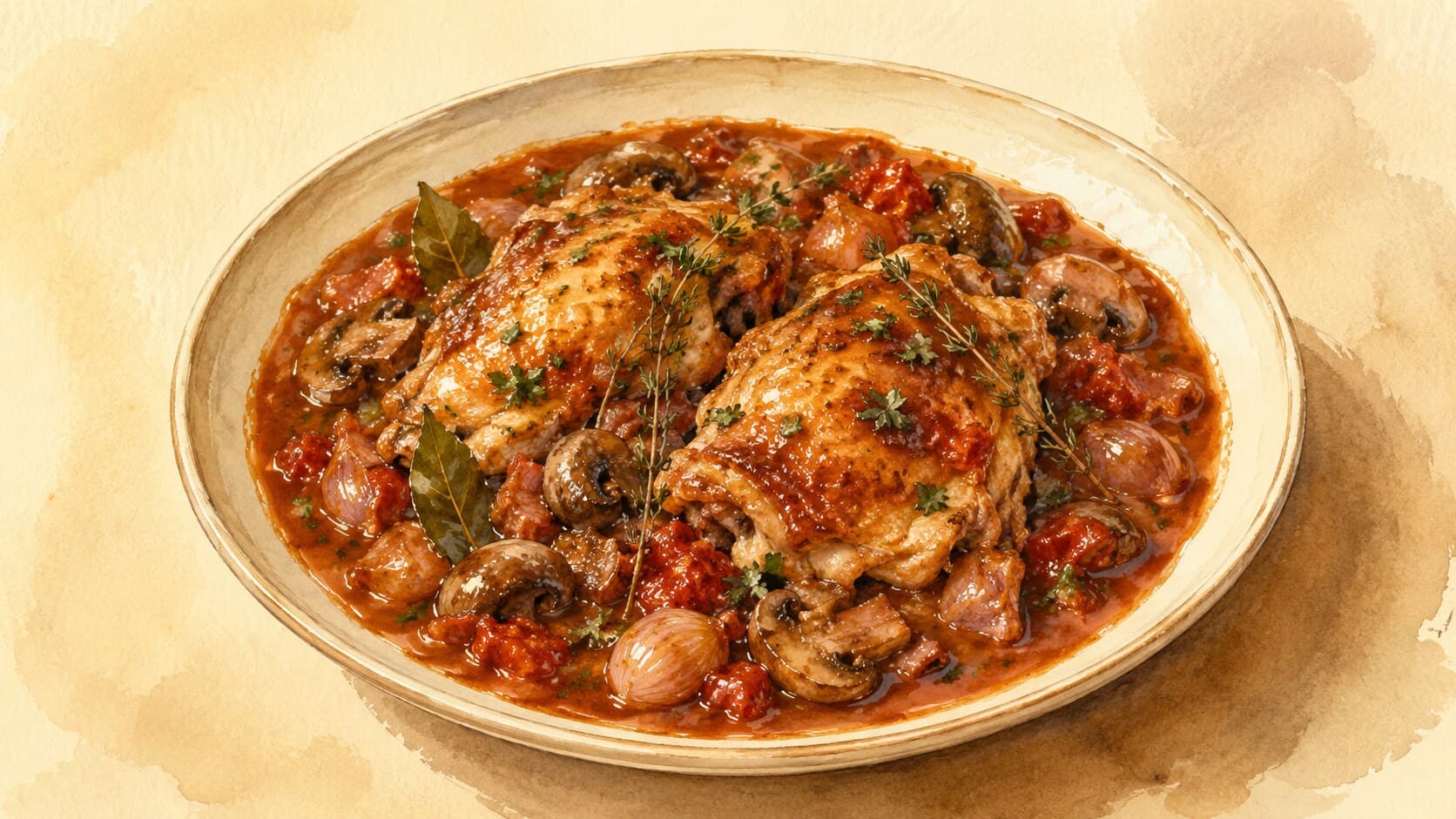
Ingredients
- 1.5 kg bone-in chicken pieces
- 2 tbsp olive oil
- 200 g cremini mushrooms, sliced
- 3 shallots, sliced
- 200 ml dry white wine
- 400 g canned diced tomatoes
- 2 tbsp fresh tarragon, chopped
- Salt, to taste
- Pepper, to taste
Steps
Heat the olive oil in a large French pan over medium-high heat. Season the chicken pieces with salt and pepper, then brown them in the hot oil for about 8-10 minutes on each side, until golden.
Remove the chicken from the pan and set aside. Add the sliced shallots and mushrooms to the same pan, cooking until softened, about 5 minutes. This deglazes the pan and incorporates the flavorful bits left from the chicken.
Pour in the white wine, scraping up any remaining bits from the bottom. Let it simmer for about 3 minutes until reduced by half.
Stir in the canned tomatoes and tarragon, then return the chicken to the pan. Ensure the chicken is nestled in the sauce, cover, and reduce the heat to low. Simmer for about 30 minutes, until the chicken is cooked through.
Check for seasoning, adjusting with salt and pepper as needed. Serve hot, garnished with additional tarragon if desired.
Why this works
Poulet Chasseur is the dish form of the chasseur sauce technique — the same shallot-mushroom-wine-tomato reduction logic covered in Sauce Chasseur, scaled up so the chicken braises in its own sauce. If the sauce itself is new to you, read that recipe first; this is what you build with it.
Braising lets the chicken absorb the flavors of the sauce while becoming tender and juicy. Using a pan-reduction method ensures that the sauce is concentrated and rich, as it builds layers of flavor from the browned chicken, the sautéed shallots, and mushrooms, and the acidity of the wine and tomatoes. If you find that the sauce is too thin, allow it to simmer uncovered for a few extra minutes to evaporate some liquid and thicken. Conversely, if the sauce seems too thick, you can add a splash of water or broth to bring it back to your desired consistency. This balance is crucial for achieving a delightful texture that clings to the chicken without overwhelming it.
Common mistakes
Crowding the pan when browning the chicken. Target: chicken pieces sit with at least a finger-width of space between them in a single layer. Why it matters: browning is the Maillard reaction (amino acids and sugars rearranging at high heat into hundreds of new flavor compounds — the deep savory crust). Crowded pieces release steam faster than the pan can drive it off, the surface temperature drops below the browning threshold, and the chicken poaches gray instead of building that crust the sauce later borrows. What to do: brown in two batches if needed, dry the chicken skin with paper towel first, and don't move each piece until it releases from the pan on its own.
Dumping the mushrooms into a cold or crowded pan. Target: mushrooms hit a hot pan in a single layer with a little space; you hear an immediate sizzle. Why it matters: sliced mushrooms are about 90% water. In a cool or crowded pan that water releases before the surface can sear, and you end up with pale, rubbery mushrooms swimming in their own liquid — no roasted flavor, no concentrated savory note for the sauce. What to do: wait until the pan is properly hot after removing the chicken, spread the slices out, and don't stir for the first two minutes. Once they release liquid and it evaporates, they'll brown.
Adding the wine before the chicken-mushroom fond has set. Target: the brown bits on the pan bottom (the fond) look dark amber and smell nutty, not bitter or black. Why it matters: wine deglazes the fond — its acid and water dissolve the stuck-on browned proteins back into the sauce. If you add wine too early the fond is pale and watery; if you let it go too dark it turns acrid and the whole sauce inherits that burnt note. What to do: sauté the shallots and mushrooms until the fond looks like dark caramel, then pour the wine in and immediately scrape with a wooden spoon.
Pulling the chicken too soon and serving it pink at the bone. Target: an instant-read thermometer at the thickest part of the thigh, not touching bone, reads 74°C / 165°F; juices run clear, no pink at the joint. Why it matters: bone-in chicken needs longer than boneless because heat travels slowly through bone. Undercooked poultry near the joint is a real foodborne illness risk (Salmonella, Campylobacter). This is a BLOCK-level safety guard, not a texture preference. What to do: use a thermometer rather than eye-balling time. If 74°C / 165°F isn't reached at 30 minutes, cover and simmer 5–10 minutes more, then re-check. The sauce only gets better.
What to look for
- A glossy, lacquered surface on the chicken skin after browning — that sheen is rendered fat and emulsified proteins, and it's the foundation of a sauce that clings rather than slides.
- The wine smell shifting from sharp-alcoholic to round-fruity after about three minutes of hard simmer — that's the signal the harsh ethanol has burned off and you're left with the acidity and depth that balance the tomato.
- Mushrooms that have shrunk by about half and turned the color of toast before you add liquid — undercooked mushrooms will leak water into the sauce later and thin it out.
- A sauce that coats the back of a spoon and parts cleanly when you draw a finger through it — French cooks call this nappant (literally "coating" — the moment a sauce thickens enough to film a spoon). If it runs straight off, simmer uncovered a few minutes more; if it sits in a stiff mound, loosen with a splash of water or stock.
A note on history
The dish belongs to the broader French tradition of à la chasseur ("in the hunter's style"), which in classical cooking signals shallots, mushrooms, white wine and tomato — the kind of sauce a returning hunter might build from what the forest and the cellar already held (Wikipedia: Chicken chasseur). The first published recipe for poulet à la chasseur dates to 1865, and the form was later codified in the great repertoire of 19th-century French sauces (Global Food Origin). The same impulse — game, mushrooms, wine — runs through many European cuisines, from Italian alla cacciatora (the same "hunter's-style" idea — tomato, herbs, sometimes wine, around chicken or rabbit) to similar Polish stews.
Get the essays in your inbox — free
Weekly notes on flavor, fermentation, and food history — the writing behind the Atlas of Flavor. No spam; unsubscribe anytime.