
Pommes Anna
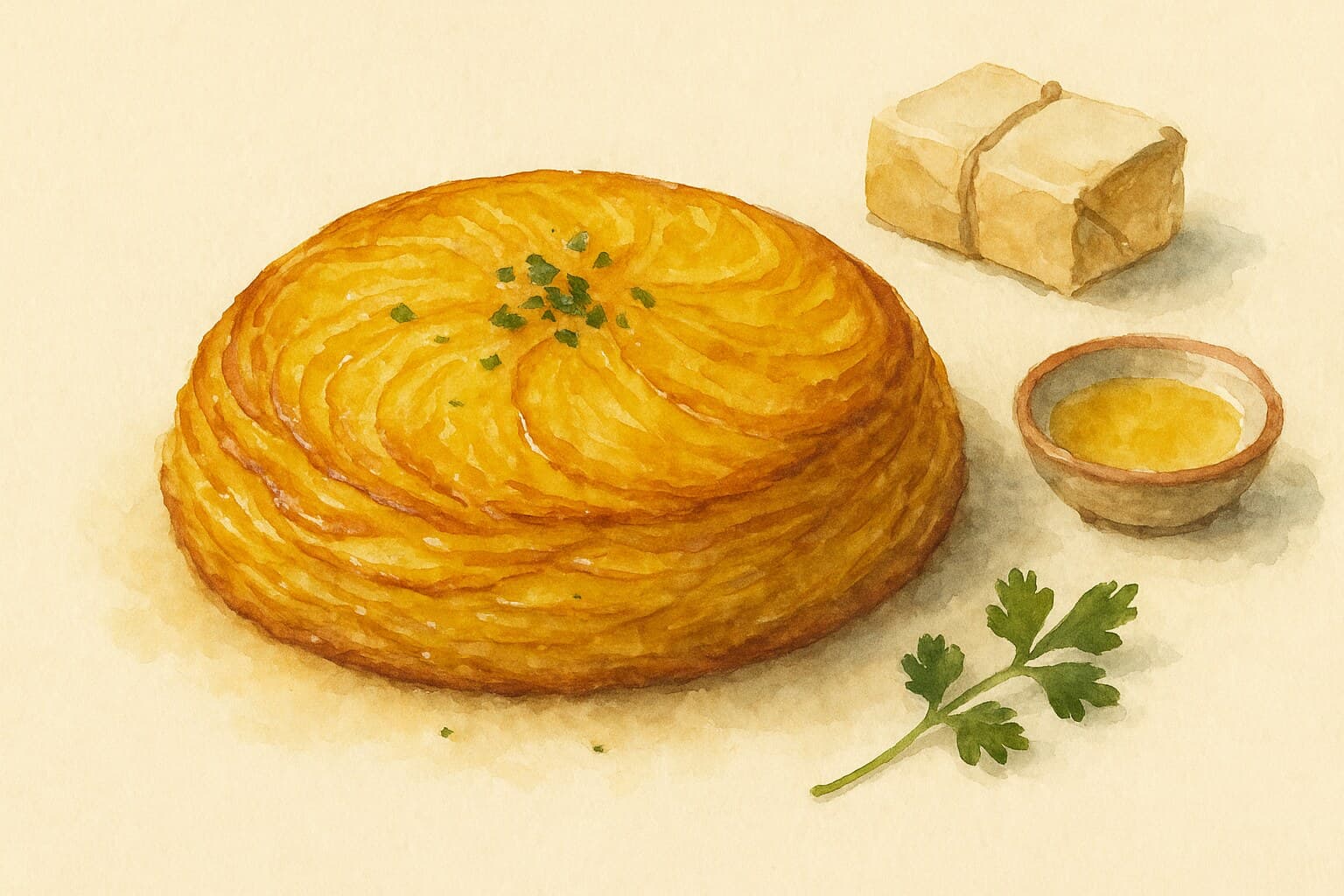
Pommes Anna consists of thinly sliced potatoes layered in a dish, seasoned, and baked until golden and crispy.
Contents (5 sections)▾
Ingredients
- 600 g Yukon Gold potatoes
- 120 g unsalted butter
- 1 tsp sea salt
- 1/2 tsp black pepper
- 1 sprig fresh thyme
- 1 clove garlic, minced
- to taste: additional salt and pepper
Steps
Preheat your oven to 200°C (400°F). This ensures the potatoes will roast evenly and develop a crispy exterior.
Peel the potatoes and slice them thinly (about 2 mm thick) using a mandoline or sharp knife. Uniform slices are crucial for even cooking.
In a large skillet, melt 60 g of butter over medium heat. Add minced garlic and thyme, cooking for 1-2 minutes until fragrant.
Layer half of the potato slices in a greased round baking dish, overlapping them slightly. Season with salt and pepper.
Pour half of the garlic-butter mixture over the layered potatoes. Repeat this process with the remaining potatoes and butter.
Cover the dish with aluminum foil and bake for 30 minutes. This steaming step cooks the potatoes through.
Remove the foil and bake for an additional 10 minutes until the top is golden brown. This step creates the desired crispiness.
Let the dish rest for 5 minutes before slicing. This allows the layers to set slightly for easier serving.
Why this works
Pommes Anna relies on the technique of layering thinly sliced potatoes, which allows them to cook evenly while creating a deliciously crispy exterior. The use of Yukon Gold potatoes is essential due to their creamy texture and rich flavor, enhancing the dish's overall appeal. The butter adds richness and helps in achieving that golden crust. If your potatoes seem too dry while cooking, consider adding a bit more melted butter to the layers. Conversely, if the layers break apart while slicing, ensure to let them rest longer before cutting, allowing them to firm up slightly.
Common mistakes
Cutting slices unevenly or too thick. Target: Even slices about 2 mm thick — uniform enough that a stack lies flat without gaps. Why it matters: Pommes Anna is built on layered slices cooking together as one disc. Uneven slices leave under-cooked thick pieces between cooked thin ones, and the cake won't hold its shape when inverted because the layers don't bond. What to do: Use a mandoline (a handheld slicer with an adjustable blade that produces very thin, even slices) if you have one, otherwise a sharp chef's knife and a slow hand. Slice as you go and keep the slices in a bowl — not in water, which washes away the surface starch that helps the layers stick.
Letting the butter scorch. Target: Clarified or whole butter held just below the smoke point (clarified around 200°C / 390°F; whole butter darkens earlier — pull off if it starts to smell nutty-burnt rather than nutty-sweet). Why it matters: Pommes Anna depends on a large amount of butter for both flavour and the dark, lacquered crust that forms against the pan (the Maillard reaction — proteins and sugars browning into deep, savoury notes). Scorched butter coats every slice with bitterness that no salt can rescue, and the milk solids in whole butter burn first. What to do: Clarify the butter (skim the foam, leave the white solids behind) if you can. Watch the pan colour, not the clock: nutty-amber is good; dark-acrid means burning.
Pulling the foil off too early or too late. Target: Covered first half of the bake (around 30 minutes) to cook the interior through; foil off for the last 10-15 minutes to brown and crisp the top. Why it matters: The covered phase steams the layers so the centre cooks through (starch gelatinisation — granules absorbing water and softening); the uncovered phase dries the surface and lets it brown. Skip the cover and the top blackens before the inside cooks. Skip the open finish and you'll have soft, pale layers with no crust. What to do: Set a timer for the cover-off moment. When the foil comes off, the kitchen should smell sweet and butter-rich, not raw or starchy.
Inverting before the cake has set. Target: Rest in the pan for at least 5 minutes (longer if it's deep) before flipping. Why it matters: Hot from the oven, the layers are still soft and the butter is liquid. A short rest lets the starch network firm up and the butter partially re-solidify, so the cake holds its shape when you turn it out. Flip too soon and the layers slide apart. What to do: Let the dish settle on a rack for 5-10 minutes. Run a thin knife around the edge first, then invert decisively onto a warm plate.
What to look for
- A deep, lacquered amber on the top and bottom. Not just gold — the colour should be the colour of a polished saddle, with crisp edges that catch the light.
- Slices that hold together when you cut a wedge. A clean wedge holds its layered profile; if the layers slide, the bake was either too short, the slices too thick, or the rest too brief.
- Butter that smells nutty-sweet, not acrid. A whiff of caramel and toasted dairy is good; sharp, burnt smells mean the pan got too hot.
- A centre that yields to a fork. Test the middle slice — it should be tender all the way through with no chalky core. The exterior is crisp, the interior soft and yielding.
A note on history
Pommes Anna was created around 1870 by Adolphe Dugléré, head chef of the Café Anglais in Paris during the reign of Napoleon III (Wikipedia: Pommes Anna, Wikipedia: Adolphe Dugléré). Dugléré was a pupil of Antonin Carême (an early-19th-century chef widely considered the founder of French grande cuisine) and led the Café Anglais kitchen at its peak as one of the most celebrated dining rooms in 19th-century Paris. The dish is generally credited as having been named after Anna Deslions, a well-known courtesan who often dined at the restaurant — though there is some disagreement among historians about which "Anna" he was honouring. The dish was so popular that a dedicated copper pommes Anna pan with a tight-fitting cover was developed for it, and the recipe has remained on bistro and fine-dining menus essentially unchanged for more than 150 years.
Get the essays in your inbox — free
Weekly notes on flavor, fermentation, and food history — the writing behind the Atlas of Flavor. No spam; unsubscribe anytime.