
Creamy Polenta with Mushrooms
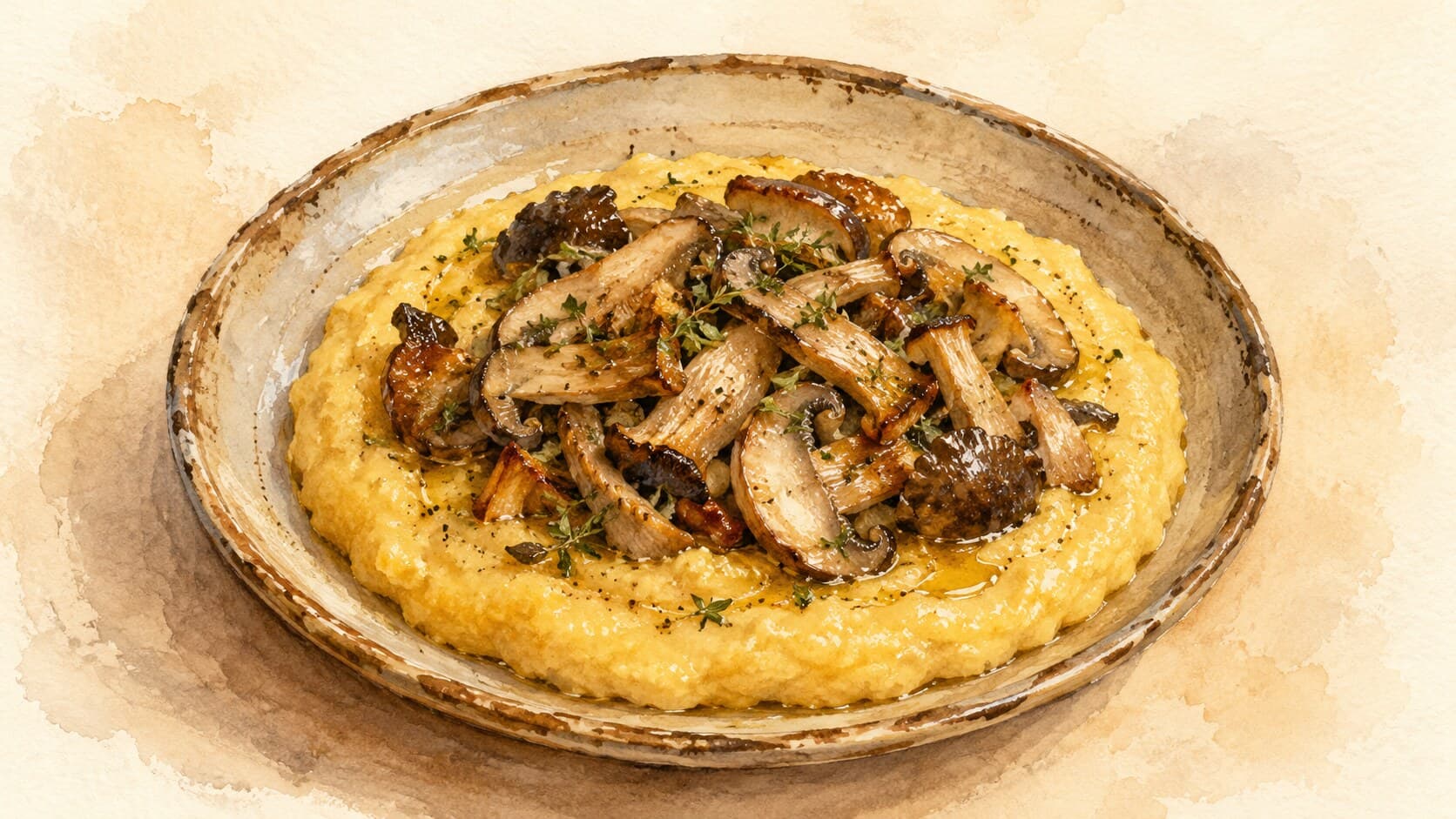
Creamy polenta topped with sautéed mushrooms. Focus on stirring techniques and texture control for optimal consistency and flavor.
Contents (5 sections)▾
Ingredients
- 250 g cornmeal
- 1 liter vegetable broth
- 100 g Parmesan cheese, grated
- 50 g unsalted butter
- 200 g assorted mushrooms, sliced
- 2 cloves garlic, minced
- 2 tbsp olive oil
- Salt to taste
- Black pepper to taste
- Fresh thyme sprigs, for garnish
Steps
In a pot, bring the vegetable broth to a boil over medium heat.
Slowly whisk in the cornmeal, stirring continuously to avoid lumps. Cook for about 15 minutes, until creamy.
Stir in the Parmesan cheese and butter, then season with salt and black pepper to taste.
In a skillet, heat olive oil over medium-high heat. Add the minced garlic and sauté for 1 minute until fragrant.
Add the sliced mushrooms to the skillet, cooking for about 5-7 minutes until they are golden brown and tender.
Serve the creamy polenta in bowls, topped with the sautéed mushrooms and garnished with fresh thyme.
Why this works
Polenta, made from finely ground cornmeal, creates a comforting, creamy base that absorbs flavors beautifully. By cooking the cornmeal slowly in simmering vegetable broth, you achieve a smooth texture; stirring continuously prevents lumps and ensures even cooking. The addition of Parmesan cheese and butter enhances the richness, adding depth to the dish. When sautéing the mushrooms, the high heat helps to caramelize their natural sugars, which boosts umami flavors, creating a delightful contrast with the creamy polenta. If the polenta seems too thick while cooking, whisk in a little more broth or water to reach your desired consistency. Conversely, if the polenta breaks or separates, simply continue stirring it over low heat, adding liquid until it comes back together into a smooth mixture again.
Common mistakes
Pulling the polenta off the heat as soon as it thickens. Target: Total stovetop time around 30-45 minutes for coarse polenta (a Northern Italian porridge of slowly simmered cornmeal) (about 15 minutes for fine, instant-style), cooked until the gritty bite has fully softened into a silky, slightly elastic porridge. Why it matters: Polenta thickens long before it's actually cooked. That thickening is starch absorbing liquid, not the granules cooking through (starch gelatinisation — when granules swell and release starch into the cooking liquid). Stopping there leaves the corn raw and gritty inside, with a sharp dusty taste even under cheese and butter. What to do: Once the polenta looks thick, keep going on low heat with regular stirring, splashing in extra broth or water as needed to keep it loose enough to stir. Taste — when there's no chalky grit left on the tongue, it's done.
Dumping all the cornmeal in at once. Target: A slow, steady rain of cornmeal into simmering liquid while whisking continuously. Why it matters: Cornmeal hitting still or boiling liquid in a single dose clumps before the granules can hydrate, leaving stubborn lumps that no amount of stirring will fully break later. What to do: Bring the broth to a brisk simmer, lower the heat slightly, and pour the cornmeal in a thin, steady stream from one hand while whisking with the other. Switch to a wooden spoon once it thickens.
Overcrowding the pan with mushrooms. Target: Mushrooms in a single, uncrowded layer in a hot pan; cook in batches if the pan won't hold them. Why it matters: Mushrooms are about 90% water. Crowded mushrooms steam in their own moisture instead of caramelising (the Maillard reaction — proteins and sugars browning under dry heat to make deep, savoury flavour). Steamed mushrooms turn out grey, rubbery, and watery — the opposite of the deep umami the dish wants on top of the bland, sweet polenta. What to do: Get the pan properly hot first, add oil, and lay the mushrooms in one layer. Leave them undisturbed for the first couple of minutes so they brown on one side before you toss. Add garlic only after the mushrooms have colour, or it will burn.
Letting the polenta sit and seize on the way to the table. Target: Stir cheese, butter, and a final splash of warm broth in just before serving so the polenta lands creamy on the plate. Why it matters: Polenta is starch and liquid in suspension (cream emulsion in the sense that fat, water, and starch hold together as one smooth body). As it cools, the starch matrix sets and it stiffens into a slab. A polenta that was perfect in the pot can be paste-like five minutes later. What to do: Have everything else ready first. Loosen the polenta with a splash of warm broth right at the end if it's tightened up, plate immediately, and top with the mushrooms (also fully cooked through) and a finishing drizzle of olive oil.
What to look for
- A surface that holds a soft trail behind the spoon. Drag a wooden spoon across the bottom; the line should hold for a beat, then close gently. That's the moment fat, starch, and liquid are in balance.
- No grit on the tongue. Taste a small spoonful; properly cooked polenta is silky with no chalky residue between teeth.
- Deep amber-brown mushrooms with crisp edges. Dry, caramelised surfaces — not the grey, watery sheen of steamed mushrooms.
- A spoonable, slightly elastic body. When you ladle the polenta, it should fall in soft waves rather than blocks; if it lands as a slab, loosen with warm broth before plating.
A note on history
The roots of polenta go back to the Roman puls and pulmentum — porridges made from ground barley, spelt, fava, or other grains, eaten daily across the ancient Mediterranean (Wikipedia: Polenta, La Cucina Italiana). Corn (maize) arrived in Italy from the Americas in the 16th century after the Columbian Exchange (the post-1492 transfer of crops, animals, and people between the Old and New Worlds), and grew especially well in the cooler, fertile plains of Lombardy, Veneto, and Piedmont, where it gradually displaced the older grain mixtures. By the 17th century, cornmeal polenta had become a staple food for the working poor of Northern Italy — cheap, filling, and reliable through long winters (CNN: Polenta history). Paired with foraged mushrooms, it remains one of the most quietly enduring expressions of Northern Italian peasant cooking.
Get the essays in your inbox — free
Weekly notes on flavor, fermentation, and food history — the writing behind the Atlas of Flavor. No spam; unsubscribe anytime.