
Nasi Goreng
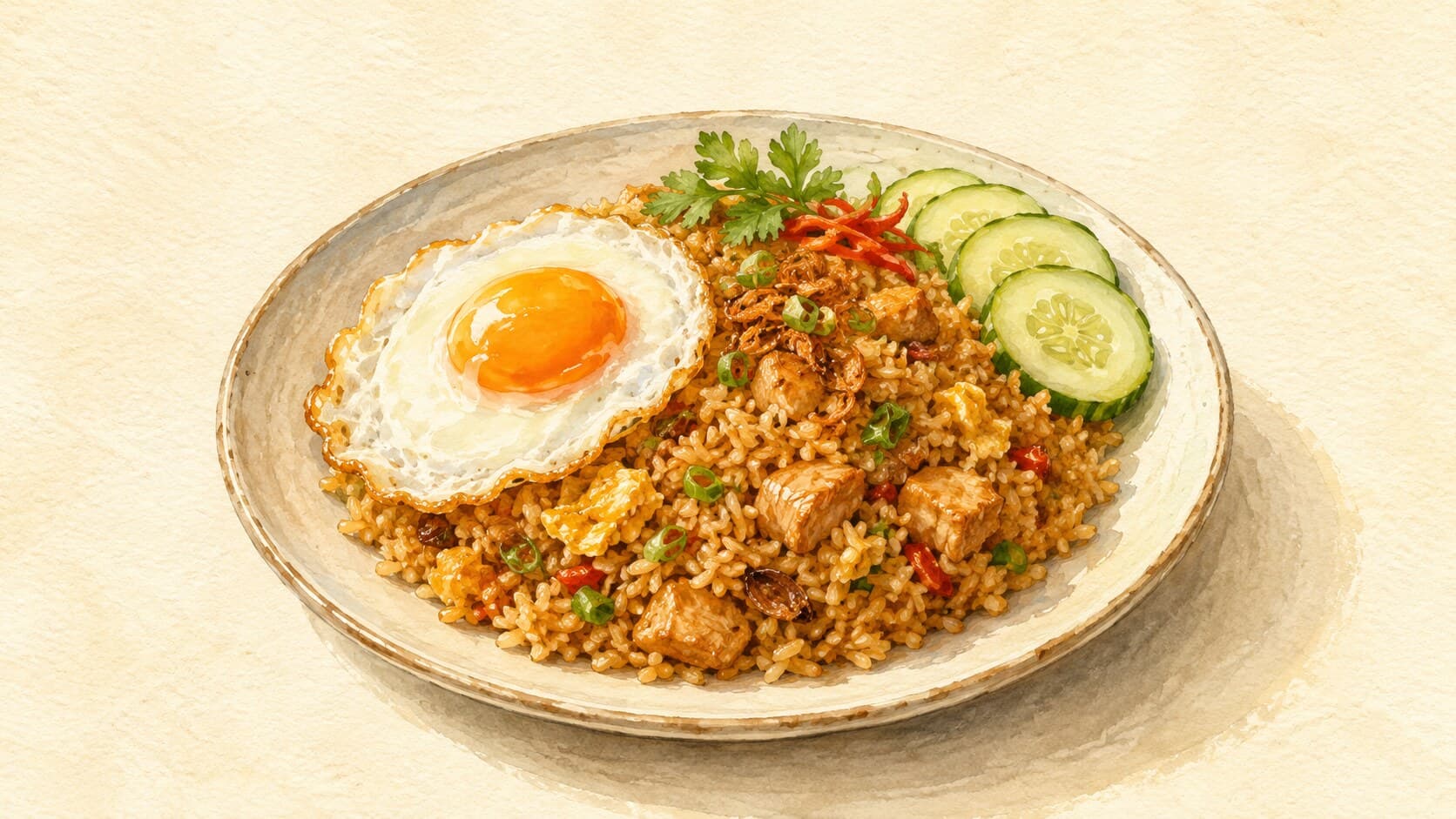
This delicious nasi goreng features day-old rice stir-fried with savory ingredients, perfect for a quick weeknight dinner.
Contents (5 sections)▾
Ingredients
- 300 g day-old rice
- 2 tbsp kecap manis
- 2 shallots, finely chopped
- 2 cloves garlic, minced
- 1 red chili, chopped (or to taste)
- 150 g cooked chicken, diced (or any savory protein)
- 2 tbsp vegetable oil
- 1 egg (optional, for topping)
- Salt, to taste
- Sambal, for serving (optional)
- Cucumber slices, for garnish (optional)
Steps
Heat a wok over high heat until smoking hot, then add 2 tbsp of vegetable oil. This high temperature is essential for achieving the smoky flavor characteristic of nasi goreng.
Add the chopped shallots, minced garlic, and chopped chili to the wok, stirring quickly for about 1 minute until fragrant but not burnt.
Introduce the diced chicken into the wok, stirring for another minute until heated through.
Add the day-old rice, breaking up any clumps. Stir-fry for 3-4 minutes, ensuring the rice is heated evenly and begins to caramelize slightly.
Pour in the kecap manis and mix thoroughly. Cook for an additional 1-2 minutes, allowing the rice to absorb the sweet soy sauce and turn a beautiful amber color.
If desired, top with a fried egg. Cook an ordinary (non-pasteurized) egg fully — white opaque and the yolk set. For a soft or runny sunny-side-up yolk (traditional), use an egg pasteurized in the shell (through to the contents) or a pasteurized egg product — this applies to everyone, not only high-risk diners. High-risk diners: use a pasteurized egg, cook it fully, or omit. Freshness, a "raw-eating" (生食用) label, a clean shell, the hot rice and residual heat are not substitutes.
Serve the nasi goreng hot, topped with the fried egg, and garnish with cucumber slices and sambal if desired.
Why this works
Nasi goreng effectively utilizes day-old rice, which has drier grains that fry better than freshly cooked rice. High heat is crucial in this dish as it creates a pleasant caramelization and enhances the flavors through the Maillard reaction (the heat-driven browning between proteins and sugars that produces roasted, savory aromas). The combination of shallots, garlic, and chili provides a robust base, while kecap manis (Indonesian sweet soy sauce — soy sauce thickened and sweetened with palm sugar, syrupy and almost molasses-like) contributes sweetness and depth. If the rice seems too sticky or clumpy during cooking, continue stir-frying over high heat, as this will help separate the grains and develop the desired texture. Additionally, if you find the dish lacks flavor, a splash more of kecap manis or a pinch of salt can improve the taste. This dish can also be adjusted with various proteins, making it versatile for any leftovers you may have on hand.
Safety note. The fried-egg topping (telur mata sapi) is optional and structural to the canonical presentation. A soft/runny yolk is undercooked egg with no validated Salmonella kill step: to keep it runny, use an egg pasteurized in the shell (through to the contents); otherwise cook the yolk through. High-risk diners (pregnancy, immunocompromised, very young or old) should use a pasteurized egg, cook the yolk through, or omit the egg entirely. The dish stands on its own without the egg.
Common mistakes
Using freshly cooked rice straight from the cooker. Target: rice that has rested overnight in the fridge, uncovered or lightly covered, so the grains are dry and individual. Why it matters: hot rice is full of free moisture. Hit it with a hot wok and the moisture turns to steam — you end up boiling the rice in its own water instead of frying it. Cold day-old rice has undergone starch retrogradation (the gelatinised starch firms up as it cools), giving you separate grains that take colour and absorb the kecap manis instead of clumping into a gluey lump. What to do: plan ahead — spread leftover rice on a tray and refrigerate. If you must use same-day rice, cook it 30% drier than usual, spread it on a tray to cool, and chill for at least 1 hour before frying.
Cooking the proteins through inside the rice instead of separately. Target: chicken, shrimp, or any other protein cooked to safe doneness in or before the stir-fry — chicken with no pink or translucency at the centre (~74 °C / 165 °F), shrimp opaque pink-white and curled into a loose C, never tight O. Why it matters: stir-frying is so fast that meat tossed in raw with the rice can finish cooking just as the rice burns. Worse, the residual juices that come out can re-contaminate the wok surface and the rice already in the bowl. Safe doneness is non-negotiable for poultry and shellfish here — the wok-hei (the smoky high-heat flavour) is no substitute for proper internal cooking. What to do: sear the protein first in the hot wok, push it to the side or remove it, then build the aromatic paste in the same pan. Return the protein at the end to coat it in sauce. Don't crowd — work in batches if cooking for more than two.
Adding kecap manis at the start so it burns. Target: sweet soy added in the last 1–2 minutes, after the rice is hot and broken up. Why it matters: kecap manis is a thick, sugary soy sauce (palm sugar + soy + aromatics). On contact with a smoking wok it caramelises beautifully — for about 30 seconds. Beyond that the sugar tips into burnt-bitter territory, and you get acrid black flecks instead of the deep amber gloss that defines nasi goreng. What to do: push the rice to one side, drizzle the kecap manis directly onto the bare wok metal for a moment of caramelisation, then immediately fold it through the rice. Move fast.
Frying the egg until the white is glassy or slimy. Target: the white fully opaque all the way through and the yolk cooked through — unless you are deliberately keeping the yolk soft, which requires an egg pasteurized in the shell (through to the contents), not an ordinary egg. That applies to everyone, not only vulnerable diners; high-risk diners (pregnancy, immune-compromised, very young or elderly) should use a pasteurized egg or cook the yolk firm. Why it matters: egg whites that are still translucent at the edge of the yolk are still partly raw, and that is where Salmonella is most likely if the egg is contaminated. A fully opaque white is the visual sign that the protein has denatured (the egg-white protein chains unfolding and bonding) and cooked safely. What to do: with an ordinary (non-pasteurized) egg, cook it through — fry sunny-side-up, then lid on (or flip) until the white is fully opaque and the yolk is set. To keep a soft telur mata sapi yolk, use a pasteurized-in-shell egg (or a pasteurized egg product) — freshness, a "raw-eating" (生食用) label, a clean shell, the hot rice and residual heat are not substitutes. A separately cooked omelette ribbon is a fine egg-cooked-through alternative.
What to look for
- Rice grains that bounce when they hit the wok, not stick together in clumps — the test for "dry enough." If the spoon comes up with a sheet of rice, it is too wet; spread on a tray and dry it under a fan for 20 minutes before continuing.
- A short, sharp sizzle as the aromatic paste hits the oil, smelling sweet-fragrant within 30 seconds, not raw-pungent — that is shallot, garlic, and chilli releasing their oils. A raw onion smell means lower heat is needed (slow the paste from burning); no sizzle at all means the wok wasn't hot enough.
- A glossy amber colour on the rice with no black soot specks — kecap manis caramelised but not burnt. Visible burnt black bits mean the sweet soy went in too early or sat on the metal too long.
- Faint smell of smoke as the rice tosses high — wok-hei, the breath of the wok — the high-heat aromatic note that defines this style. If the rice steams and smells damp instead, the wok wasn't hot enough or it was overcrowded.
A note on history
Nasi goreng's roots reach back to maritime trade networks of the 10th century CE, when Chinese traders introduced stir-fry methods to the Indonesian archipelago. The technique took hold partly as a practical answer to the heat: before refrigeration, the previous evening's rice needed to be reheated to prevent spoilage in a tropical climate, and frying gave a faster, safer route than sun-drying or pressing into crackers. While the wok and the stir-fry technique come from China, the defining flavours — kecap manis (sweet soy sweetened with local palm sugar) and shrimp paste — are entirely Indonesian, with palm sugar in the archipelago dating back to roughly the 2nd century (Wikipedia: Nasi goreng; Slurrp: Nasi Goreng's Chinese culinary heritage).
Get the essays in your inbox — free
Weekly notes on flavor, fermentation, and food history — the writing behind the Atlas of Flavor. No spam; unsubscribe anytime.