
Mushroom Risotto
A classic Italian mushroom risotto featuring creamy Arborio rice and earthy mushrooms.
Contents (5 sections)▾
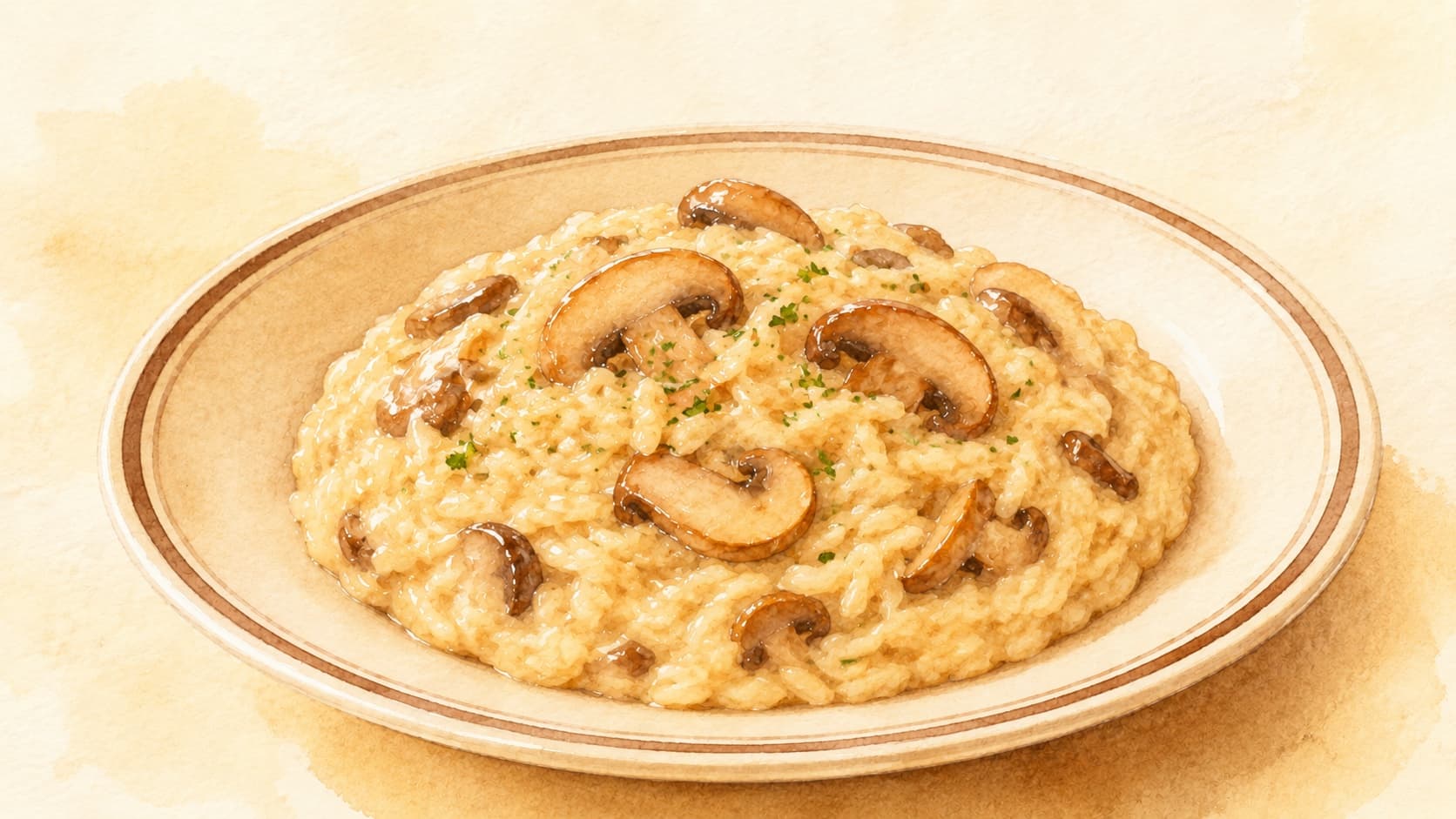
Ingredients
- 300 g Arborio rice
- 1 liter vegetable stock, heated
- 200 g mushrooms, sliced (e.g., cremini or shiitake)
- 1 medium onion, finely chopped
- 2 cloves garlic, minced
- 100 ml dry white wine
- 50 g grated Parmesan cheese
- 2 tbsp olive oil
- 30 g unsalted butter
- Salt to taste
- Black pepper to taste
- Fresh parsley, chopped for garnish
Steps
In a large pan, heat the olive oil over medium heat. Add the chopped onion and cook for about 5 minutes until translucent; this builds a flavor base.
Add the minced garlic and sliced mushrooms, cooking for another 5 minutes until the mushrooms are softened and have released their moisture.
Stir in the Arborio rice, toasting it for 2-3 minutes until it becomes slightly translucent, which helps to develop a nutty flavor.
Pour in the white wine and let it simmer until mostly evaporated, about 2 minutes. This adds depth to the risotto.
Begin adding the warmed vegetable stock, one ladle at a time, stirring constantly. Allow each addition to be absorbed before adding the next, about 15 minutes total.
Once the rice is al dente, remove from heat and stir in the butter and Parmesan cheese until creamy. Season with salt and pepper to taste.
Garnish with fresh parsley and serve immediately for the best texture.
Tools you'll want
- · Microplane Premium Classic Zester (46020)
Why this works
Risotto's creamy texture comes from the starch released by Arborio rice (a short, plump Italian rice variety prized for its high surface starch — the source of risotto's natural creaminess, no cream required) as it cooks slowly and is stirred frequently. This method allows the rice to absorb the stock (a savory simmered broth made from bones, vegetables, or both — used here to season and steam the rice) gradually, creating a silken sauce that coats each grain. The addition of wine adds acidity, balancing the richness of the butter and cheese. If the risotto becomes too thick, simply add more stock or water to regain the desired creamy consistency. Conversely, if it appears too soupy, let it cook a little longer uncovered to evaporate excess liquid. Additionally, using heated stock maintains an even cooking temperature, which is crucial for achieving the perfect risotto texture. By controlling the amount of liquid and the cooking time, you can ensure a dish that is both flavorful and creamy, embodying the essence of a traditional Italian risotto.
Common mistakes
Washing the Arborio rice "to clean it." Target: rice toasted dry in fat for 1–2 minutes, no rinsing. Why it matters: risotto's signature creaminess is the released surface starch (amylopectin) of short-grain rice — that thick, glossy sauce around each grain is literally starch in suspension, not added cream. Rinsing washes that starch down the drain, and you end up with a soupy, separated risotto no matter how much you stir. What to do: leave the rice as it comes from the bag. The toasting step (la tostatura) — rice in oil and butter until the grains turn glassy with a chalk-white core — also seals the outer starch a little, so it releases slowly into the stock instead of all at once.
Pouring in cold stock from the fridge. Target: stock simmering on the side, added a ladle at a time at roughly the same temperature as the risotto pan. Why it matters: cold liquid hitting hot rice drops the pan temperature each time and stops the gradual starch release. Risotto then takes longer, the grains over-soften on the outside before the inside cooks, and you lose the al dente core that distinguishes risotto from rice pudding. What to do: keep the stock on a back burner at a quiet simmer. Add ladle by ladle, stir until the surface no longer pools liquid when you draw the spoon across, then add the next ladle.
Stirring constantly the whole time (the cookbook lie). Target: stir frequently — every 30 seconds or so — but not without pause; the rice needs surface contact with the pan to release starch. Why it matters: continuous, agitated stirring breaks the grains. The starch you want is the outer starch, polished off gently by movement, not the inner starch released by snapped grains — which makes the dish gluey, not creamy. What to do: stir in slow figure-eights with a wooden spoon. Let the rice settle for 20–30 seconds between additions so the bottom can release starch into the liquid. The classic test: drag the spoon across the pan; the rice should part briefly and then close behind it (the "wave").
Adding butter and cheese while the pan is on the heat (no mantecatura). Target: pull off the heat, rest 1 minute, beat in cold butter and Parmesan vigorously. Why it matters: mantecatura (the final beat-in of cold butter and cheese) is what creates risotto's signature glossy, emulsified finish. Cold fat hitting warm — not boiling — rice forms a stable emulsion of starch, water, fat, and cheese protein. On direct heat, the cheese tightens and the butter splits, leaving an oily slick. What to do: take the pan off the burner the moment the rice is al dente with a touch of remaining liquid (it should still be "wavy," not stiff). Rest a minute, then beat in cold butter cubes and grated Parmesan with energy. Serve immediately — risotto stiffens fast.
What to look for
- Toasted rice grains that look slightly translucent at the edge with a chalk-white centre — that is la tostatura done. If grains are uniformly white still, give them another minute in the fat before any liquid.
- A loose, glossy texture that flows in a slow wave when you tip the pan — the Italian all'onda ("on the wave"). If the risotto stays in a stiff mound, it is over-reduced; add a small splash of stock and stir back.
- A single bite revealing a tender grain with a faint chalk-white pinhead of starch at its very core — al dente. The grain should yield with light resistance, not crunch and not collapse.
- A finish that smells of warm Parmesan rind and earthy mushrooms, not boiled milk or butter splitting — the mantecatura worked. Beads of fat floating on top mean the pan was too hot when the butter went in.
A note on history
Rice itself reached Italy by way of Sicily in the 13th century, brought by Moors and Saracens, and travelled north to the Po Valley — flatland, abundant water, humid summers — where it found ideal conditions. The Po Valley remains one of Europe's largest rice-producing regions today. Risotto as a cooked, mantecato dish (the technique of slowly adding stock and finishing with butter and cheese) is associated with Milan and Lombardy, with cookbook recipes appearing in the 1800s and the Milanese chef Felice Luraschi naming risotto alla Milanese giallo in 1929 (Wikipedia: Risotto; Italy Magazine: The History of Risotto alla Milanese).
Get the essays in your inbox — free
Weekly notes on flavor, fermentation, and food history — the writing behind the Atlas of Flavor. No spam; unsubscribe anytime.