
Lemon Curd
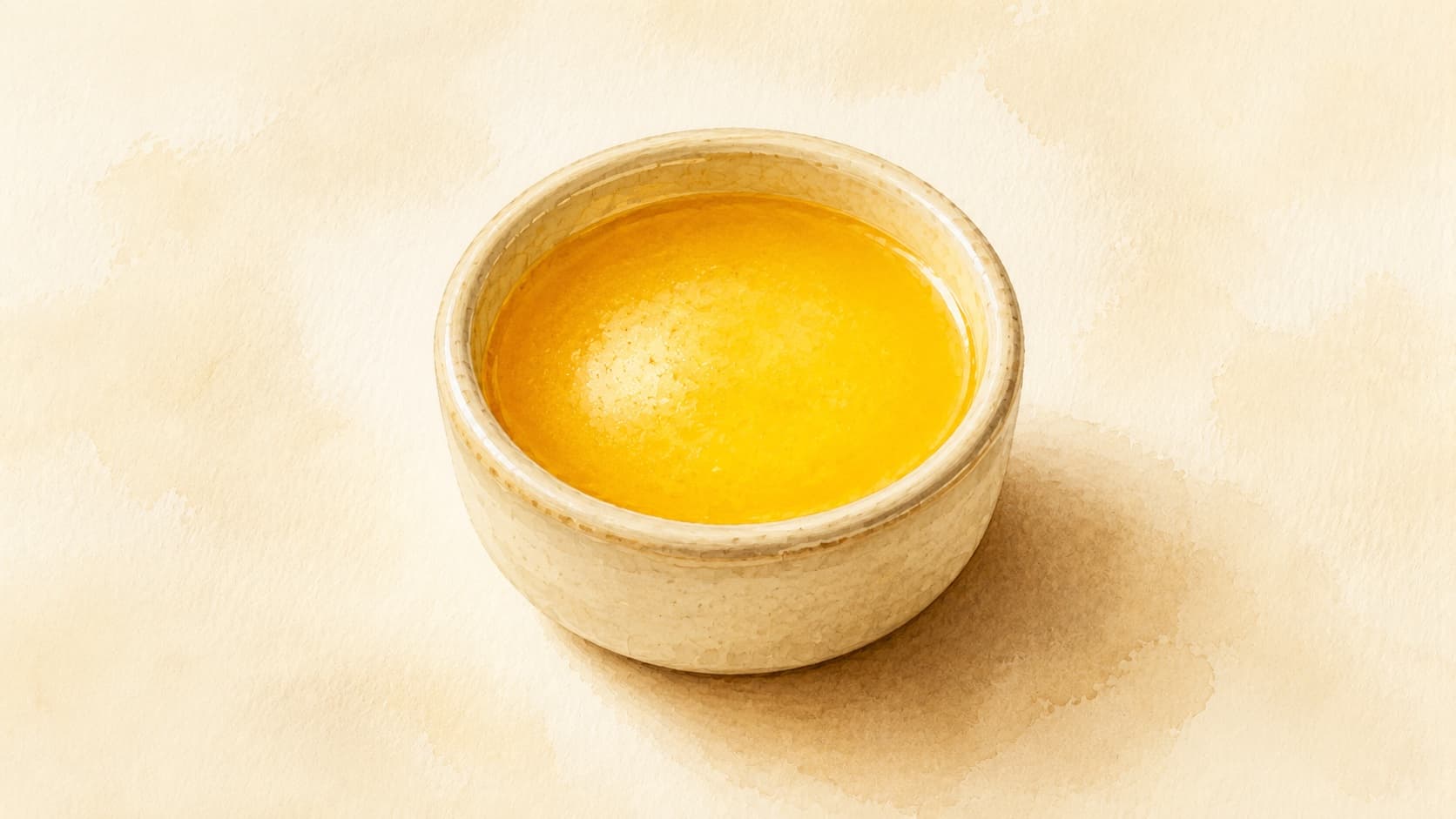
Lemon curd is a thick, tangy sauce made from lemon juice, sugar, eggs, and butter, used in various desserts like tarts and pastries.
Contents (5 sections)▾
Ingredients
- 150 g granulated sugar
- 3 large eggs
- 150 ml fresh lemon juice
- zest of 2 lemons
- 100 g unsalted butter, cubed
Steps
In a mixing bowl, whisk together the granulated sugar and eggs until pale and fluffy, about 2 minutes.
Stir in the fresh lemon juice and lemon zest, then transfer the mixture to a saucepan.
Over medium-low heat, cook the mixture, stirring constantly, until it thickens and coats the back of a spoon, about 10 minutes. Do not let it boil.
Once thickened, remove from heat and whisk in the cubed butter until fully melted and incorporated.
Strain the lemon curd through a fine-mesh sieve into a clean bowl to remove any lumps.
Allow the lemon curd to cool to room temperature before covering and refrigerating.
Why this works
The key to a smooth lemon curd lies in gentle cooking and continuous stirring. As you heat the mixture of eggs, sugar, and lemon juice, the proteins in the eggs coagulate, thickening the curd. If the temperature is too high, the eggs can scramble, resulting in a lumpy texture. If it breaks and appears curdled, immediately remove it from the heat and whisk vigorously to bring it back together. Straining the curd ensures a silky finish, removing any coagulated bits. The addition of butter enriches the flavor and adds creaminess, creating a delightful mouthfeel. This lemon curd can be used as a filling for tarts or as a topping for desserts like pavlova or cheesecake, making it a versatile component in your dessert repertoire.
Common mistakes
Curd cooked too cool — undercooked egg and salmonella risk (BLOCK-level safety). Target: Curd thickens visibly and coats the back of a spoon; instant-read thermometer reads 78–82 °C (172–180 °F) at the thickest part. Refrigerate immediately at ≤4 °C and use within 5–7 days. Why it matters: Lemon curd contains raw egg cooked gently. The temperature window for safety is the same that thickens it — egg proteins start to denature (the protein chains unfold and lock together, the chemistry behind cooked egg) around 65 °C and continue thickening through about 82 °C. Below the upper end, pathogens like Salmonella may survive; at storage above 4 °C they can multiply. Stop short of pasteurisation and the dish is unsafe for vulnerable people; let it warm in storage and it spoils faster than it should. What to do: Use a thermometer if you have one — pull from the heat when it reads 78–82 °C and just coats the back of a spoon. Once strained and cooled, cover with cling film pressed onto the surface (this prevents a skin) and refrigerate within 90 minutes. Discard if it smells off or develops mould.
Eggs scrambled by direct, fierce heat. Target: A smooth, silky curd with no visible egg threads or grainy texture. Why it matters: Egg proteins coagulate fast above about 70 °C; if any patch of the mixture gets significantly hotter than its neighbours — common with direct flame or hot pan walls — those proteins set into solid scrambled-egg flecks while the rest stays liquid. Once cooked, those flecks cannot be re-melted. What to do: Cook over medium-low heat in a heavy-bottomed pan, or use a double boiler (a bowl set over barely simmering water — the water never touches the bowl, so the curd cannot exceed 100 °C). Stir constantly with a silicone spatula, reaching the corners and edges where heat builds up first.
Curd left curdled, never strained. Target: A glass-smooth surface when the curd is finished and cooled. Why it matters: Even careful cooks get a few tiny coagulated bits — the egg's chalazae (the white ropy strands anchoring the yolk) and small set patches at pan edges. A fine sieve catches them and gives you the texture professionals achieve. Skip it and you can feel grit on the tongue. What to do: Pour the hot finished curd through a fine-mesh sieve (or muslin) into a clean bowl. Use a spatula to push it through; what's left in the sieve is the coagulated debris you don't want.
Butter added while curd is too hot. Target: Butter melted smoothly into the curd, giving a glossy, slightly opaque finish. Why it matters: Butter is an emulsion of fat, water, and milk solids. Added to curd above about 90 °C, the emulsion breaks — fat pools on top, milk solids form specks — and you lose the silky mouthfeel. Cooler and the butter blends in smoothly. What to do: Pull the curd from the heat, let it sit one minute, then whisk in the butter a few cubes at a time. The residual heat melts the butter without breaking it.
What to look for
- Mixture coating the spoon — when you draw a finger across the back, the line holds without dripping closed: this is the classic nappe stage, the cue that thickening is complete.
- A glossy, opaque pale yellow: the egg has cooked but not over-cooked; deeper yellow with visible egg threads means you went too far.
- Steam, not bubbles, rising from the surface: simmering means too hot. Curd should never boil.
- A slight thickening on the spatula edge that increases noticeably in the last minute: thickening accelerates near 80 °C; pull off heat the moment it does, the residual heat finishes the job.
A note on history
Lemon curd has its roots in British cookery, with the earliest mention of the term in print appearing in 1844, in The Lady's Own Cookery Book by Lady Charlotte Campbell Bury. It rose to wide popularity in late 19th-century England as an afternoon-tea treat, spread on scones, crumpets, or fresh bread, and as a filling for tarts and small cakes. Earlier 17th- and 18th-century recipes for lemon-based spreads were thicker and closer to preserves, often using the curd of clotted cream rather than eggs as the thickener. Sources: Fruit curd (British Food: A History), The Lemon Curd Mystery (The Will Bureau).
Get the essays in your inbox — free
Weekly notes on flavor, fermentation, and food history — the writing behind the Atlas of Flavor. No spam; unsubscribe anytime.