
Hong Shao Rou
Experience the rich flavors of Shanghai with this sweet and savory Hong Shao Rou, a classic red-braised pork belly dish.
Contents (5 sections)▾
Ingredients
- 800 g pork belly, cut into 4 cm cubes
- 3 tbsp sugar
- 200 ml Shaoxing wine
- 100 ml dark soy sauce
- 3 slices ginger
- 3 star anise pods
- 1 tsp Sichuan peppercorns
- 2 cups water
- 2 scallion greens, chopped for garnish
- salt to taste
Steps
Blanch the pork belly cubes in boiling water for 5 minutes to remove impurities, then drain and set aside.
In a large pot, heat the sugar over medium heat until it melts and caramelizes to a deep amber color, about 5-7 minutes. Stir constantly to prevent burning.
Add the blanched pork belly to the pot, stirring to coat the pieces in caramel. Cook for 2-3 minutes until the pork is well-coated.
Pour in the Shaoxing wine and dark soy sauce, stirring to combine. Add the ginger, star anise, Sichuan peppercorns, and water.
Bring the mixture to a boil, then reduce the heat to low. Cover and simmer for 45 minutes, stirring occasionally until the pork is tender and the sauce has thickened.
Remove the lid and increase the heat to medium, cooking for an additional 5-10 minutes to reduce the sauce further, if necessary. Season with salt to taste.
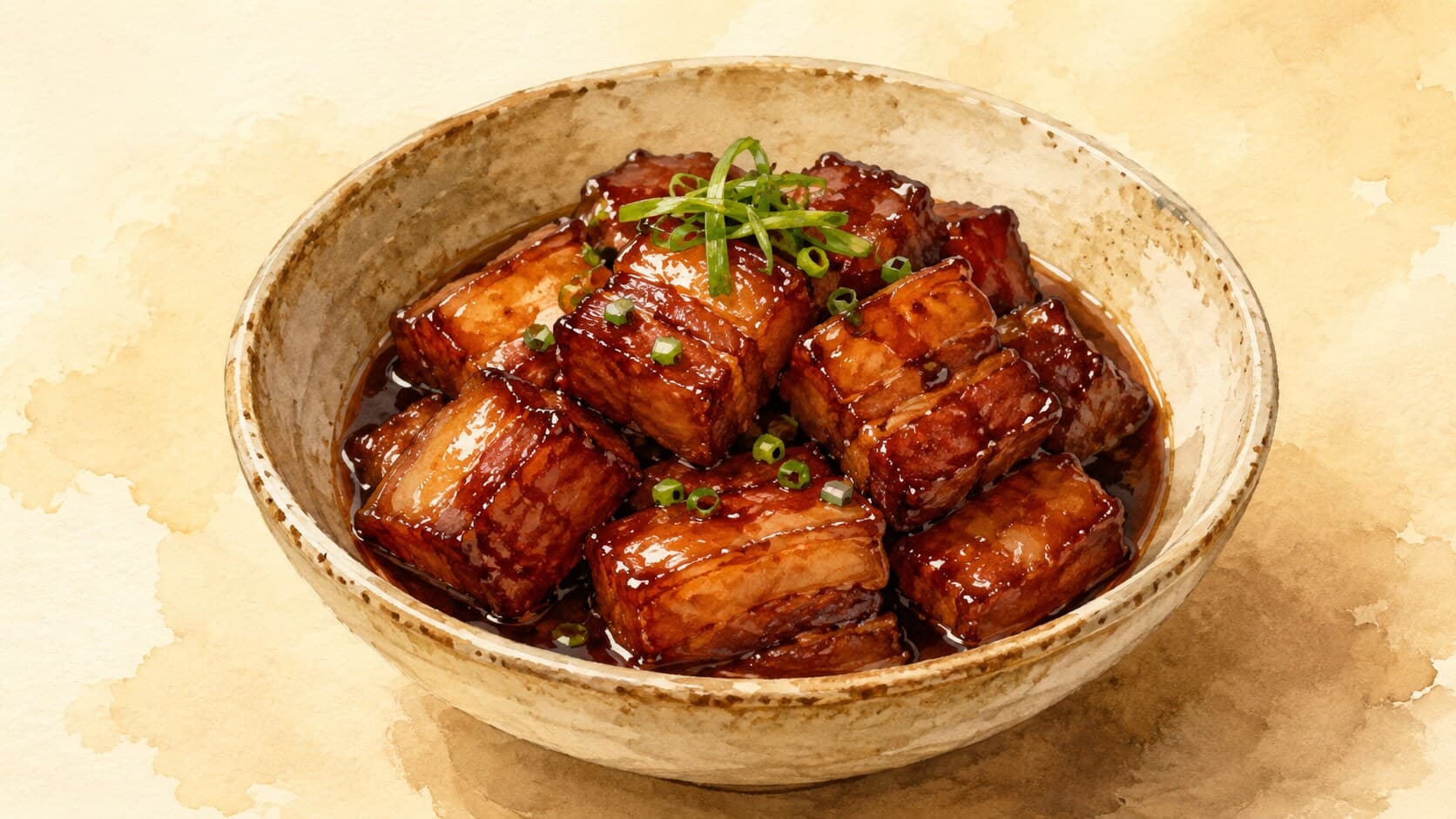
Serve the pork belly in a lacquer-like bowl, garnished with chopped scallion greens.
Why this works
The technique of blanching the pork belly removes excess impurities and helps achieve a cleaner flavor in the final dish. Caramelizing the sugar is crucial because it adds depth and a rich sweetness that balances the savory notes from the dark soy sauce and Shaoxing wine (a fermented Chinese rice wine, amber-colored and slightly nutty — the standard cooking wine in eastern Chinese braises). The braising process allows the pork to absorb the flavors of the sauce while becoming tender. If the sauce seems too thick towards the end, you can add a little water to adjust the consistency. Conversely, if it appears too thin, simmer uncovered for a few more minutes to concentrate the flavors further. The combination of spices adds warmth and complexity, making this dish a comforting favorite. The high sugar content also gives the pork its signature glossy finish, which is visually appealing and enhances the overall dining experience.
Variant + alcohol note. Two canonical regional variants exist: Shanghai-style (sweet, dark, soy-forward — this recipe) and Hunan/Mao-style (spicier, drier finish). Shaoxing rice wine is canonical to the Shanghai style. For alcohol-avoidant cooks, substitute equal-volume chicken stock plus 1 tsp rice vinegar — the depth shifts slightly but the dish still works. The long braise means the pork is fully cooked through; no doneness concerns.
Common mistakes
Skipping the blanch.
Target: Always start with a cold-water blanch — cover the pork belly cubes with cold water, bring to a boil, simmer 3–5 minutes, then drain and rinse the cubes under cold running water until they no longer feel slick.
Why it matters: The blanch is not for cooking — it is for clarification. Pork belly carries blood, scum, and surface fat residues that, if left in the braise, settle as a gray fatty film and a slightly muddy off-flavor in the finished sauce. A clean blanch is the difference between a glossy mahogany glaze and a dull, greasy one. The pork will fully cook through in the long braise, so the blanch is purely a quality step.
What to do: Cold water start (a hot-water plunge seals the surface and traps the impurities). Skim the gray foam as it rises. Drain, rinse, pat dry — the dry surface helps the caramel cling in the next step.
Burning the sugar instead of caramelizing it.
Target: Melt the sugar slowly over medium-low heat until it turns deep amber — the color of strong tea — and smells nutty and slightly bitter. Stop before it goes black or smokes harshly.
Why it matters: Sugar caramelization is the entire foundation of the dish's color and bitterness-balanced sweetness. Caramelization (the browning reaction of sugar above 160°C / 320°F, producing nutty, slightly bitter compounds) is what gives red-braised pork its mahogany hue and its grown-up, not-too-sweet finish. Burnt sugar turns acrid and locks the dish into a sour-bitter note no amount of soy can rescue.
What to do: Work in a heavy pan over medium-low heat. Tilt and swirl rather than stir. Drop a piece of pork in the moment the color is right — the cooler pork stops the carry-over and locks in the perfect shade.
Crowding the pan when adding pork to the caramel.
Target: Cubes in a single layer, with a finger's gap between them, so each face gets caramel contact and a touch of Maillard browning.
Why it matters: Caramel-coating the pork is the second color and flavor stage. If the pan is crowded, the cubes steam in their own moisture, the caramel slides into the bottom, and you get pale, sauced pork instead of glossy lacquered pork. The combination of caramelization on the sugar and Maillard browning (the browning reaction between amino acids and sugars on meat surfaces, producing roasted depth) on the meat is what gives the finished braise its layered "red-cooked" flavor.
What to do: Two batches is fine for 800 g. Toss each batch to coat for 2–3 minutes before adding the next liquid stage.
Hard boil instead of low braise.
Target: A gentle, lid-on simmer — surface barely trembling, occasional lazy bubbles — for the full 45 minutes.
Why it matters: Pork belly's fat needs slow, low rendering to dissolve its connective tissue into gelatin and leave the meat tender rather than fibrous. A rolling boil agitates the fat into the sauce as droplets (broken emulsion) instead of letting it slowly render and meld in, and it also drives off the volatile aromatics in the Shaoxing wine and spices. The braise is the workhorse of the whole dish — it must be patient.
What to do: Bring to a boil once, then drop the heat to the lowest setting that keeps any motion. Check every 10–15 minutes that the pan isn't dry; nudge the heat up only at the end for the lid-off reduction.
What to look for
- After blanching: the cubes look pale rose-gray, the rinsing water runs clear, the surface is dry to the touch — that is your clean canvas for the caramel.
- At caramel readiness: deep amber, the color of strong tea, with a faint thread of smoke and a nutty smell — not black, not pale gold — overshoot by 5 seconds and it goes bitter.
- After the caramel toss: pork cubes shine like polished mahogany, no sugar pooled at the bottom of the pan — every face has caught color.
- Mid-braise: surface trembles with the occasional bubble, fragrant steam carrying soy and star anise rises lazily — never a rolling boil, never silent.
- At finish: the sauce reduces to a glossy lacquer that ribbons off the spoon, the pork yields immediately to a chopstick but holds its cube shape — fully cooked through, with rendered fat translucent and gelatinous, not greasy.
A note on history
Hong shao rou ("red-braised pork") belongs to the red-cooking (hong shao) tradition of eastern China — the broader Jiangnan region encompassing Shanghai, Jiangsu, and Zhejiang — where braising meats with soy sauce, fermented soy products, caramelized sugar, and rice wine developed into a defining technique of the region's cuisine (Wikipedia, The Mala Market). The Shanghai style covered here is characterized by a sweeter, glossier sauce from a higher proportion of rock sugar and a generous pour of Shaoxing rice wine, and it has been a marker of Shanghai's culinary heritage since the late Qing and early Republic eras, served at family gatherings, Lunar New Year, weddings, and birthdays as a symbol of prosperity and good fortune (Urban China Travelogue, The Woks of Life). A spicier, drier Hunan-style variant is famously associated with Mao Zedong and is sometimes labeled "Mao-style" red-braised pork (Wikipedia).
Get the essays in your inbox — free
Weekly notes on flavor, fermentation, and food history — the writing behind the Atlas of Flavor. No spam; unsubscribe anytime.