
Hijiki no Nimono
Hijiki no Nimono is a simmered dish made with hijiki seaweed, carrots, and soy sauce, showcasing umami and texture contrast.
Contents (5 sections)▾
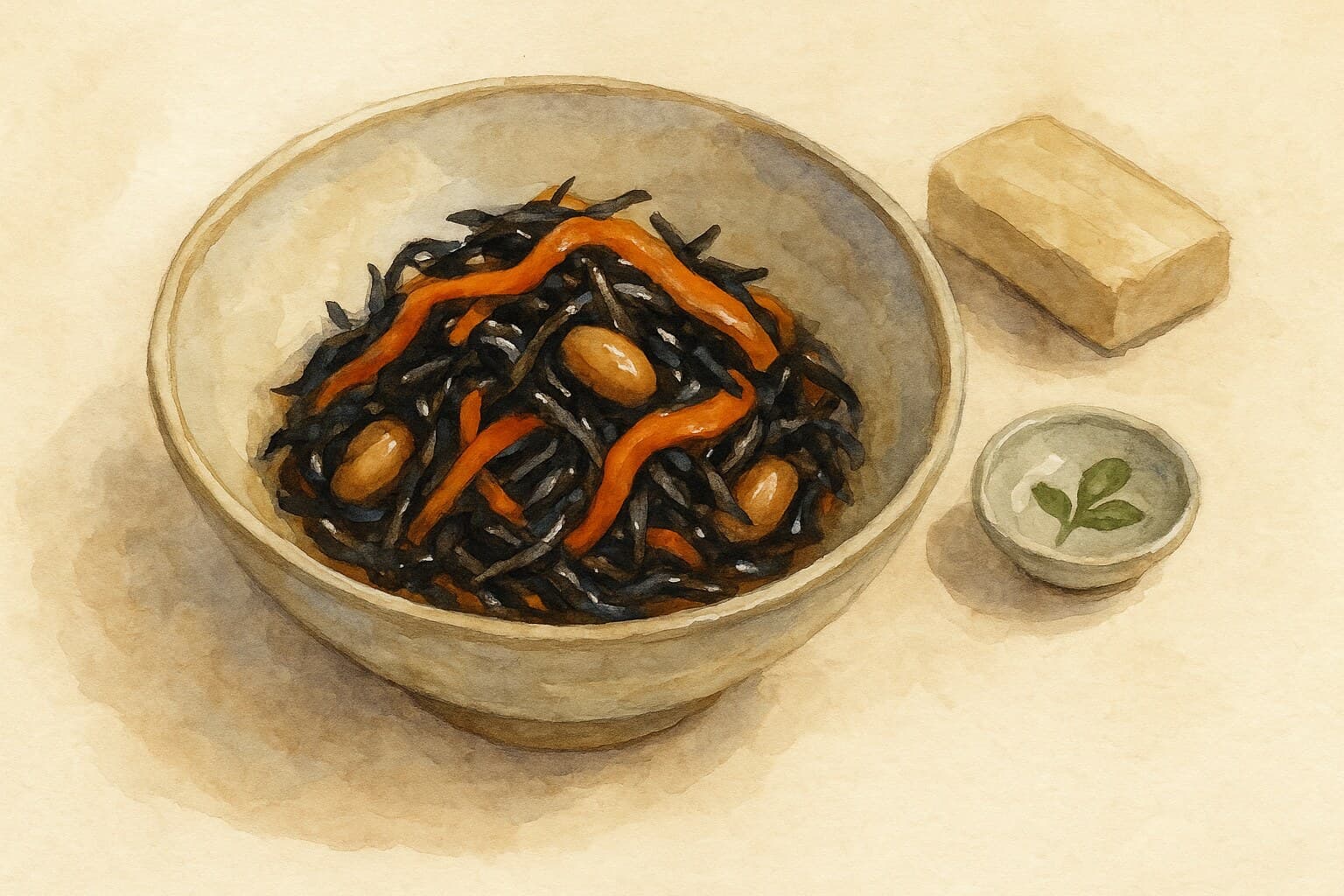
Ingredients
- 30 g hijiki seaweed, dried
- 1 medium carrot, sliced into thin ribbons
- 100 g aburaage (fried tofu), cut into small cubes
- 300 ml dashi stock
- 2 tbsp soy sauce
- 1 tbsp mirin
- 1 tbsp sugar
- to taste salt
Steps
Soak the hijiki seaweed in warm water for about 10 minutes until rehydrated, then drain and set aside.
In a pot, combine the dashi stock, soy sauce, mirin, and sugar. Bring to a gentle simmer over medium heat.
Add the drained hijiki, carrot ribbons, and aburaage cubes to the pot. Stir to combine and ensure the vegetables are submerged.
Reduce heat to low and simmer for about 15 minutes, allowing the flavors to meld.
Taste and adjust seasoning with salt if necessary. Remove from heat and let cool before serving.
Why this works
The technique of simmering hijiki (a thin, jet-black sea vegetable common in Japanese home cooking, sold dried and rehydrated before use) in dashi infuses the seaweed with savory umami, and softens its texture, making it more palatable. Dashi, a fundamental component of Japanese cuisine, adds depth to the dish while the soy sauce and mirin provide a balanced sweetness. The addition of carrots and aburaage (thin sheets of deep-fried tofu, light and spongy — they soak up the broth) enhances the texture and visual appeal, making the dish suitable for bento. If the hijiki seems too tough after soaking, ensure it is soaked in warm water long enough to fully rehydrate. If the dish appears too salty, balance it with a touch of water or additional sugar to counteract the flavor. This make-ahead dish can be stored in the refrigerator for several days, making it a convenient side for busy days.
Common mistakes
Under-soaking the hijiki.
Target: Soak dried hijiki in plenty of room-temperature or lukewarm water for a full 20–30 minutes until each strand is plump and pliable.
Why it matters: Dried hijiki expands roughly 8–10 times its dry weight. If you simmer it before it has rehydrated fully, the strands stay wiry in the center and absorb dashi unevenly. Cold-soaking also gives time for the inorganic arsenic naturally present in hijiki to leach out into the soaking water, which you then drain away — a meaningful safety step, not just a texture step.
What to do: Soak, drain into a fine-mesh strainer, then rinse under cold running water for 10–15 seconds. Hijiki contains inorganic arsenic, so eat it in moderation as part of a varied diet rather than daily in large portions.
Skipping the oil sauté before simmering.
Target: Warm a teaspoon of neutral oil (or toasted sesame oil) in the pan and toss the drained hijiki, carrot, and aburaage for 1–2 minutes before any liquid goes in.
Why it matters: Hijiki carries deep marine flavor compounds that are fat-soluble. A brief sauté coats every strand in a thin film of oil, which both blooms those aromas and helps the dashi cling rather than rinse the seasoning off later. The aburaage also de-greases slightly here, so the finished bowl tastes savory rather than oily.
What to do: Sauté over medium heat just until everything looks glossy and the carrot edges soften — no color, no fond. Then pour in the dashi and seasonings.
Boiling instead of barely simmering.
Target: A gentle simmer (small bubbles around the edges, surface barely moving) for the full 15 minutes — never a rolling boil.
Why it matters: Nimono cooking (the Japanese simmer-and-season technique) relies on slow inward diffusion of dashi and soy. A hard boil drives off the volatile aroma compounds in dashi (the kombu and katsuobushi notes that justify the entire dish) and pushes the carrot toward mush before the hijiki has absorbed anything. The goal is infusion, not reduction.
What to do: Bring to a boil once to dissolve the sugar, then drop the heat immediately. If your pan runs hot, set a drop-lid (otoshibuta — a small lid that sits directly on the food to circulate liquid) or a circle of parchment directly on the surface.
Serving it straight off the heat.
Target: Cool the pot to room temperature, then chill for at least an hour before serving.
Why it matters: Like most nimono, hijiki no nimono finishes flavoring during the cool-down phase. As the liquid cools, the seasoning migrates back into the ingredients rather than sitting in the broth. Fresh off the stove the dish tastes thin and one-note; the next day it tastes layered.
What to do: Cook it the morning ahead, or the night before. Stored in a covered container in the fridge, it holds for 3–4 days and gets better through day two.
What to look for
- After soaking: each strand is springy, fully black-brown, and bends without snapping — no wiry cores, no grainy bite when you press one between your fingers.
- During sauté: the pan smells faintly of the sea and toasted carrot — sweet and savory, never raw or vegetal.
- Mid-simmer: the liquid sits one finger below the ingredients and barely trembles — a slow inward draw, not a bubbling reduction.
- When done: hijiki strands hold their shape but yield instantly to chopsticks; the sauce coats but does not pool — glossy, not soupy.
A note on history
Hijiki has been part of the Japanese diet, traditionally harvested from rocky coastlines around Japan, Korea, and China, and valued both for its mineral content (calcium, iron, magnesium) and for its symbolic association with longevity and good fortune in spring meals after the seaweed harvest (Nippon.com, Japambience). The simmered form with carrot and aburaage is a staple of Japanese home cooking and a common side at set meals and izakaya, made ahead and held in the refrigerator as part of the everyday tsukuriokina rotation (RecipeTin Japan). Modern food-safety advice notes that hijiki contains inorganic arsenic, so it is best enjoyed in moderation as part of a varied diet rather than as a daily staple in large portions (Nippon.com).
Get the essays in your inbox — free
Weekly notes on flavor, fermentation, and food history — the writing behind the Atlas of Flavor. No spam; unsubscribe anytime.