
Gyoza
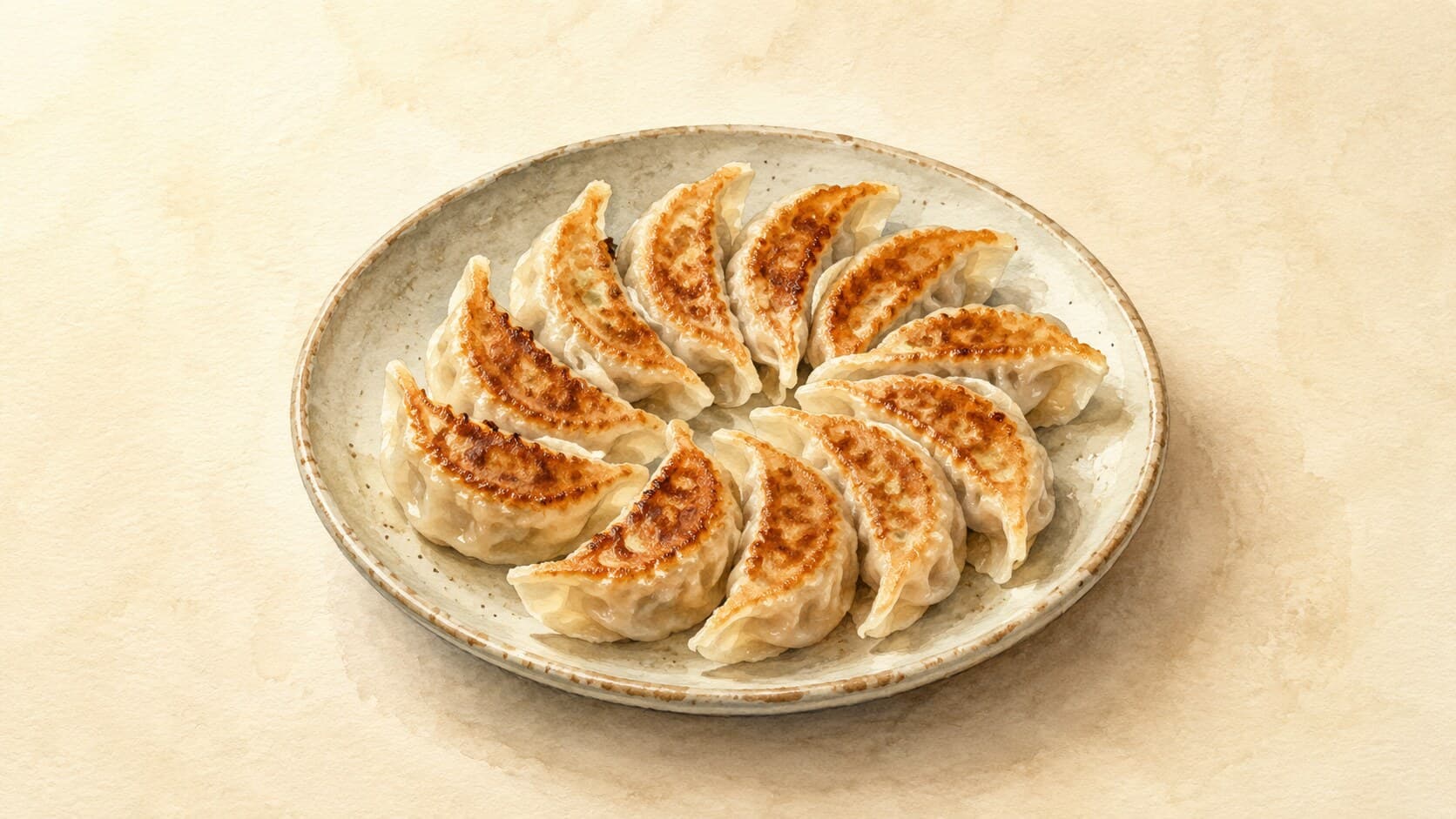
Gyoza are Japanese dumplings filled with seasoned pork, wrapped in thin dough, and pan-fried for a crispy bottom and tender top.
Contents (5 sections)▾
Ingredients
- 200 g ground pork
- 100 g cabbage, finely chopped
- 2 spring onions, finely chopped
- 1 clove garlic, minced
- 1 tsp ginger, grated
- 1 tbsp soy sauce
- 1 tsp sesame oil
- 1 package gyoza wrappers
- vegetable oil for frying
- water for steaming
Steps
In a bowl, combine ground pork, cabbage, spring onions, garlic, ginger, soy sauce, and sesame oil. Mix well to ensure all ingredients are evenly incorporated.
Place a gyoza wrapper in your palm and add about 1 tablespoon of the filling in the center. Moisten the edges of the wrapper with water and fold it in half, pinching to seal. Create pleats along the edge for a decorative touch.
Heat a non-stick pan over medium heat and add 1 tablespoon of vegetable oil. Arrange the gyoza in the pan, ensuring they don’t touch each other. Fry for about 2-3 minutes until the bottoms are golden brown.
Carefully add 50 ml of water to the pan and cover immediately. Steam the gyoza for about 5-7 minutes until the water has evaporated and the wrappers are tender. Cook the ground meat until it reaches 71 °C / 160 °F on an instant-read thermometer (no longer pink throughout) — colour, float and time are guides, not the safety test.
Why this works
Gyoza, or Japanese dumplings, are a dish that embodies umami through the combination of meat and vegetables. The use of ground pork provides a rich flavor, while the addition of cabbage adds texture and moisture to the filling. Wrapping the gyoza requires a bit of technique; the key is to create a tight seal to prevent the filling from leaking out during cooking. When frying, the oil creates a crispy bottom layer, while the steaming process cooks the dumplings evenly. If the gyoza seem too dry after cooking, consider adding a splash more water during the steaming step, or serve them with a dipping sauce to enhance the flavor. The pleats add visual appeal and help to hold the filling securely. Gyoza can be a quick weekday meal because they can be made ahead and frozen, ensuring that you have delicious homemade dumplings ready to cook whenever the craving strikes.
Common mistakes
Skipping the cabbage salt-and-squeeze. Target: Salt the chopped cabbage, rest 10 minutes, then squeeze out as much water as you can. Why it matters: Cabbage is around 90% water. Unsalted cabbage in the filling weeps liquid as it cooks, blowing out the wrappers and giving you watery, sad gyoza. The salt-and-squeeze step (osmosis pulling water out of the cells) is non-negotiable. What to do: Squeeze in a clean towel until almost no water comes out. The cabbage should feel almost dry to the touch before it joins the pork.
Filling under-mixed or over-mixed. Target: Mix the filling until it turns slightly sticky and pale — about 2 minutes by hand or 1 minute with chopsticks in one direction. Why it matters: Mixing builds the myosin (a salt-soluble meat protein that links into a sticky network) — this is what holds the filling together and gives gyoza their springy, juicy bite. Under-mix and it crumbles; over-mix and it turns dense and rubbery. What to do: Stop when the mixture lifts as a single mass and looks slightly tacky. If it still falls apart in chunks, mix another 30 seconds.
Wet pan, oily pan, dirty pan. Target: A clean nonstick or well-seasoned cast iron pan, lightly filmed with oil at medium-high heat. Why it matters: Too little oil and the gyoza stick and tear; too much and they greasily fry instead of crisp. A dirty pan with old residue creates uneven hot spots that scorch some dumplings while leaving others pale. What to do: 1 tablespoon of oil for a 28 cm pan, swirled to coat. Arrange the gyoza in a tight pinwheel or rows so they touch — they support each other when you flip the crust onto the plate. The pork is ground, so it must be fully cooked through by the end of the covered steam — the steam phase is what does the real cooking. Colour and clear juices are not the safety test; an instant-read thermometer pushed into the filling of the largest gyoza should read 71°C / 160°F.
Adding water before the bottoms are golden. Target: Sear bottoms 2–3 minutes until clearly golden brown before adding the steam water. Why it matters: Water added to a half-set crust prevents the Maillard browning (the dry-heat reaction that creates the deep flavor and color on the bottom) from completing. The hallmark of gyoza is the contrast between the crackling brown base and the tender, steamed top. What to do: Tilt one gyoza with a spoon at the 2-minute mark to peek. Wait for the cue. Then pour the water in fast, slap the lid on, and walk away for 5–7 minutes.
What to look for
- Filling after mixing: tacky, pale, lifts in one mass on the chopsticks. If it crumbles, mix more; if it looks shiny and dense, stop.
- Pleated wrapper edge: visibly sealed — no filling peeking through, no air bubble. Air pockets burst in the pan.
- Bottom at the 2-minute mark: uniform deep golden brown, the smell of toasted dough turning sweet. This is your steam-now cue.
- After the lid comes off: wrappers translucent and tender on top, bottoms crackling-crisp. The filling should be fully cooked through — because it is ground pork, confirm with an instant-read thermometer (71°C / 160°F in the filling of the largest one) rather than by colour or juices.
A note on history
Gyoza arrived in Japan in the late 1940s, brought back by Japanese soldiers and civilians repatriated from Manchuria after World War II. The dish itself is an adaptation of Chinese jiaozi — the word "gyoza" likely descends from a Shandong-dialect pronunciation common in Manchuria. Returnees opened the first gyoza shops in Tokyo around 1953, and Utsunomiya became known as Japan's "Gyoza City" because so many of those Manchuria-returnees settled there. The Japanese style diverged from its Chinese parent through thinner wrappers, lighter garlic, and the pan-fried-then-steamed cooking method that defines yaki-gyoza (Asian Inspirations, Nasu Utopia).
Get the essays in your inbox — free
Weekly notes on flavor, fermentation, and food history — the writing behind the Atlas of Flavor. No spam; unsubscribe anytime.