
Daikon to Buta no Nimono
Daikon to Buta no Nimono is a Japanese dish featuring simmered daikon and pork, emphasizing simmering techniques and flavor extraction.
Contents (5 sections)▾
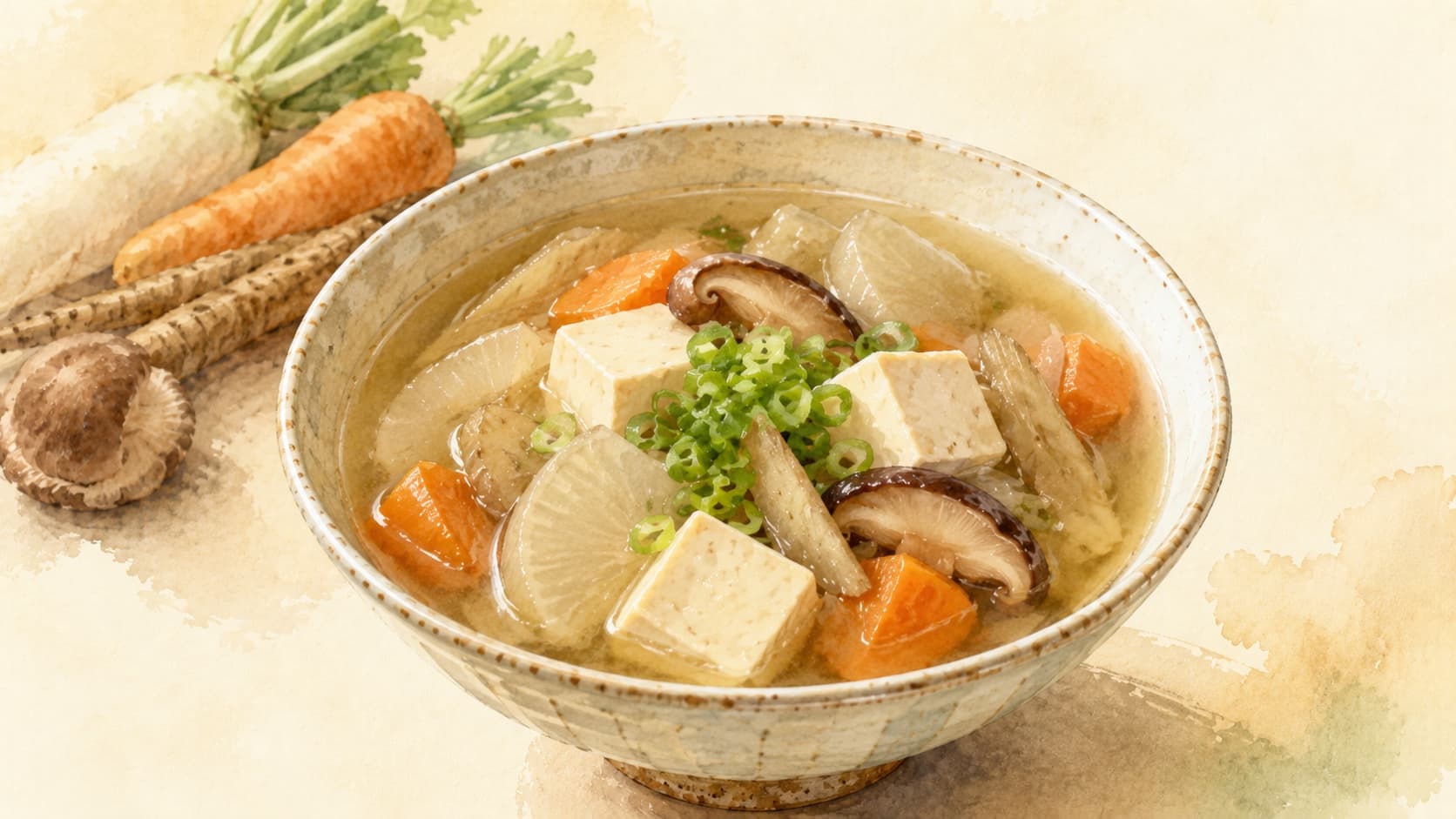
Ingredients
- 500 g daikon, peeled and cut into thick slices
- 300 g pork belly, sliced into bite-sized pieces
- 500 ml dashi stock
- 3 tbsp soy sauce
- 2 tbsp mirin
- 1 tbsp sake
- 1 tsp sugar
- 2 green onions, chopped for garnish
- salt to taste
Steps
In a pot, combine the dashi stock, soy sauce, mirin, sake, and sugar. Bring to a gentle simmer over medium heat.
Add the pork belly to the pot and simmer for about 5 minutes, allowing the flavors to meld and the pork to begin to tenderize.
Add the daikon pieces to the pot, ensuring they are submerged in the broth. Cover and simmer for an additional 10 minutes.
After 10 minutes, check the tenderness of the daikon. If it is too firm for your liking, simmer for an additional 5 minutes.
Taste the broth and add salt if necessary. Remove from heat and let it sit for a few minutes before serving.
Serve hot, garnished with chopped green onions.
Why this works
This recipe employs braising, which combines both moist and dry heat to tenderize the pork while infusing deep umami flavors into the daikon. Dashi stock (a clear Japanese broth made from kombu seaweed and bonito flakes) provides a foundational layer of umami (the deep savory taste found in soy sauce, aged cheese, and ripe tomatoes), complemented by the soy sauce, mirin, and sake, creating a harmonious balance. The simmering process allows the pork fat to render, enriching the broth and enhancing the dish's overall flavor. If the daikon seems too firm after the simmering time, simply extend the cooking time by an additional 5 minutes to ensure it becomes tender. This technique helps in flavor absorption and ensures that each ingredient is harmonized. As with all simmered dishes, patience is key; letting it rest before serving allows the flavors to deepen further.
Common mistakes
Daikon cut too thin, or skipping the pre-cook.
Target: 2–3 cm thick slices or half-moons; ideally par-boil (cook partway in plain water first) the daikon 8–10 minutes before it goes into the seasoned broth.
Why it matters: Daikon is mostly water held inside a firm, spongy cell structure. Thin slices collapse and turn mushy before they absorb flavor, while raw daikon dropped straight into the soy-and-dashi broth can taste sharp and slightly bitter. A brief par-boil softens the cell walls so the seasoned liquid can move in, and washes out the raw pungency.
What to do: Cut thick. Simmer (cook in liquid kept just below a boil) the daikon in plain water — or rice-rinsing water, which helps draw out bitterness — until a skewer meets only light resistance, then transfer it to the flavored broth.
Boiling the pork hard instead of simmering.
Target: A gentle simmer — small bubbles breaking lazily at the surface, roughly 85–95°C — never a rolling boil.
Why it matters: Pork belly is tender only when its collagen (the connective tissue between muscle fibers) slowly converts to gelatin, which needs time at a moderate temperature. A hard boil seizes the muscle proteins and squeezes water out, leaving the meat dry and stringy even while the surface looks cooked. Low and slow does the opposite: the meat stays moist and the rendered fat enriches the broth.
What to do: Bring it up to heat, then drop to low. If the surface is churning, the heat is too high.
Salting (soy sauce) too early and too hard.
Target: Add the bulk of the soy sauce partway through, once the daikon has begun to soften.
Why it matters: Salt firms the surface of both pork and daikon by drawing water out (osmosis — water moving across cell walls toward the saltier side). Hit raw daikon with full-strength soy from the start and the outside tightens before the center has softened, so flavor stops at the skin. Easing the salt in once the vegetable is already tender lets the seasoning travel to the core.
What to do: Start in dashi with just a little of the seasoning, then build the soy, mirin, and sugar as the daikon yields.
Serving it the moment it's cooked.
Target: Cook, then let it rest off the heat at least 15–20 minutes — better still, cool fully and reheat.
Why it matters: Flavor penetration is slowest while everything is hot and the liquid is thin. As a nimono (simmered dish) cools, the broth thickens slightly and is drawn back into the daikon and pork, carrying salt and umami (the savory taste from dashi and soy) deep into each piece. This is why simmered dishes are famously better the next day.
What to do: If you can, make it ahead. At minimum, pull it off the heat and let it stand before serving.
What to look for
- Daikon doneness: a bamboo skewer slides through with almost no resistance, and the slice has turned from opaque white to faintly translucent. That translucency means the broth has replaced some of the daikon's own water — flavor is in, not just on the surface.
- The pork: fork-tender, the fat soft and glossy rather than firm and waxy. Rendered, yielding fat is the sign the collagen has converted; firm white fat means it needs more time.
- The broth: lightly thickened and clear-glossy, coating the back of a spoon in a thin film. Gelatin from the pork gives a faint body that plain seasoned water never has.
- The aroma: no raw, sulfurous daikon smell — just clean soy, dashi, and sweet pork. A lingering sharp note means the daikon needed a longer pre-cook.
A note on history
Nimono — simmering a base ingredient in dashi seasoned with soy, sake, mirin, and a little sweetness — appears in Japanese cookbooks from the early 18th century, but the early forms centered on vegetables, fish, and tofu (Wikipedia: Nimono). Pork in the pot is much newer: everyday meat-eating only became common in Japan during the Meiji era, after the country reopened to foreign influence in the late 19th century (Wikipedia: History of meat consumption in Japan). Pairing pork belly with daikon in a soy-mirin braise belongs to that later tradition of meat nimono — the same family as kakuni, chunks of pork belly stewed with daikon and egg (Wikipedia: Nimono).
Get the essays in your inbox — free
Weekly notes on flavor, fermentation, and food history — the writing behind the Atlas of Flavor. No spam; unsubscribe anytime.