
Crème Brûlée
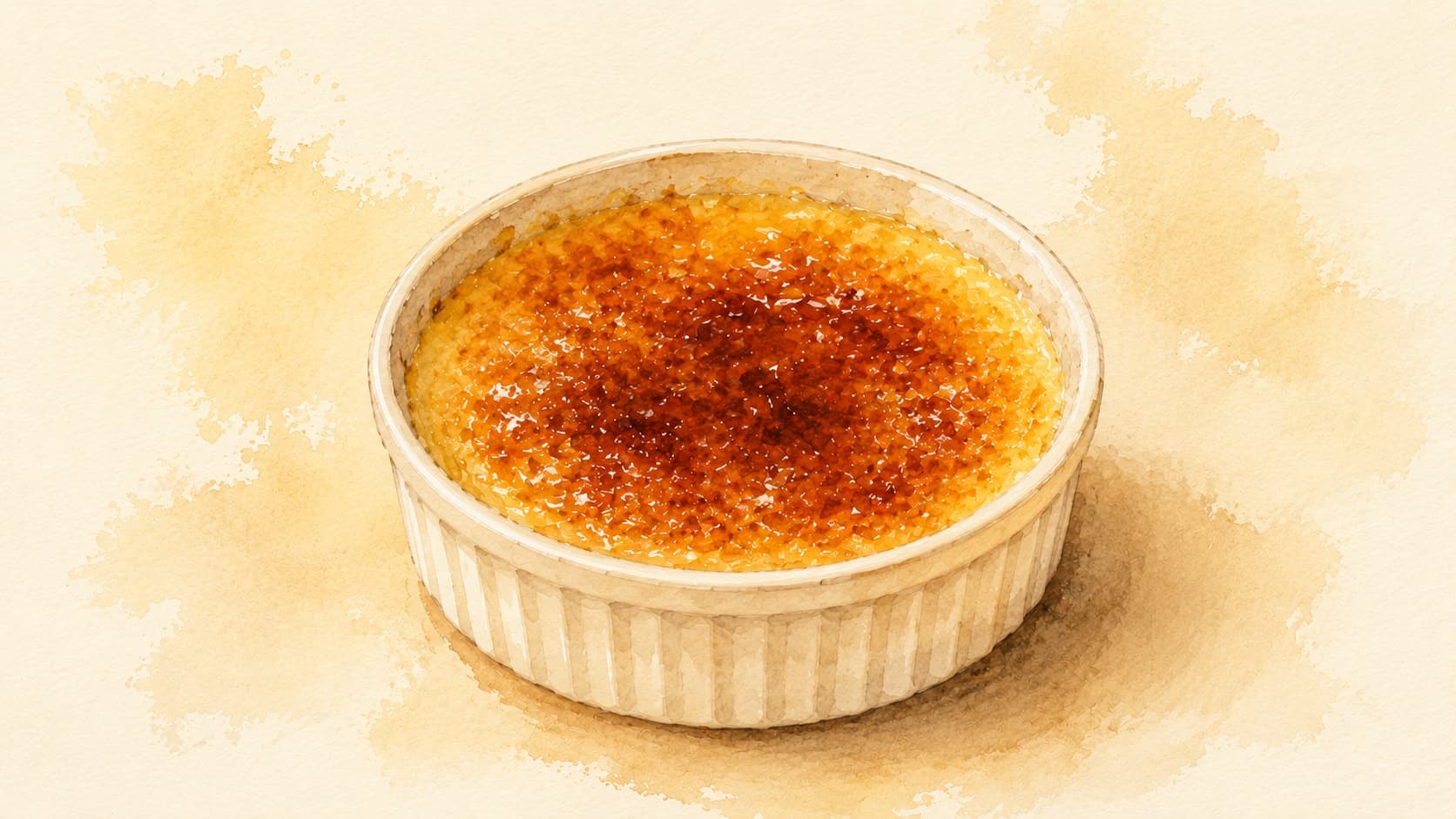
A classic French dessert featuring creamy custard topped with a perfectly caramelized sugar crust.
Contents (5 sections)▾
Ingredients
- 500 ml heavy cream
- 100 g granulated sugar
- 5 large egg yolks
- 1 tsp vanilla extract
- Pinch of salt
- 50 g brown sugar (for topping)
Steps
Preheat your oven to 150°C (300°F). This low temperature ensures gentle baking, preventing curdling of the custard.
In a saucepan, combine heavy cream, granulated sugar, and salt. Heat over medium until just simmering, stirring occasionally.
In a bowl, whisk together egg yolks and vanilla extract until combined. Slowly pour in the warm cream mixture while whisking to temper the yolks.
Strain the custard mixture through a fine sieve into a measuring jug to remove any coagulated bits.
Pour the custard into ramekins and place them in a baking dish. Fill the dish with hot water until it reaches halfway up the sides of the ramekins.
Bake for 30-35 minutes, or until the custard is just set but still slightly jiggly in the center. Remove from the oven and let cool.
Once cooled, refrigerate the ramekins for at least 2 hours, allowing the flavors to meld.
Before serving, sprinkle a thin layer of brown sugar on top of each custard and caramelize it with a kitchen torch until golden and crisp.
Why this works
The key to a successful crème brûlée lies in the balance of ingredients and gentle cooking methods. The heavy cream provides richness, while the sugars contribute sweetness and aid in caramelization (cooking sugar until it browns and turns deeply flavored). Baking the custard (a soft cream set by gently cooked eggs) in a water bath (a tray of hot water the dishes sit in, so they cook slowly and evenly) ensures even cooking, which prevents the egg yolks from curdling and yielding a grainy texture. If the custard seems too runny after baking, return it to the oven for further cooking, checking every few minutes. Cooling the custard thoroughly allows it to set perfectly and enhances the flavor. The caramelized sugar topping should be applied just before serving to maintain its crunchy texture; if it softens, you can re-crisp it with the torch. This method results in a delightful contrast between the smooth custard and the crisp caramel layer.
Common mistakes
Pouring hot cream into the yolks all at once.
Target: Add the warm cream a little at a time, whisking constantly, to temper the yolks.
Why it matters: Egg yolk proteins set (coagulate) with heat. Hit them with all the hot cream at once and they cook on contact into fine scrambled-egg threads, leaving a grainy custard. Tempering — warming the yolks gradually by trickling in the hot cream while whisking — raises their temperature gently so they thicken smoothly instead of curdling.
What to do: Whisk the yolks, then add the cream in a thin stream, a ladle at a time, whisking the whole while. Straining afterward catches any stray cooked bits.
Baking too hot or skipping the water bath.
Target: A low oven (around 150°C / 300°F) with the ramekins in a hot-water bath (bain-marie) reaching halfway up their sides.
Why it matters: Custard is delicate. Direct, fierce oven heat overcooks the edges before the center sets, and the proteins tighten so hard they squeeze out water — the custard turns grainy and weeps. The water bath surrounds the ramekins with gentle, even heat that can't exceed boiling, so the custard cooks slowly and stays silky.
What to do: Set the ramekins in a baking dish, pour hot water around them to halfway up, and bake low and slow. Lift them out of the water as soon as they come from the oven.
Pulling them out too late — or serving them underbaked.
Target: Bake until just set with a slight wobble in the center, then chill at least 2 hours.
Why it matters: This is the safety and texture point together. The custard must bake until it is set — gently cooked through, not raw — never served as a loose raw-egg cream. But overbake it and the same proteins overtighten into a stiff, grainy curd. The target is the narrow window where the edges are firm and only the very center quivers; chilling then finishes the set.
What to do: Jiggle the dish at 30–35 minutes — the center should wobble like soft jelly, not slosh like liquid. If it still sloshes, give it a few more minutes and check again. Cool, then refrigerate until cold and fully set before serving.
Caramelizing the sugar top too far ahead.
Target: Torch a thin, even layer of sugar to deep amber just before serving.
Why it matters: The signature crack is caramelization — sugar melted and browned into brittle glass. Sitting on the cold, moist custard, that crust steadily absorbs moisture and softens, so a top burned an hour early goes tacky. A thick layer also caramelizes unevenly, scorching on top while staying raw beneath.
What to do: Sprinkle a thin, even coat of sugar, torch it just before it goes to the table, and let it set for a minute. If an earlier crust has softened, a quick fresh pass with the torch re-crisps it.
What to look for
- The tempered custard before baking: smooth and pourable, with no flecks of cooked egg. Straining should leave a silky liquid; visible threads mean the yolks caught and the pour was too fast or too hot.
- Doneness in the oven: edges set firm, with only the very center wobbling like soft jelly when you nudge the dish. A liquid slosh means it needs longer; no wobble at all means it has gone too far.
- The chilled custard: a clean, even surface that holds the dent of a spoon, cool and fully set throughout. A runny or weepy custard hasn't set — chill it longer, or it was underbaked.
- The caramel top: a thin, glassy, deep-amber sheet that cracks sharply under the spoon. Pale sugar needs more heat; a soft, tacky top was caramelized too early or laid on too thick.
A note on history
The earliest known printed recipe for crème brûlée ("burnt cream") appears in François Massialot's 1691 cookbook Cuisinier royal et bourgeois; Massialot was a French chef who cooked for the household of the Duke of Orléans, brother of Louis XIV, and his version finished the cream with sugar caramelized by a red-hot iron. The origin is genuinely contested, though: England claims a "burnt cream" served at Trinity College, Cambridge, and Catalonia has its closely related crema catalana, recorded earlier still. These similar custards seem to have arisen in parallel rather than from a single source. (Wikipedia: Crème brûlée; Coquinaria: Crème brûlée)
Get the essays in your inbox — free
Weekly notes on flavor, fermentation, and food history — the writing behind the Atlas of Flavor. No spam; unsubscribe anytime.