
Chicken Stock Classic
A classic chicken stock recipe that forms the foundation for countless dishes.
Contents (6 sections)▾
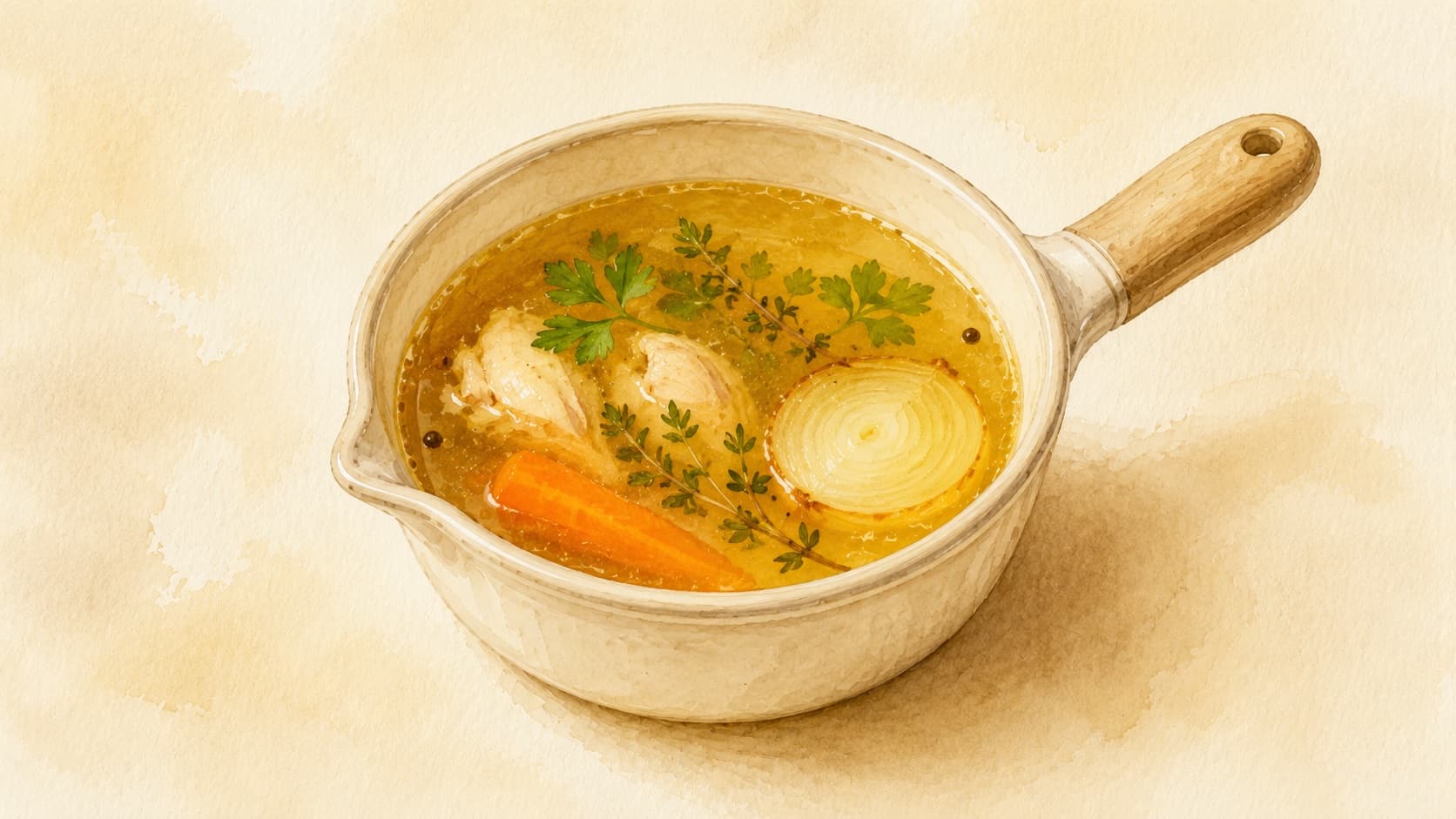
Ingredients
- 1 kg chicken carcasses
- 2 liters water
- 2 medium onions, quartered
- 2 medium carrots, chopped
- 2 celery stalks, chopped
- 4 cloves garlic, crushed
- 1 bay leaf
- 10 black peppercorns
- 2 sprigs fresh thyme
- Salt to taste
Steps
Place the chicken carcasses in a large pot and add 2 liters of cold water. This helps extract flavors evenly.
Bring the pot to a gentle boil over medium heat, then reduce to a simmer. Boiling too vigorously can result in a cloudy stock.
Add onions, carrots, celery, garlic, bay leaf, peppercorns, and thyme to the pot. Simmer uncovered for 4 hours to develop rich flavors.
Skim off any foam or impurities that rise to the surface during cooking to keep the stock clear.
After 4 hours, strain the stock through a fine mesh sieve into a clean container. Discard the solids.
Season with salt to taste and let it cool before refrigerating or freezing for future use.
Why this works
Making chicken stock is a fundamental technique in cooking, as it serves as a base for sauces, soups, and numerous dishes. The process of simmering chicken carcasses allows for the extraction of collagen (the connective tissue in bones and meat that melts into gelatin and gives stock its body) and flavor, resulting in a rich and gelatinous stock. The inclusion of mirepoix (onions, carrots, and celery) adds depth and sweetness, while herbs and spices enhance the aroma. It’s crucial to simmer rather than boil to avoid cloudiness and bitterness; if the stock seems too cloudy at the end, skim more impurities from the surface during cooking. Allowing the stock to cool properly is also vital to prevent bacterial growth, so remember to refrigerate it promptly. This stock can be reduced further to intensify flavors or used as a base for sauces, where an emulsion (fat and water beaten together into one smooth, unified liquid) might be desired for a silky texture. Mastering this classic technique enables home cooks to improve their culinary creations significantly.
Common mistakes
- Boiling instead of simmering. A rolling boil emulsifies the rendered fat into the liquid, turning the stock cloudy. Target a barely-trembling surface — single bubbles breaking every few seconds, never a chain of bubbles.
- Salting the pot. Salt now means oversalted reductions later. Stock is unsalted by design; season the dish at the end.
- Skipping the cold-water start. Cold water draws blood proteins out gradually as it heats; hot water locks them in and the stock turns murky.
- Lid on tight. A closed lid traps fat aerosol and forces it back into the broth. Leave the lid cracked or off.
What to look for
- First skim moment: gray-brown scum gathers in the first 10 minutes — skim (lift off the foam and scum that rise to the surface) until the foam stays white and tight.
- The surface: clear amber, fat in a ring around the edge, single bubbles only. If the surface ripples, the heat is too high.
- Color at the end: pale-gold to light-amber. Dark stock means it was reduced too far or boiled.
- Gel test (cold): a tablespoon of cold stock on a plate should set softly within 5 minutes in the fridge — that's the collagen confirming.
Substitutions
- Whole chicken → bone-in thighs + wings. Cheaper, faster, more gelatin per kilo. Best home-stock substitute.
- Roasted-bone start → raw-bone start. Both work. Roasted gives a deeper, browner flavor; raw gives a cleaner one.
- Stovetop → pressure cooker (90 min at high pressure). Excellent shortcut. Same flavor, much faster.
- Onion → leek tops + a shallot. Cleaner, less sharp. Carrot and celery can scale freely with what you have.
Make-ahead and storage
- Cool within 2 hours of finishing. Decant into shallow containers — a deep pot of stock can stay in the danger zone for hours.
- Refrigerate up to 4 days. The fat cap on top is a seal; don't break it until you're ready to use the stock.
- Freeze up to 3 months. Portion into 500 ml containers or freeze into ice cubes for tablespoon-sized additions.
- Reheat to a simmer before each use. Never re-cool half-used stock and reuse — bring all of what you'll need to a simmer, use, and discard the rest.
- Safety note: Cooked stock should not sit at room temperature longer than 2 hours (1 hour above 30 °C). If the stock smells sour or shows surface bloom, discard rather than judge by smell alone.
Get the essays in your inbox — free
Weekly notes on flavor, fermentation, and food history — the writing behind the Atlas of Flavor. No spam; unsubscribe anytime.