
Canard à l'Orange
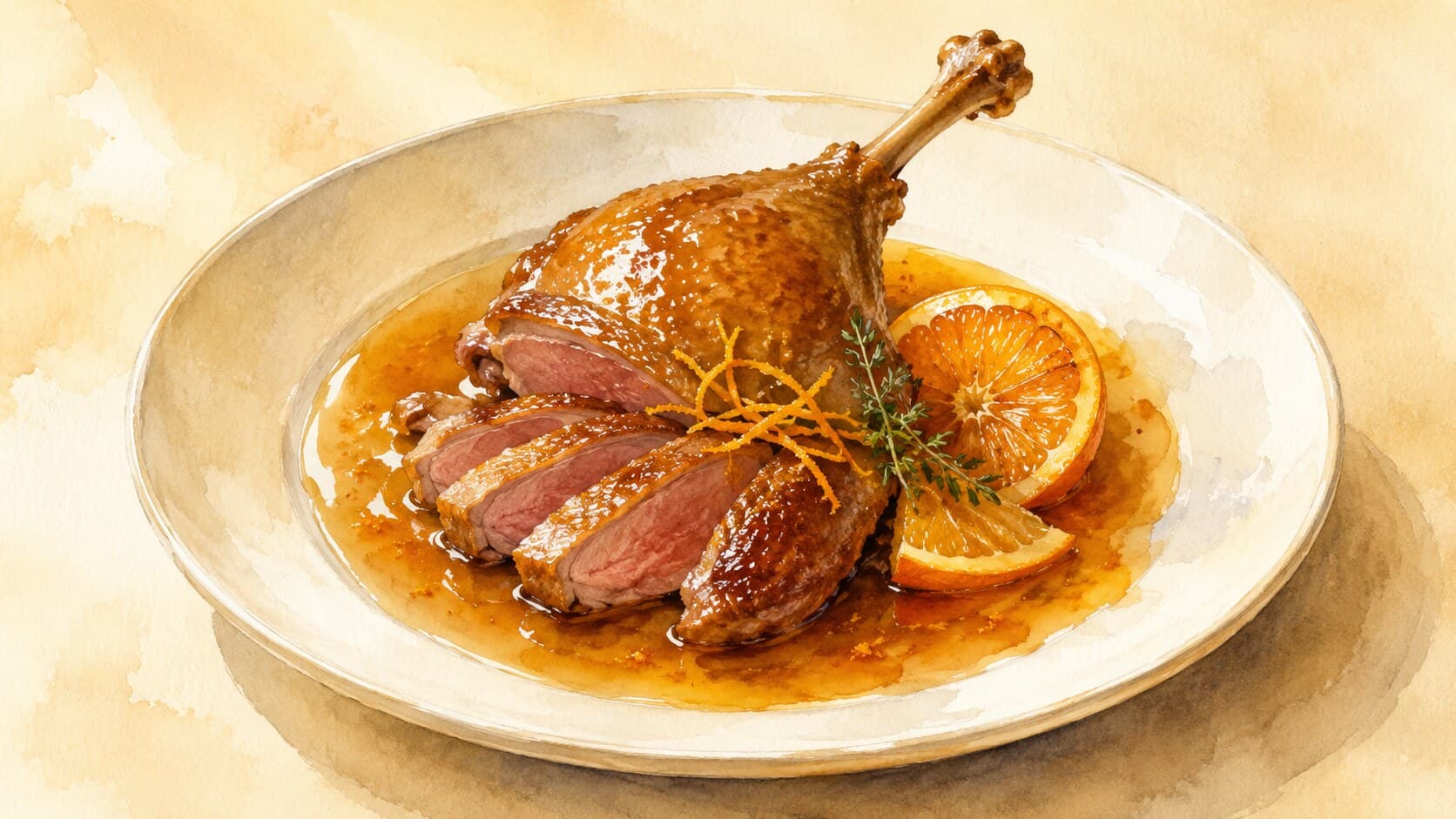
This classic Canard à l'Orange features a perfectly roasted duck paired with a vibrant bigarade sauce.
Contents (5 sections)▾
Ingredients
- 1 whole duck (approximately 2 kg)
- 30 g sea salt
- 1 tbsp black peppercorns
- 2 tbsp orange zest
- 2 tbsp orange liqueur
- 250 ml duck stock
- 200 ml fresh orange juice
- 50 g sugar
- 1 tbsp white wine vinegar
- Fresh thyme sprigs for garnish
- Orange segments for garnish
Steps
1. Dry-brine the duck by rubbing it with sea salt and crushed black peppercorns. Refrigerate uncovered for at least 12 hours to enhance flavor and aid in rendering the fat.
2. Preheat your oven to 160°C (320°F). Score the duck's skin in a crosshatch pattern, being careful not to cut into the meat. This helps render the fat during roasting.
3. Place the duck on a roasting rack in a roasting pan and roast at 160°C for 1 hour, allowing the fat to render and the meat to cook gently.
4. Increase the oven temperature to 220°C (428°F) and roast for an additional 30 minutes, or until the internal temperature of the thigh reaches 74°C (165°F) and the skin is crispy.
5. While the duck roasts, prepare the bigarade sauce by melting sugar in a saucepan until it caramelizes. Add white wine vinegar, orange juice, zest, and duck stock, then simmer until thickened.
6. Strain the sauce to remove any solids and stir in orange liqueur. Adjust seasoning with salt if necessary.
7. Once the duck is done, let it rest for 10 minutes before carving. Serve with bigarade sauce, orange segments, and garnish with fresh thyme.
Why this works
The technique of dry-brining the duck enhances its flavor and helps in rendering the fat (slowly melting the fat out of the skin with gentle heat) from the skin, resulting in a crispy exterior. Scoring the skin (cutting shallow lines into the surface so fat can escape and seasoning gets in) allows the fat to escape during cooking, while the initial low-temperature roasting helps the meat to cook evenly. The subsequent high-temperature roast crisps the skin beautifully. If the skin seems too greasy during cooking, you can carefully tilt the duck to allow excess fat to drain away, ensuring a perfect roast. The bigarade sauce (a classic French orange sauce, named for the bitter Seville orange), with its balance of caramelized sugar (sugar cooked until it browns and turns nutty and amber) and citrus acidity, complements the rich flavor of the duck, creating a harmonious dish that is both elegant and satisfying.
Doneness note (safety-aware). This recipe is the whole-roasted canard à l'orange. The whole bird roasts to 74°C+ internal at the thigh — fully cooked through. There is no medium-rare path in this recipe; the duck-breast (canard magret) preparation is a separate dish and is not covered here. For alcohol-avoidant cooks, the orange liqueur in the bigarade sauce can be substituted with 1 tbsp orange juice concentrate + 1 tsp white-wine vinegar.
Common mistakes
Roasting the skin while it is still damp.
Target: A duck that has air-dried, uncovered, in the fridge for 12–24 hours after the salt rub.
Why it matters: Crisp skin is a drying problem before it is a heat problem. Surface water has to boil off before the skin can brown, and as long as it is evaporating the skin stays below browning temperature. A dry skin renders (melts its fat slowly out) and crisps; a wet one steams and stays flabby.
What to do: Salt the bird, set it on a rack, and leave it uncovered in the fridge overnight. Pat it dry again just before it goes in the oven.
Skipping the score, or cutting through into the meat.
Target: Shallow crosshatch cuts through the skin and fat only, never reaching the flesh.
Why it matters: Scoring opens escape routes so the thick fat layer can render out during the long roast. Cut too deep, though, and the meat juices leak into the fat and the surface — and wet surfaces do not crisp; they also bleed away the moisture that keeps the breast from drying out.
What to do: Use a sharp tip at a shallow angle. You are aiming to part the skin, not to reach the muscle underneath.
Pulling the bird off by time instead of temperature.
Target: 74°C / 165°F at the thickest part of the thigh, read on an instant-read thermometer.
Why it matters: Ovens, bird sizes, and starting temperatures all vary, so a clock is a guess. This recipe is whole-roasted and cooked fully through — there is no pink, medium-rare path here. (The pink duck-breast preparation, magret, is a different dish and is a personal-risk choice cooks make with a single trimmed breast, not a whole bird; cooked-through is the safe default and the only one this recipe teaches.)
What to do: Probe the thigh without touching bone. Under 74°C, keep roasting; rest only once it is there.
Breaking the caramel, or letting the sauce turn one-note.
Target: An amber (not black) caramel, balanced at the end with the acidity of vinegar and bitter-orange.
Why it matters: Sugar taken past deep amber turns acrid, and the whole sauce inherits it. The classic bigarade is a tension between sweet caramel and sharp acid — lose the acid and you get candy, lose the caramel and you get sour juice. The point is the balance.
What to do: Pull the caramel at amber, add the vinegar and orange off direct high heat (it will sputter), then simmer and taste. Adjust with a little more acid or a pinch of salt until it reads as bright, not flat.
What to look for
- Skin before roasting: matte and dry to the touch, not tacky. Tacky skin still holds water and will steam.
- Rendered skin, late in the roast: deep mahogany, taut, blistered, with rendered fat pooled in the pan. A pale, soft skin means more time or more heat is needed.
- The caramel: clear amber, the color of an old copper coin, just starting to smoke. Past dark-brown it tips into bitter.
- Finished sauce: glossy, lightly syrupy, coats the back of a spoon. Tastes of orange, sweetness, and a clear edge of acid all at once.
- At the thigh: juices run clear, not pink, and the thermometer reads 74°C. That is the doneness this dish is built around.
A note on history
The dish descends from canard à la bigarade — duck with the juice of the bitter Seville (bigarade) orange — and a popular story credits the Florentine cooks who came to France with Catherine de' Medici on her 1533 marriage to the future Henry II, though food historians treat that origin as disputed (Wikipedia). What is better documented is the written record: an early version appears as "Ducklings à la bigarade" in Louis Eustache Ude's The French Cook (1813), and the sauce was later codified in the classical French canon by Auguste Escoffier in Le Guide Culinaire (Wikipedia). The "bigarade" in the name simply points back to that bitter orange at the dish's heart.
Get the essays in your inbox — free
Weekly notes on flavor, fermentation, and food history — the writing behind the Atlas of Flavor. No spam; unsubscribe anytime.