
Chả Giò (Vietnamese Fried Spring Rolls)
Rice paper frying works differently from wheat wrappers — the starch gelatinizes into a crisp shell only at the right oil temperature. Too low and the roll absorbs oil before the crust can form. The two-stage fry is the solution.
Contents (8 sections)▾
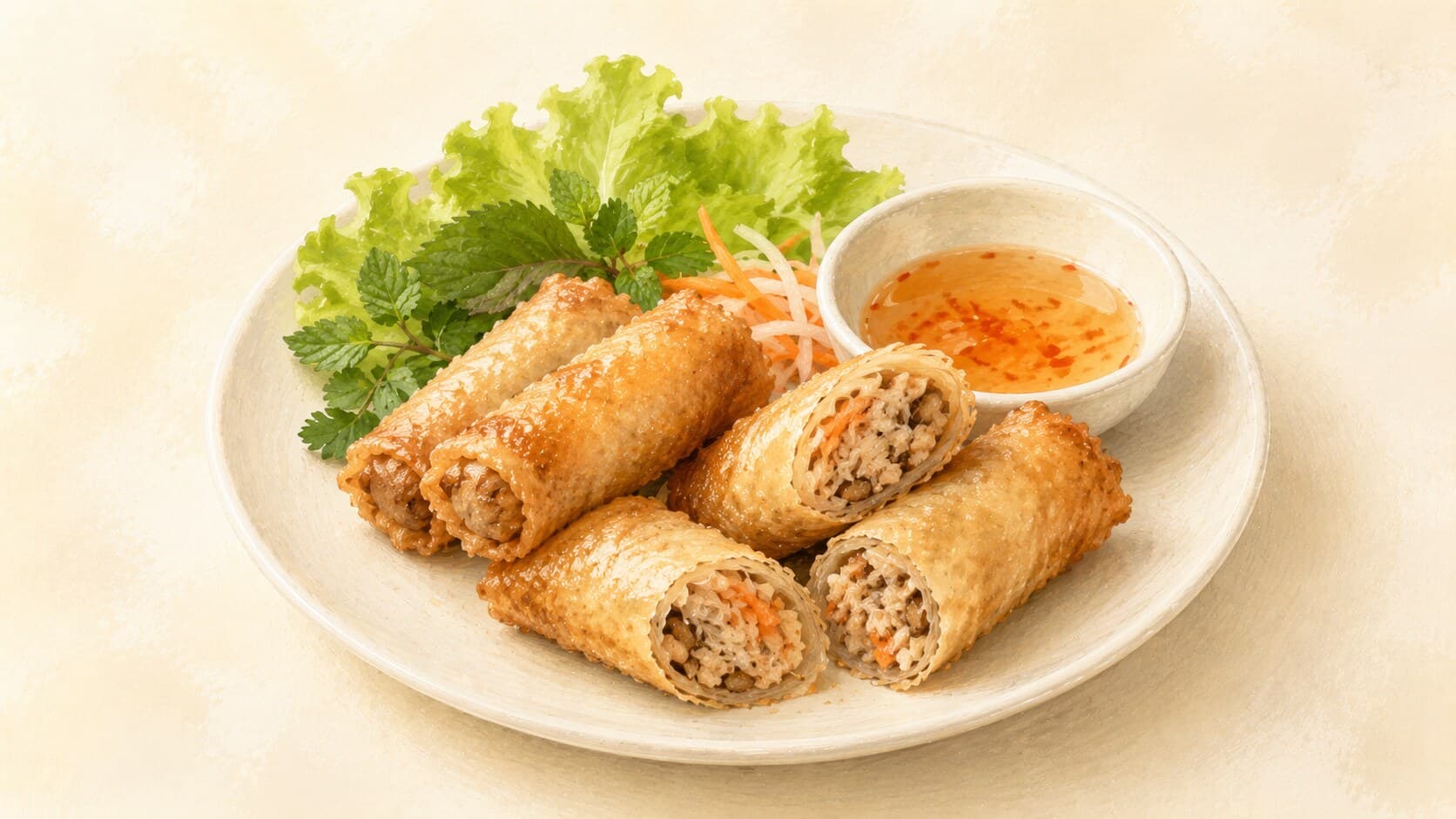
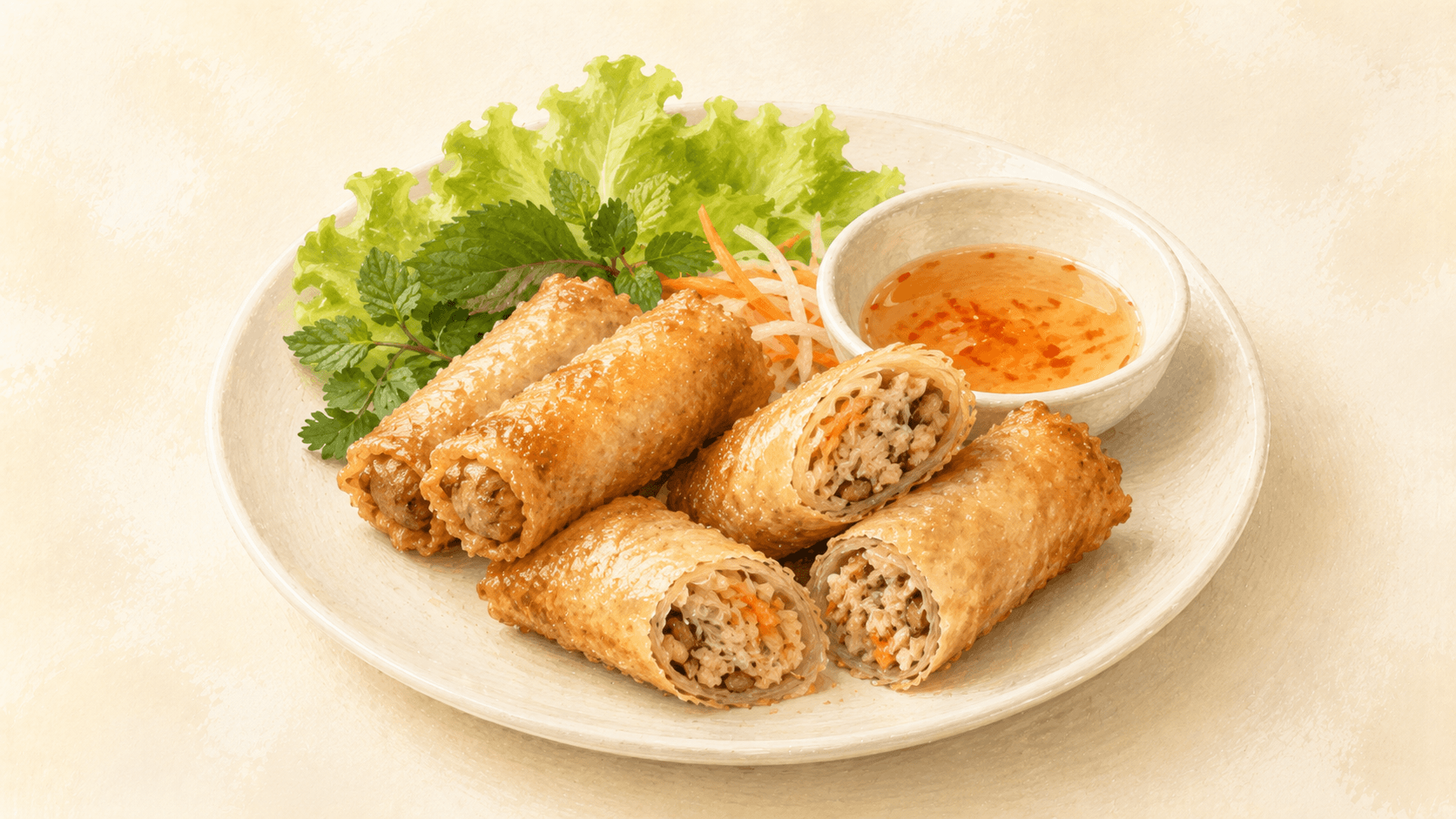
Ingredients
- **For the filling:**
- 250 g ground pork
- 50 g glass noodles (bean thread noodles), soaked in warm water and cut into short lengths (3–4 cm)
- 100 g carrot, finely grated or julienned
- 2 shallots, minced
- 2 cloves garlic, minced
- 1 tbsp fish sauce
- ½ tsp black pepper
- 1 egg (as binder)
- **For wrapping and frying:**
- 12–15 small round rice paper sheets (21 cm diameter) — the same rice paper used for fresh rolls
- ~1 L neutral oil for deep-frying
- **To serve:**
- Lettuce leaves, fresh herbs (perilla, mint, cilantro)
- Nước chấm dipping sauce
Steps
Mix the filling: combine ground pork, drained glass noodles (cut short), carrot, shallot, garlic, fish sauce, pepper, and egg. Mix firmly with your hands until the mixture binds together. The egg is the binder — without it the filling will separate in the oil.
Hydrate the rice paper: fill a wide shallow dish with warm water. Dip each rice paper sheet for exactly 1 second — just until it is barely pliable, not soft. The paper should still feel nearly rigid. You are making it foldable, not preparing it for a fresh roll. Over-softened rice paper will tear when you roll it and become gummy when fried.
Place a sheet on a clean, dry surface. Add approximately 2 tbsp filling near the bottom edge of the paper. Roll tightly from the bottom, fold in the sides firmly, then finish rolling. Press the seam closed for a few seconds. The seal must be firm — a loose roll will open in the hot oil and the filling will disperse.
Heat oil to 170°C in a wok or deep saucepan. To test: drop a small piece of rice paper into the oil — it should sizzle immediately and float to the surface within 1 second. If it sinks slowly and sizzles weakly, the oil is not hot enough.
First fry: add rolls in batches without crowding — maximum 4–5 at a time. Fry for 3–4 minutes until lightly golden. Turn once halfway through. Remove with a spider or slotted spoon and drain on a wire rack. Let rest for 2–3 minutes. By the end of this first fry the centre of the filling must reach 71 °C / 160 °F on an instant-read thermometer inserted into the centre of a roll — the 170 °C is the oil temperature, not the safety endpoint, and colour and time are guides; if the centre is short, fry longer before resting.
Second fry: raise the oil temperature to 175–180°C. Return the rested rolls and fry for 1–2 minutes until deeply golden and completely crisp. The second fry drives out the remaining moisture from the wrapper and produces the shatteringly thin shell that defines good chả giò.
Drain on a wire rack — not on paper towels. Paper towels trap the steam released from the interior, which softens the crust from below. Serve immediately with lettuce leaves, fresh herbs, and nước chấm for dipping.
Tools you'll want
- · Instant-read digital thermometer
Why this works
Rice paper is a sheet of gelatinized rice starch — the same starch that forms the crisp shell of the fried roll, but in a softened, hydrated state before frying. When rice paper enters hot oil, three things happen in rapid sequence: the surface water flashes to steam and creates pressure outward (this is the immediate sizzle), the oil temperature begins to drive off the remaining moisture from the starch matrix, and — if the oil is hot enough — the rice starch reaches the temperature where it transitions from a pliable gelatinized state to a rigid, glassy one. This transition is what produces the shattering crust.
The critical threshold is oil temperature. Below roughly 165°C, the rice paper surface cannot transition fast enough — moisture evaporates slowly, the paper becomes saturated with oil before the starch sets, and the result is a greasy, limp roll with no crust. At 170°C, the surface sets quickly and the oil penetration is minimal. This is why rice paper fried spring rolls are more oil-temperature-sensitive than wheat-wrapper spring rolls: wheat gluten forms a more structurally rigid network on its own and can tolerate a wider temperature range. Rice starch has no such structural protein — it needs the heat to do the work.
The two-stage fry exploits this thermodynamics. The first fry at 170°C cooks the filling thoroughly and begins the crust formation. Resting allows the interior steam to equalize and escape without continuing to soften the partially formed crust from within. The second fry at 175–180°C drives out the last moisture from the wrapper and brings the starch crust to full rigidity and color. You cannot achieve the same result in a single long fry at a single temperature — the filling would overcook before the wrapper fully crisped.
Common mistakes
Over-hydrating the rice paper.
Target: 1 second in warm water — barely pliable, still slightly rigid.
Why it matters: Over-soaked paper tears during rolling and becomes gummy when fried. The 30 seconds of rolling time provides additional hydration from ambient moisture — the bowl-soak just needs to start the process.
What to do: Quick dip — count "one Mississippi" — lift. Test by trying to fold gently; if it cracks, dip 0.5 sec more.
Workarounds:
- Paper too rigid → 1.5 sec dip, no more.
Frying at too low a temperature.
Target: 170°C for the first fry. Test: small piece of rice paper sizzles immediately and floats within 1 second.
Why it matters: Below 165°C, rice paper absorbs oil before the starch matrix sets — greasy, pale, no shatter. The starch-to-glass transition requires the right thermal threshold.
What to do: Thermometer. Test before every batch with a rice paper scrap. If it sinks or sizzles weakly, wait.
Workarounds:
- No thermometer → wooden chopstick test: should produce a steady stream of bubbles around the chopstick when dipped.
Skipping the second fry.
Target: First fry at 170°C (3-4 min) → rest 2-3 min → second fry at 175-180°C (1-2 min).
Why it matters: Single-fry rolls look done but lose crispness within 10 minutes. The two-stage method drives out remaining moisture and brings starch to full glass-state — only this produces shatteringly crisp shells that hold during the meal.
What to do: Don't skip the rest between fries. Plan for the two-stage timing.
Workarounds:
- Time-constrained → still better to do quick second fry than skip it entirely.
Draining on paper towels.
Target: Wire rack — paper towels trap steam and re-soften the crust from below.
Why it matters: Paper towels condense interior steam against the crust → softens from below. Wire rack lets steam escape in all directions, preserving crispness for 10+ minutes.
What to do: Set up wire rack over baking sheet before frying. Place fried rolls directly.
Workarounds:
- No wire rack → use a metal cooling rack or even chopsticks across a plate to elevate the rolls.
Loose rolling.
Target: Tight, firm rolling — no air pockets, sealed seam pressed for several seconds.
Why it matters: Air pockets expand in hot oil = wrapper balloons and may tear. Loose rolls also open in oil and disperse filling.
What to do: Roll tight from the start, fold sides firmly, press seam closed. Compact log shape.
Workarounds:
- Filling falling out during roll → less filling per wrapper; about 2 tbsp is the standard.
What to look for
- The rice paper hydration: Should be barely pliable when you start rolling — still slightly resistant to bending, not limp or transparent.
- The oil temperature test: A small piece of rice paper should sizzle immediately, hit the surface, and float within 1 second. This is your go/no-go test before every batch.
- The color after the first fry: Light golden — not white, not deeply golden. The color should develop further in the second fry.
- The crust sound when tapping after the second fry: A crisp, hollow sound — not a dull thud. The hollow sound indicates the internal moisture has driven out fully.
- The cross-section when bitten: A translucent, glassy shell with visible layers — not a thick opaque coating. The shell should shatter, not bend.
Chef's view
What I find interesting about chả giò is that it is gluten-free but not by design — it predates the concept of gluten-free eating by centuries. Rice paper exists because rice is what there is in this part of the world, and the frying technique developed around the material. The result is a different crust than a wheat-flour spring roll — more translucent, more fragile, more texturally precise. The Chinese-style egg roll, by comparison, is sturdier and more forgiving, but it does not shatter. The shattering is the point.
I also want to say something about the eating ritual. In HCMC, chả giò is not eaten directly — you pick up a roll, place it at the end of a lettuce leaf, add a few herb sprigs, roll it up, and dip the whole thing into nước chấm. The lettuce cools and adds moisture to the hot roll; the herbs add aromatics; the nước chấm adds acid and salt. The hot-crisp roll wrapped in cool-fresh lettuce is a repeat of the same textural argument that runs through all of Vietnamese cooking: contrast is the point, not consistency.
Chef Test Notes
Test 1 — hydration time for rice paper. 0.5 seconds, 1 second, 2 seconds, 5 seconds in warm water. The 0.5-second version was too rigid to fold without cracking. The 1-second version was the working minimum — just pliable enough to roll, still slightly rigid. The 2-second version was workable but produced slightly gummier results in the oil. The 5-second version was too soft, tore during rolling, and became gummy when fried. One second is the confirmed target.
Test 2 — oil temperature for the first fry. 155°C, 165°C, 170°C, 175°C. The 155°C batch was visibly greasy and pale after 4 minutes — oil had penetrated before the crust set. The 165°C batch was better but still slightly greasy. The 170°C batch was the working temperature — good crust formation, minimal oil absorption. The 175°C batch for the first fry produced slightly uneven coloring as the exterior darkened faster than the filling cooked through. 170°C for first fry, 175–180°C for second fry.
Test 3 — single vs. two-stage fry. One batch fried once at 170°C for 5 minutes total; one batch fried twice (3 min at 170°C, rested, 1.5 min at 178°C). At the 15-minute mark, the single-fry roll had lost most of its crispness. The two-stage roll retained a full, snapping crust. The two-stage fry is not just about color — it is about crust durability over the time it takes to eat the meal.
A note from HCMC
In HCMC, chả giò appears at the start of family meals as a shared plate — always with lettuce and herbs for wrapping, always with nước chấm. The assembly at the table — picking up the hot roll, placing it in the lettuce, folding — is part of the meal rhythm, not just a condiment arrangement. I have sat at tables in HCMC where the rolls arrived at the exact moment we sat down and were gone within three minutes. The wrapping slows you down just enough that you eat them at the pace they deserve.
Related glossary terms
- Rice paper — a dried sheet of gelatinized rice starch; behaves differently from wheat wrappers at frying temperatures due to the absence of gluten.
- Two-stage frying — a technique that separates cooking the interior from crisping the exterior, producing superior crust durability.
- Nước chấm — Vietnamese dipping sauce made from fish sauce, lime, sugar, and chili; the acid counterpoint to fried food.
Get the essays in your inbox — free
Weekly notes on flavor, fermentation, and food history — the writing behind the Atlas of Flavor. No spam; unsubscribe anytime.