
Gỏi Cuốn (Vietnamese Fresh Spring Rolls)
Rice paper hydration is a one-second window. Soak it for three and it becomes a problem; fold it while firm and it finishes softening around the filling as you roll. The assembly is the technique.
Contents (8 sections)▾
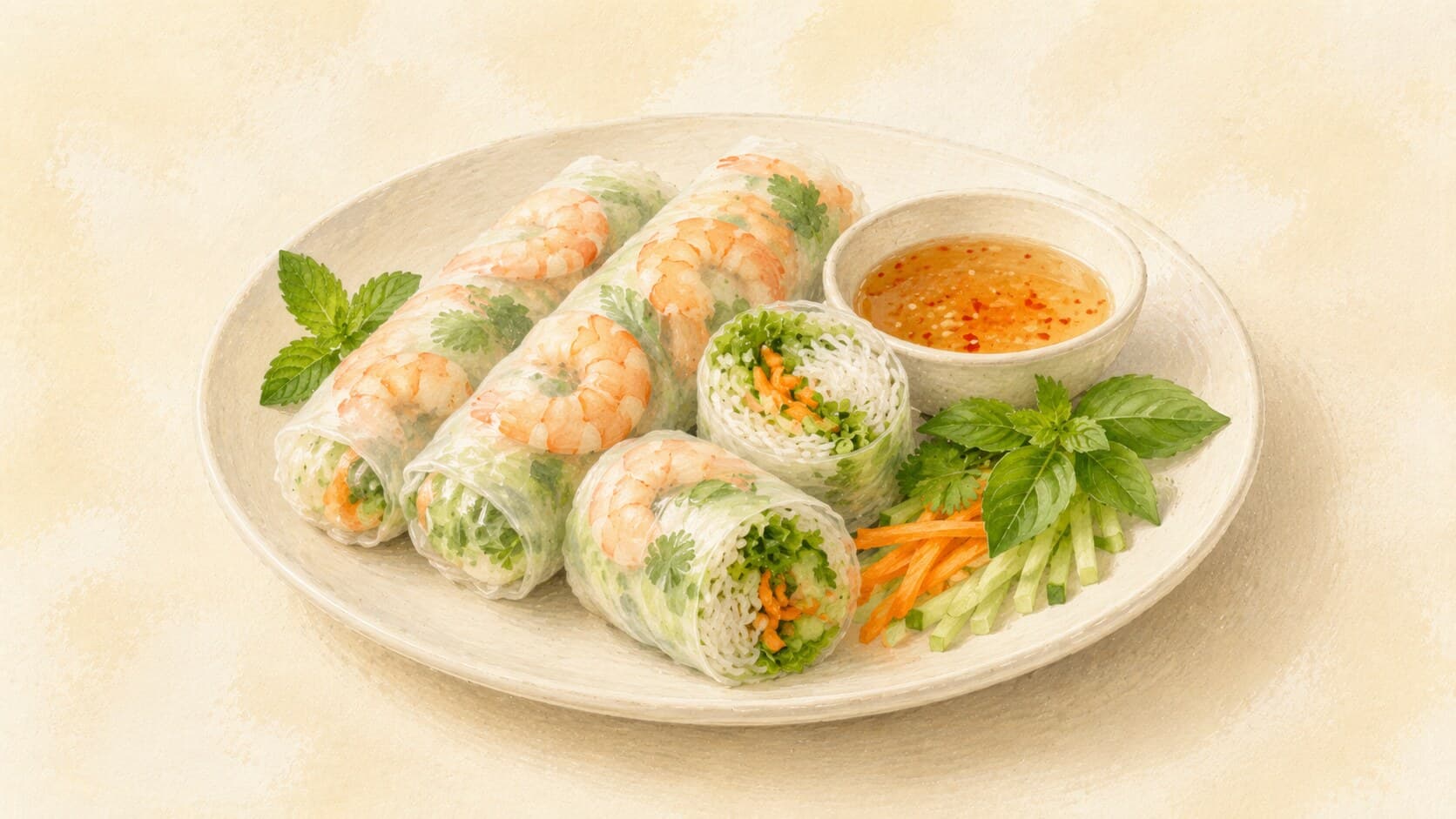
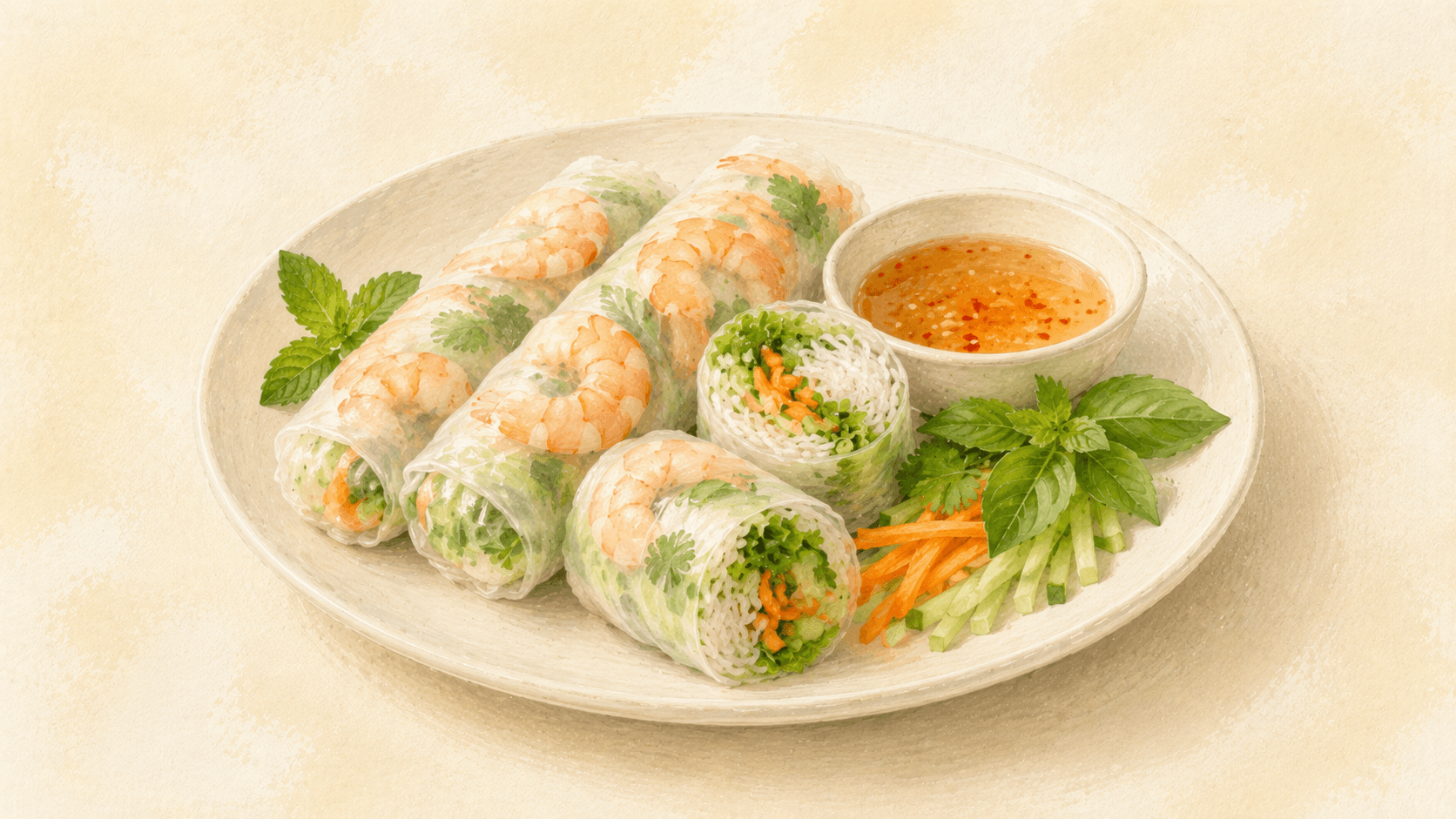
Ingredients
- 12 sheets round rice paper (22 cm diameter)
- 200 g cooked pork belly or shrimp (or both)
- 100 g rice vermicelli, cooked and cooled
- 12 large lettuce leaves (butter lettuce or romaine)
- Fresh perilla, mint, Thai basil leaves
- 1 carrot, julienned
- 1 cucumber, julienned
- Nước chấm: fish sauce + lime juice + sugar + warm water + garlic + chili
- OR peanut sauce: hoisin + peanut butter + warm water + rice vinegar
Steps
Prepare all fillings before you start wrapping — once rice paper is wet, you have 20–30 seconds before it becomes too sticky to handle easily. Having everything laid out is not optional.
Set up a wide, shallow bowl of warm water. Not hot — hot water over-softens the paper immediately. Warm (around 40°C) gives you a manageable window.
Dip a rice paper sheet for exactly 1 second. Pull it out while it still feels firm and semi-rigid. Do not wait until it is soft. Lay it flat on a clean, lightly damp surface or directly on the dry counter.
Work from the bottom third of the paper: lay a lettuce leaf first as a moisture barrier, then noodles, then herbs, then carrot and cucumber, then protein. Keep the filling strip narrow and leave 3 cm clear at both side edges.
Fold the bottom up over the filling firmly. Fold the left and right sides in like an envelope. Roll away from you, applying even pressure along the whole width. The rice paper finishes softening as you roll — by the time the roll is sealed, it will be pliable and self-adhesive.
Serve within 1 hour. Keep under a damp cloth if not serving immediately. Do not refrigerate — cold temperatures make rice paper stiff and brittle.
Tools you'll want
Why this works
The central mechanism of gỏi cuốn (Vietnamese fresh rice-paper rolls wrapped around herbs, noodles and shrimp or pork — no frying) is hydration timing. Rice paper (bánh tráng) is dried rice starch formed into a thin, rigid disc. When submerged in water, the starch begins to absorb moisture and soften. The error most beginners make is waiting too long in the water — until the paper is already pliable and soft before they start wrapping. At that point, the paper is over-hydrated: it is sticky, difficult to lift, and tears under any tension during rolling. The correct technique is counterintuitive: pull the paper out while it still feels stiff and slightly leathery. The residual moisture on its surface and the filling moisture from the noodles and vegetables will finish the hydration process while you roll. By the time the roll is sealed and resting on the plate, the rice paper has reached the correct soft, elastic, translucent state entirely on its own.
The physics of this is straightforward: rice starch absorbs water progressively, not all at once. A one-second dip deposits surface moisture; the starch takes another 30–60 seconds to fully absorb it. If you dip for 3–4 seconds, the paper reaches full softness before you have even started rolling — it then continues to absorb moisture from the filling and becomes overworked. The professional technique at every Vietnamese table is the same: dip briefly, work quickly, trust the paper to finish softening on its own.
The lettuce leaf placed first serves a practical purpose beyond adding a crunchy layer. Wet noodles and watery vegetables in direct contact with rice paper accelerate the hydration of that local patch dramatically, causing the paper to become soft and sticky in the center while the edges are still drying. The lettuce leaf acts as a moisture barrier — it absorbs the surface moisture from the wet ingredients and releases it slowly, rather than transmitting it directly to the rice paper. This is why the rolls hold together: the filling is physically separated from the wrapper by a dry layer.
The tightness of the roll matters. A loose roll has air pockets, uneven moisture distribution, and ingredients that shift when you bite. A tight roll — achieved by firmly pulling the bottom edge up over the filling before folding the sides — holds its shape and allows the rice paper to set in tension, producing a roll that is structurally coherent and cuts cleanly if you want to halve it.
Common mistakes
Over-soaking the rice paper.
Target: 1 second dip — pull while paper still feels firm and slightly leathery.
Why it matters: Over-hydrated paper tears during folding, sticks to everything, and is unusable. The paper finishes hydrating ON the counter from filling moisture — water dip just initiates the process.
What to do: Count "one Mississippi" — lift. Lay flat. By the time you've arranged filling, paper will be pliable.
Workarounds:
- Already over-soaked → start fresh. Save the wet paper for a different application (it won't recover for rolling).
Using water that is too hot.
Target: 35-45°C warm tap water — never hot.
Why it matters: Hot water (>60°C) softens rice paper almost instantly — no working window. The paper goes from firm to floppy as you lift it from the bowl.
What to do: Test water with your finger — should feel warm, not hot. Use a thermometer for first-time accuracy.
Workarounds:
- Tap water too cold (<25°C) → mix half-half with kettle-hot water for the right temperature.
Overfilling.
Target: Filling forms a 3 cm log at most. Less than feels right.
Why it matters: Too much filling = roll too thick to seal tight around circumference, paper bursts or rolls open. Compact filling = clean roll, even seal.
What to do: Start with less than you think. Toll a test roll first to calibrate.
Workarounds:
- Made too thick → unwrap, remove excess filling, re-roll with fresh paper.
Not leaving side margins.
Target: 3 cm clear on both side edges — filling stays in narrow center strip.
Why it matters: Rice paper needs bare edge to fold over and self-adhere. If filling reaches the edges, the fold creates visible gaps where the paper can't seal.
What to do: Visualize the filling as a narrow log centered on the paper. Leave margins consistently.
Workarounds:
- Filling spreading → use a slightly less wet filling base (drain noodles more thoroughly).
Refrigerating the finished rolls.
Target: Room temperature only. Serve within 1 hour. Keep under damp cloth.
Why it matters: Cold causes rice starch retrogradation — paper becomes hard, opaque, brittle. A perfect roll becomes unpleasant within 20-30 minutes in fridge.
What to do: Plan to serve at room temp. Damp cloth keeps paper supple without refrigeration.
Workarounds:
- Make-ahead → assemble within 1 hour of serving. Don't make 4 hours in advance.
What to look for
- The rice paper in the water: dip for exactly one second — you can count it. The paper should still feel stiff and slightly rough when you pull it out.
- The paper on the counter 10 seconds after removal: it will have started to soften at the edges and become slightly translucent. This is correct — it is not yet ready to eat but ready to fill.
- The filling arrangement: compact, centered, with clear side margins. The filling should not bulge or spread to the edges.
- The roll under pressure: firm, even cylinder with no lumps or gaps. If you can feel air pockets, the roll was not tight enough.
- The finished roll after resting 30 seconds: translucent, smooth, pliable but holding its shape. A tear or opacity in patches means the dip was too long or the filling was too wet.
Chef's view
Gỏi cuốn is one of those dishes that looks technically simple until you try to make twelve of them for a table and the third one falls apart. The technique requires repetition. The first two are for calibrating your water temperature and your dip timing; by the fourth or fifth, the motion has normalized and the rolls come out consistently. I would not recommend making gỏi cuốn for a party without having practiced alone first.
The sauce question is genuinely divided. Nước chấm is the Saigon-style accompaniment — bright, acidic, thin, and adjustable at the table with extra lime and chili. Peanut sauce (hoisin-based with peanut butter) is more common in central and northern styles and is richer and sweeter. I prefer nước chấm because it does not overwhelm the delicate fresh flavors inside the roll — but if you are serving this to people who like richness, the peanut sauce gets more enthusiastic responses.
Chef Test Notes
I tested three rice paper brands with identical filling and technique:
- Thin rice paper (weight: light, almost translucent when dry): Beautiful finished roll, very translucent. Tore more easily if soaked even one second too long. Forgiving temperature window is narrow. Best for experienced rollers.
- Standard thickness rice paper (the recipe default): Most reliable. One-second dip gives a 20–30 second working window. Holds up to a slightly overfull filling without tearing. The most consistent results across attempts.
- Thick rice paper: Did not produce the characteristic translucency — the finished roll looked opaque and heavy. Texture was too chewy. Would not use again for gỏi cuốn.
I also tested dipping in water at three temperatures:
- Cold water (tap, ~15°C): Too slow. The paper needs 3–4 seconds to begin softening, which means it is still stiff as you start filling and tears when you fold.
- Warm water (~40°C): The recipe default. One-second dip produces a 20–30 second working window. Consistent and forgiving.
- Hot water (~65°C): The paper goes limp too fast. By the time it is on the counter, it is already sticky and difficult to handle. No working window.
A note from HCMC
In HCMC, gỏi cuốn appear at family tables as a starter, assembled by whoever happens to be sitting nearest the bowl of warm water. Children learn to wrap before they learn to cook anything on a flame — it is the first kitchen task because it requires no heat and no knives, only an understanding of how the paper behaves. I watched a six-year-old at a family lunch roll a tighter, more consistent gỏi cuốn than my third attempt. The child had made hundreds of them; I had made three.
Related glossary terms
- Assembly — gỏi cuốn is a pure assembly technique; the cooking has already happened and the skill is entirely in the construction.
- Starch — rice paper is dried rice starch; understanding how starch absorbs water over time explains why the dip timing is everything.
- Umami — the nước chấm is the umami delivery vehicle; everything inside the roll is mild and fresh, and the sauce provides the savory anchor.
Get the essays in your inbox — free
Weekly notes on flavor, fermentation, and food history — the writing behind the Atlas of Flavor. No spam; unsubscribe anytime.