
Bánh Mì
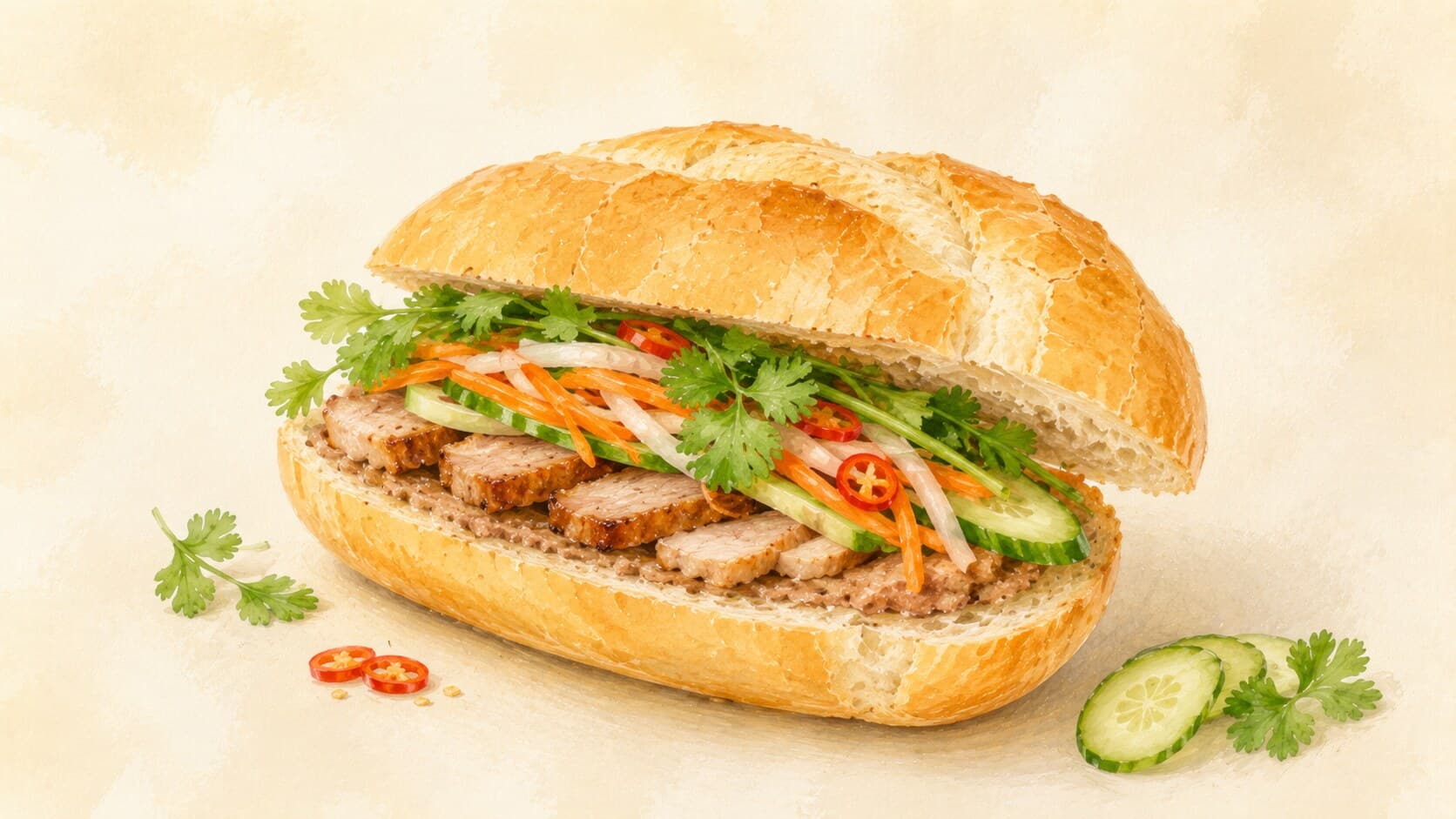
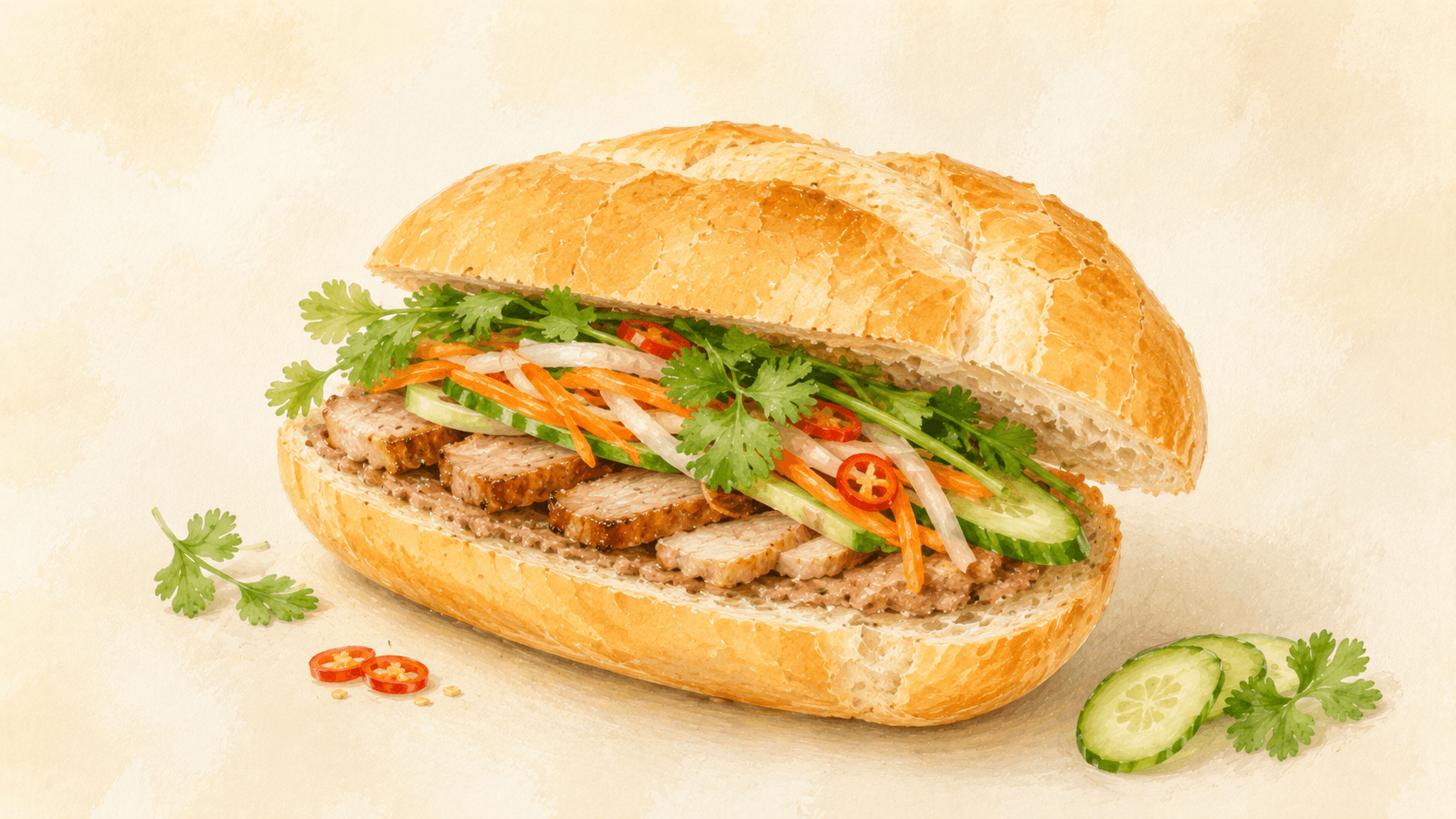
Not a sandwich — a textural argument. Crunch, fat, acid, and fresh herbs in deliberate sequence, where every component exists to maintain contrast and every layer has a structural job.
Contents (8 sections)▾
Ingredients
- 2 Vietnamese-style baguettes (demi-baguettes — light, thin crust, not French sourdough)
- 4 tbsp pork liver pâté (or chicken liver pâté)
- 4–6 slices chả lụa (Vietnamese pork roll / steamed sausage)
- 4 slices jambon (thinly sliced ham or mortadella)
- 2 tbsp mayonnaise (Vietnamese-style, thinner and slightly sweeter)
- Fresh cilantro sprigs
- Sliced fresh chili
- Cucumber slices, cut lengthwise
- Dash of Maggi seasoning sauce (or soy sauce)
- **Đồ chua (quick pickled vegetables):**
- 100 g daikon, julienned
- 100 g carrot, julienned
- 2 tbsp rice vinegar
- 1 tbsp sugar
- 1 tsp salt
Steps
Make the đồ chua first: mix daikon and carrot with rice vinegar, sugar, and salt. Let stand at room temperature for 30 minutes minimum. The pickle needs just enough time to soften slightly while retaining crunch — the contrast with the fresh cucumber is intentional.
Toast the baguette: split lengthwise, toast cut-side down in a hot dry pan or under a broiler until golden. The bread must be hot and slightly crisp for the architecture to work. Cold bánh mì is a different and lesser experience.
Layer in order: spread mayonnaise on both cut surfaces. Spread pâté generously on one side. The fat content of the pâté is functional, not decorative — it is what allows the other elements to adhere and what buffers the acid from the pickle.
Layer chả lụa, ham, and cucumber slices. Add a generous handful of đồ chua. Add cilantro sprigs. Add chili slices. Add a few drops of Maggi seasoning.
Close the sandwich firmly. The bread should give slightly under pressure but not collapse. Eat immediately — the crust softens within 10 minutes once assembled.
Tools you'll want
Why this works
The bánh mì succeeds because it is built as a sequence, not a mixture. The French influence produced the bread — the Vietnamese baguette is lighter, with a thinner crust and airier crumb than a Parisian baguette, engineered partly by the different wheat varieties available in Vietnam and partly by the specific hydration levels that make it suitable for fast assembly and eating without a plate. That lightness is not a compromise; it is a specification. A dense sourdough crust would overwhelm the other elements instead of framing them.
The textural argument runs in a deliberate order: the crust gives with an audible crunch, then the fat layer (pâté (a smooth, spreadable paste of seasoned ground meat), mayonnaise) provides lubrication, then the protein layers (chả lụa, jambon) add chew, then the đồ chua delivers acid and a second crunch that is softer and more yielding than the bread, and finally fresh herbs and cucumber add cool moisture against the warm bread. Each texture arrives in sequence as you eat through the cross-section. This is not accidental — the layering order matters.
The Maillard reaction on the toasted bread surface is the architecture's foundation. Toasting converts surface sugars and amino acids in the dough into hundreds of aromatic compounds that do not exist in untoasted bread — the golden surface has a completely different flavor from the crumb. This is why cold bánh mì is a lesser sandwich: the bread has not been brought to the temperature where these reactions occurred, and the fat from the pâté sits heavier rather than melting into the warm crumb.
Common mistakes
Using the wrong bread.
Target: Vietnamese baguette — thin, crackly crust + open, light crumb. Often made with a rice-flour blend.
Why it matters: A French sourdough baguette is wrong for bánh mì. The dense crumb and chewy crust absorb fillings moisture and turn the sandwich into a chewing exercise. Vietnamese bread is engineered specifically to crack under the bite without becoming soggy.
What to do: Source from a Vietnamese bakery if possible.
Workarounds:
- No Vietnamese bakery? Demi-baguette from a quality French bakery is second-best.
- Last resort: supermarket baguette + extra-aggressive toast (see below).
Skipping the toast.
Target: Hot oven (220 °C) for 3–4 minutes, until the crust is crackling.
Why it matters: Room-temperature bread feels softer in the mouth and absorbs fillings instantly. A hot crisp surface delays moisture absorption, creating the 5–10-minute window where the bánh mì peaks.
What to do: Toast right before assembling. The crust should sound crisp when tapped.
Workarounds:
- For ultra-crisp, slice the baguette lengthwise and toast each half cut-side up — maximum crust area.
- For a chewier interior, mist the bread with water before toasting.
Under-pickling the đồ chua.
Target: Daikon (a long, mild white radish) and carrot pickled in rice vinegar + sugar + salt for at least 1 hour, ideally 24 hours.
Why it matters: The pickled vegetables soften and absorb the vinegar over time. Adding them immediately produces a harsh, raw-vinegar taste with hard texture — undercutting the freshness they're supposed to add.
What to do: Julienne daikon and carrot (matchstick-sized), salt for 10 minutes, drain, then submerge in rice vinegar + sugar (2:1 sweet vs sour, by volume). Refrigerate overnight ideally.
Workarounds:
- Make ahead and keep in the fridge for up to 2 weeks — improves with age.
- Quick version: julienned vegetables + 1 tbsp rice vinegar + 1 tsp sugar + a pinch of salt, rest 30 minutes minimum.
Over-filling.
Target: Modest layers — about 2 tbsp đồ chua, 4–5 thin slices of protein, a few cilantro sprigs. Bánh mì should be bitable through, not requiring jaw-stretching.
Why it matters: Stuffed bánh mì collapses on the first bite — fillings push out, the bread can't hold structure. The constraint of the bread size is a guide to portion.
What to do: Even density across the length. Each bite should contain all the elements.
Workarounds:
- For meal-sized portions, make multiple smaller bánh mì instead of stuffing one.
Wrong protein temperature.
Target: Cold pâté + warm-just-cooked protein (lemongrass pork, grilled chicken) + chilled mayo. Each element at its proper temperature.
Why it matters: Temperature contrast is part of bánh mì's design. All-cold or all-hot lacks the textural tension that makes the sandwich exciting.
What to do: Time the cooking so the hot element is freshly off the grill, while pickles and mayo come from the fridge.
Workarounds:
- For pre-made bánh mì (lunch box prep), use cold-cuts (Vietnamese-style cold pork roll, headcheese) — designed to be served cold.
Not eating immediately.
Target: Assemble within 5 minutes of eating; eat within 10 minutes of assembly.
Why it matters: Moisture from pickles and cucumber migrates into the bread over time. The peak window is short — beyond 15 minutes, the crust softens and the sandwich loses its defining character.
What to do: Don't pre-assemble for later. Prep all components, build the moment you sit down.
Workarounds:
- For lunches packed ahead, transport components separately and assemble at the eating location.
- Wrap in waxed paper rather than plastic — slightly slower moisture migration.
What to look for
- The crust at the moment of bite: It should give with an audible crack — if it compresses silently, the bread was not toasted hot enough.
- The pâté layer: Pale, smooth, and thick enough to see — not a smear. You should taste it in every bite, not just occasionally.
- The đồ chua color: The daikon should be white, the carrot orange — not faded. Faded color means over-pickling.
- The herb layer: Cilantro should be visibly present, not buried. It provides the aromatic lift that keeps the sandwich from feeling heavy.
- The Maggi: A few drops only — you should not taste it distinctly, but the umami underlayer should be there, making the other flavors rounder.
Chef's view
I had bánh mì explained to me as "the French baguette that became Vietnamese" — as if colonialism were just a culinary transfer. That framing misses what actually happened. Vietnamese bakers took the basic structure and rebuilt it to fit local ingredients, local eating habits (street food, eaten fast, without utensils), and local flavor preferences that favor acid, freshness, and contrast over richness. The bread got lighter. The filling got brighter. The result is not a modified French sandwich — it is a Vietnamese sandwich that happens to use bread.
What I keep coming back to is the đồ chua and the way it is the controlling variable. Too much acid and the whole sandwich tilts sour. Too little and the fat from the pâté and mayonnaise sits unrelieved. The quick pickle is the counterweight, and the ratio between the acid elements (pickle, Maggi) and the fat elements (pâté, mayo) is what distinguishes a well-made bánh mì from a merely adequate one.
Chef Test Notes
Test 1 — bread type comparison. I made the same filling with a Vietnamese demi-baguette, a standard French baguette, and a ciabatta roll. The Vietnamese bread held up cleanest at the 10-minute mark — the crust remained audible, the crumb did not become gummy. The French baguette was acceptable at 5 minutes but degraded quickly. The ciabatta absorbed the moisture immediately and was the worst option by a significant margin.
Test 2 — đồ chua timing. I tested 15-minute, 30-minute, 1-hour, and 3-hour pickle times. The 15-minute version was too raw and the vinegar tasted separate from the vegetables. The 30-minute version was the working minimum. The 1-hour version was the best for texture — slightly softened but still with snap. The 3-hour version was too soft and the daikon had developed a slightly fermented edge that worked in isolation but disrupted the sandwich balance.
Test 3 — toasting temperature. Same bread, toasted at low (medium-low pan, 4 minutes) and high (high heat, 90 seconds) settings. The high-heat toast produced more surface Maillard compounds — the bread had a noticeably more complex flavor and retained crunch longer. The low-heat toast dried without browning and produced a stale-tasting surface without the aromatic benefit.
A note from HCMC
The bánh mì carts on Lê Thánh Tôn street near Bến Thành at 7am — the vendor moves so fast the whole assembly takes 40 seconds. The bread is always warm, pulled from a low oven behind the cart. I have watched her hands do the layering so many times that I now know the order without thinking about it: mayo first, then pâté, then meat, then cucumber, then pickle, then herbs, then chili, then Maggi, close. That sequence is not improvised. It is the result of decades of refinement by someone who has made more bánh mì than I could count.
Related glossary terms
- Maillard reaction — the browning reaction that transforms the surface of toasted bread into a more complex flavor compound.
- Đồ chua — Vietnamese quick-pickled daikon and carrot; the acid counterweight in many dishes.
- Chả lụa — Vietnamese steamed pork roll, a standard bánh mì protein with a smooth, bouncy texture.
Get the essays in your inbox — free
Weekly notes on flavor, fermentation, and food history — the writing behind the Atlas of Flavor. No spam; unsubscribe anytime.