
Yokan
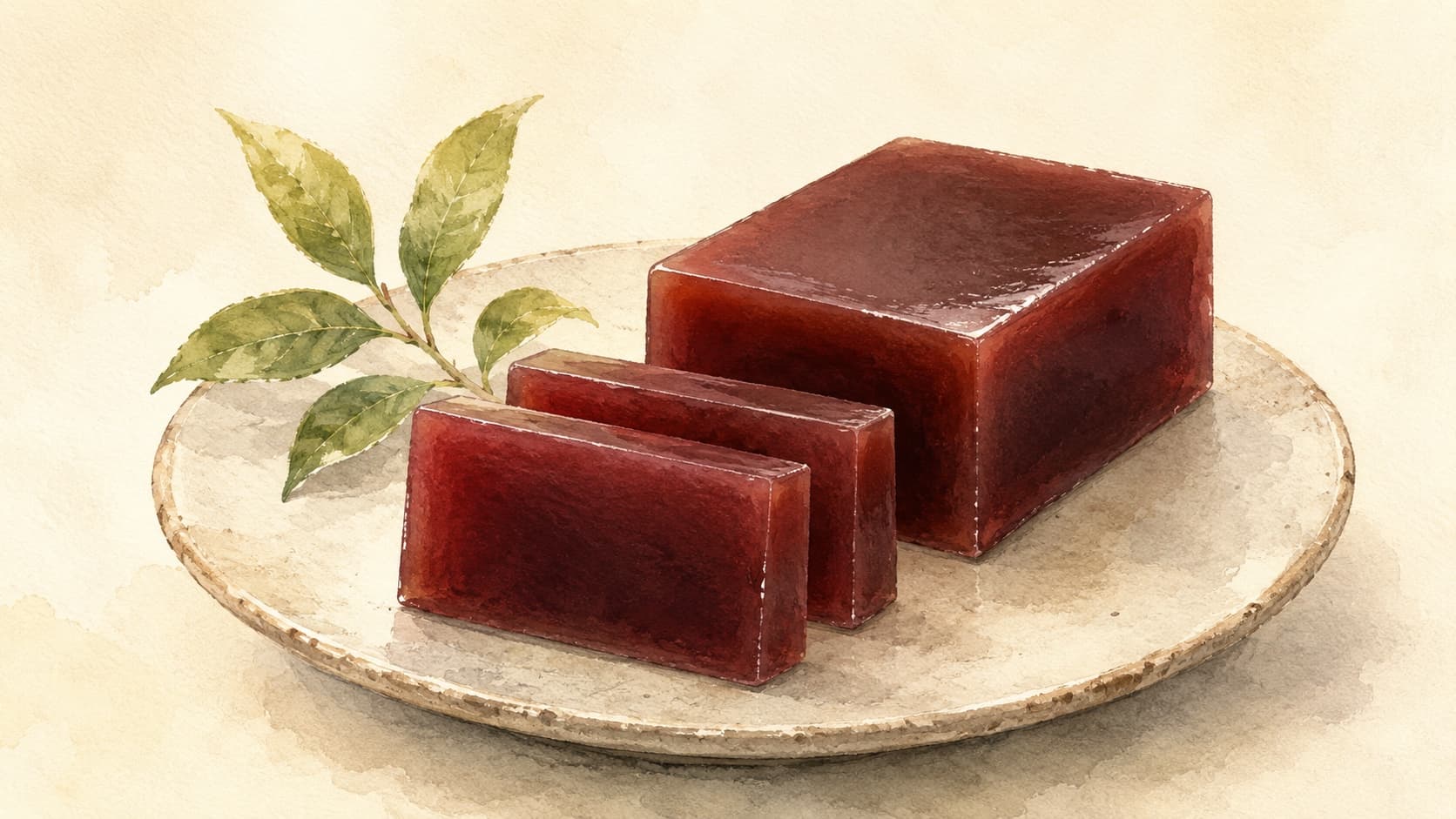
Yokan is a gelatinous dessert that balances sweet red bean paste and agar-agar, creating a firm yet smooth texture.
Contents (5 sections)▾
Ingredients
- 200g red bean paste (anko)
- 5g agar-agar
- 500ml water
- 100g sugar
- 1 pinch salt
- 1 tsp vanilla extract (optional)
- Cornstarch for dusting
Steps
Combine agar-agar and water in a saucepan.
Bring to a boil over medium heat, stirring constantly until dissolved.
Add sugar, salt, and red bean paste; mix until smooth.
Pour the mixture into a mold and let it cool to room temperature.
Refrigerate for at least 2 hours until firm.
Dust with cornstarch, slice, and serve.
Tools you'll want
- · Digital kitchen scale (gram precision)
Why this works
Yokan's structure relies on agar-agar, a gelatinous substance derived from seaweed. When heated, agar-agar dissolves and, upon cooling, forms a gel. The key is to maintain the correct ratio—about 1% agar-agar to the total liquid volume for optimal firmness. The red bean paste provides both sweetness and body, complementing the agar's texture.
Incorporating sugar during the simmering process allows it to dissolve fully, preventing graininess. Temperature control is crucial; boiling the mixture activates the agar-agar, while cooling allows it to set properly. The optional vanilla adds complexity but is not necessary for traditional flavors.
Common mistakes
Using too much or too little agar-agar.
Target: 1% agar by total liquid volume — 5 g agar per 500 ml water for the classical firm yokan.
Why it matters: Too much = rubbery, almost gummy texture. Too little = soft, can't slice cleanly. The 1% ratio is the traditional Japanese benchmark.
What to do: Weigh by scale, not measure by spoon (agar fluffs irregularly). Use a kitchen scale with 1 g precision.
Workarounds:
- Want softer mizuyokan (summer style) → reduce to 0.7% (3.5 g per 500 ml); the lighter texture is intentional.
Not boiling the agar to full dissolution.
Target: Bring agar + water to rolling boil for 2-3 minutes, stirring constantly.
Why it matters: Agar only dissolves at 90°C+ — anything less leaves microscopic granules that produce grainy yokan with weak set. Full boil is non-optional.
What to do: Boil hard for 2-3 minutes after the initial dissolve. Skim any foam.
Workarounds:
- Using agar flakes (not powder) → soak in cold water 15 min first, then boil; otherwise won't fully dissolve.
Adding anko while too hot.
Target: Stir anko in off the heat or at very low simmer; combine until smooth.
Why it matters: Anko mixed into vigorously boiling agar can curdle the bean paste — texture becomes inconsistent. Off-heat mixing keeps anko smooth and the integration even.
What to do: Pull pan off boil, add anko gradually, stir until uniform. Return to low heat briefly to reheat if needed.
Workarounds:
- Lumpy anko → push through sieve before adding; gives finer texture.
Pouring while too hot.
Target: Cool mixture to ~70°C before pouring into mold — surface tension at this temp prevents film formation.
Why it matters: Pouring at 90°C+ creates a tough skin on the top. The bottom also separates as denser solids settle. Slight cooling = even, glossy yokan.
What to do: Cool slightly in the pan with gentle stirring (no aeration) before pouring.
Workarounds:
- In a hurry → pour while hotter, but skim the surface film before refrigerating.
Skipping the refrigeration time.
Target: Refrigerate minimum 2 hours, ideally 4-6 hours for proper set.
Why it matters: Agar sets at room temperature (around 38°C) but stabilizes fully only in cold. Under-set yokan crumbles when sliced — clean cuts require firm setting.
What to do: Cover with cling film against the surface to prevent skin. Chill thoroughly.
Workarounds:
- Faster setting → place in freezer 30 min, then refrigerate; still slower than fridge alone wouldn't compromise quality.
Slicing with a wet knife.
Target: Dry, very sharp knife. Wipe clean between cuts.
Why it matters: Wet blade pulls and tears the agar gel; clean dry blade produces the glossy clean cut that's part of yokan's aesthetic.
What to do: Sharpen knife before slicing. Wipe with dry cloth between each slice.
Workarounds:
- For uniform slices → use a thin sharp knife (yanagiba style if available); chef knives also work.
What to look for
- A glossy, smooth surface on the Yokan.
- A firm yet slightly springy texture when pressed.
- Clean, sharp edges when sliced.
- Even color throughout, without dark spots.
Chef's view
Yokan (a firm Japanese sweet jelly made from sweetened red bean paste set with agar) has roots in Japan's Edo period, where it was enjoyed by the aristocracy. Its simplicity belies the skill required to achieve the perfect balance of flavor and texture. Each ingredient plays a pivotal role, reflecting Japanese culinary principles of harmony and balance. Traditionally served with matcha (powdered Japanese green tea, whisked with hot water to a frothy bright-green drink), Yokan complements the bitterness of tea, creating a well-rounded dessert experience.
<!-- beginner-glossed v1 -->Get the essays in your inbox — free
Weekly notes on flavor, fermentation, and food history — the writing behind the Atlas of Flavor. No spam; unsubscribe anytime.