
Tsukune
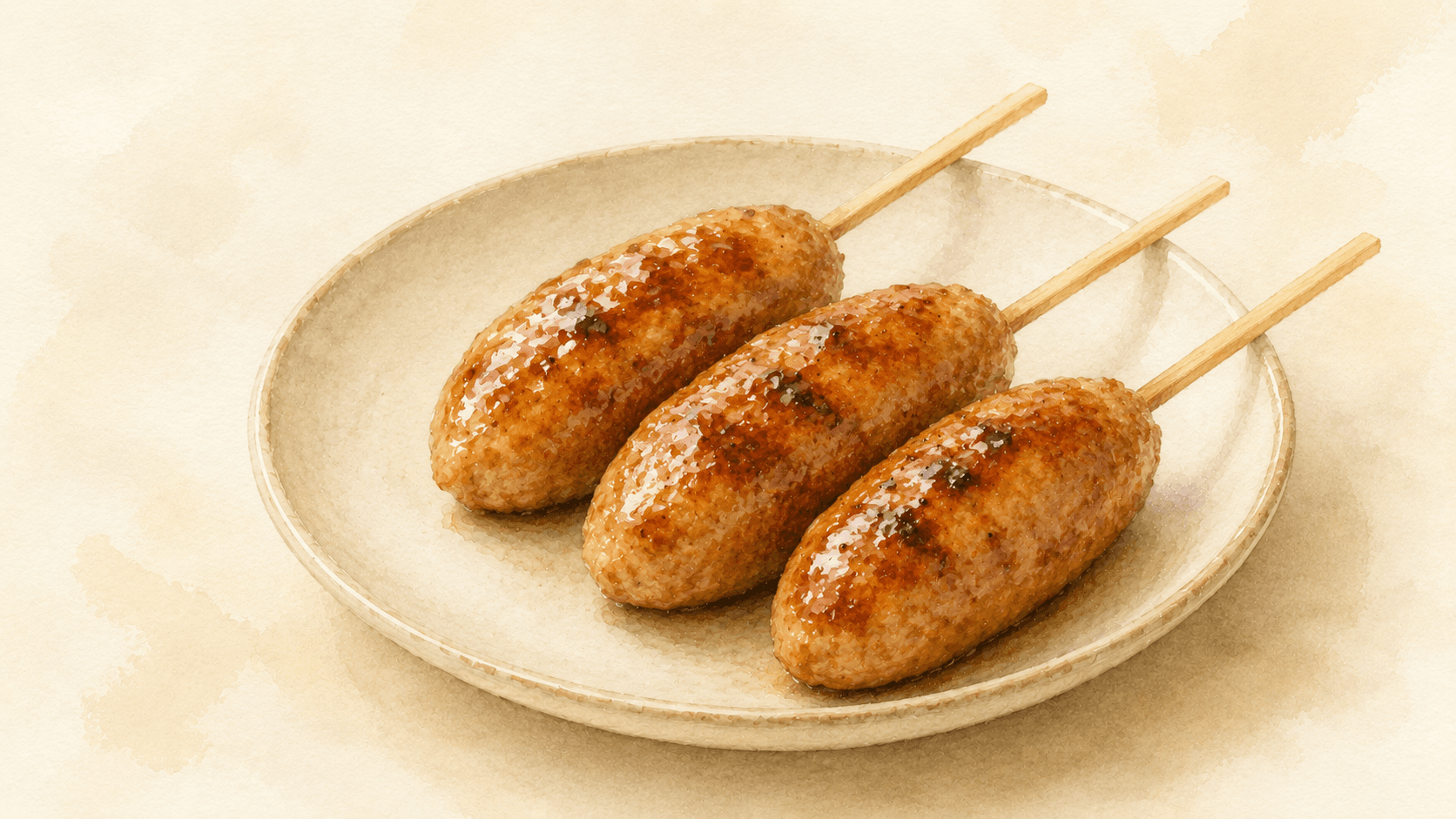
Ground chicken formed around skewers and grilled, then glazed with a sweet soy tare. Tsukune are yakitori in the sense that they use the same sauce and the same heat, but the texture is unique — the ground meat binds into a soft, cohesive ball.
Contents (7 sections)▾
Ingredients
- 400 g ground chicken (thigh preferred for moisture)
- 2 tbsp panko breadcrumbs
- 1 tsp grated fresh ginger
- 1 tbsp sake
- 1 tsp soy sauce
- ½ tsp fine salt
- For the tare: 3 tbsp soy sauce, 2 tbsp mirin, 1 tbsp sake, 1 tsp sugar — reduce together until slightly syrupy
- Egg yolk for dipping (optional) — a pasteurized egg yolk, or a yolk from a shell egg treated to destroy Salmonella (see the safety note)
Steps
Mix the ground chicken with panko, grated ginger, sake, soy sauce, and salt in a bowl. Mix vigorously with your hands until the mixture becomes sticky and pulls away from the sides of the bowl — this takes 2–3 minutes. The mixture should hold its shape when pressed together. If it feels very wet, chill for 15 minutes before forming.
Wet your hands to prevent sticking. Divide the mixture into 12 equal portions, each about 35 g. Press each portion firmly around a bamboo skewer, forming an oval shape about 4 cm long. Press firmly to eliminate air pockets — any gaps will cause the tsukune to crack during cooking.
Grill over medium-high direct heat (or on a grill pan), turning 3–4 times, for 8–10 minutes total until cooked through and lightly charred on all sides. The interior temperature should reach 74°C. Do not press the tsukune against the grill — this expels moisture.
In the final 2 minutes, brush the tsukune generously with tare. Continue grilling, turning and basting, until the tare caramelizes slightly and forms a glossy, sticky glaze. The tare should smell caramelized but not burnt. Serve with a small bowl of additional tare and, optionally, a pasteurized egg yolk for dipping (see the safety note).
Why this works
Tsukune binds through myosin extraction — the same mechanism that holds a fish cake or a sausage together. When ground chicken is worked vigorously with salt, the salt dissolves the myosin protein chains from the muscle fibers. These dissolved myosin chains are sticky; they cross-link with each other and with other proteins when heat is applied, forming a continuous protein gel that holds the entire mass together. The vigorous mixing is not optional — insufficiently worked meat will have a crumbly, loose texture rather than the cohesive, slightly springy texture that defines tsukune.
Panko breadcrumbs serve a different function than they do in a Western meatball. In tsukune, they are not primarily a binder (the myosin performs that role); they are a moisture reservoir. Panko's open, irregular structure absorbs some of the juices released during cooking, which slows the rate at which the tsukune dries out on the grill. This extends the window between done and dry.
Ginger contributes two effects. The first is aromatic — its volatile compounds (including zingerone and various sesquiterpenes) add a sharp, warm top note that cuts through the richness of the chicken fat and the sweetness of the tare. The second is enzymatic: raw ginger contains proteases — specifically zingipain — that can partially break down muscle protein if the meat sits for too long before cooking. This is why the tsukune should be formed and grilled within a reasonable time after mixing, not left overnight. In small amounts and short resting times, however, the protease effect is minor.
The tare is a reduction of soy sauce, mirin, sake, and sugar — the same base as most yakitori tare, which in professional kitchens accumulates over years by adding to a mother tare kept warm at the grill. The caramelization that occurs in the final 2 minutes of glazing is a combination of Maillard browning (from the soy sauce's amino acids reacting with the sugars) and actual sugar caramelization at the surface. This is what produces the distinctive dark, glossy finish and the characteristic bitter-sweet-savory edge of tare.
Safety — the optional raw egg-yolk dip. The tsukune themselves are cooked to a safe 74 °C / 165 °F (see the grilling step), but the classic egg-yolk dipping bowl is raw. Raw egg carries a Salmonella risk, so if you serve the dip use a pasteurized egg yolk, or a yolk from a shell egg treated to destroy Salmonella — ordinary freshness (or a "raw-eating"/生食用 label) is not the same. Pregnant people, infants and young children, older adults, and anyone immunocompromised should skip the raw-yolk dip or use pasteurized egg.
Common mistakes
Under-mixing the meat.
Target: 2-3 minutes vigorous mixing until tacky, sticky, and the mass pulls away from the bowl walls.
Why it matters: Insufficient mixing = myosin proteins haven't extracted = no protein gel = crumbly tsukune that falls off the skewer. The binding is mechanical, achieved by working the meat with salt.
What to do: Mix with bare hands (warmth helps, friction is the point). When the mass holds shape when pressed, it's ready.
Workarounds:
- Stand mixer with paddle attachment → 1-2 minutes on low; faster but easier to over-mix.
Skipping the chill when mixture is wet.
Target: If too soft to hold shape, refrigerate 15 minutes before forming.
Why it matters: Wet mixture cracks during grilling — moisture turns to steam and forces the surface apart. Chilling firms the fat and gives the protein gel time to stabilize.
What to do: Test with a small ball — does it hold shape on a flat surface? If it slumps, chill.
Workarounds:
- Time-constrained → add 1 extra tbsp panko to absorb excess moisture; chill 10 min.
Applying tare (the sweet-soy glaze of soy, mirin, sake, and sugar reduced together) too early.
Target: Tare applied only in the final 2 minutes of grilling, brushed and turned 2-3 times.
Why it matters: Sugar in tare burns fast at grill temperature — apply early and you get acrid black coating instead of glossy caramelized glaze. The window is narrow.
What to do: Cook tsukune through first with no glaze. Last 2 min: brush, turn, brush, turn, brush, plate.
Workarounds:
- Want extra glaze depth → serve with extra tare in a bowl on the side for dipping at the table.
Pressing the meat against the grill.
Target: Don't press — let tsukune cook on contact with the grill, turning gently 3-4 times.
Why it matters: Pressing forces juices out — tsukune becomes dry. The myosin-bound structure also breaks under pressure, leading to crumbly texture.
What to do: Use tongs or chopsticks to turn. Lift and rotate, never press.
Workarounds:
- If they stick → wait another 30 seconds; properly seared tsukune releases naturally.
Using lean breast meat.
Target: Chicken thigh (or 70% thigh + 30% breast). Skin removed before grinding.
Why it matters: Thigh meat has the fat and connective tissue needed to stay moist during grilling. Breast-only tsukune dries out before it can be glazed.
What to do: Grind thigh yourself for best fat distribution, or ask the butcher.
Workarounds:
- Only breast available → add 1 tbsp neutral oil to the mixture; helps moisture retention.
Over-resting after mixing.
Target: Form and grill within 1 hour of mixing. Don't leave overnight.
Why it matters: Raw ginger contains zingipain (a protease) — long resting breaks down the protein gel structure you just built, making the mixture loose again.
What to do: Mix → form → grill in one continuous session.
Workarounds:
- Need to prep ahead → form skewers, freeze raw; grill from frozen with extra cook time.
What to look for
- Mixture consistency: pale, cohesive, and sticky. Falls away cleanly from the bowl when scraped.
- After forming: oval, uniform shape. No surface cracks visible.
- Mid-grill: light char marks developing. Surface starting to firm.
- After tare application: glaze should be shiny, tacky, and slightly caramelized. Smell should be sweet-savory, not acrid.
- Done: glossy dark glaze, light char on edges, no pink interior visible when one is cut open.
Chef's view
Tsukune (Japanese ground-chicken meatballs grilled on bamboo skewers) occupy a specific emotional position in the yakitori (Japanese charcoal-grilled chicken skewers) canon: they are the dish ordered second, after the salt-seasoned thigh and before the negima. They are comfort within a format that is already comfort food. The egg yolk dipping bowl is a classic accompaniment in yakitori bars — the yolk cools the tare-glazed surface slightly and softens the sweetness of the glaze into something rounder and richer. It is one of the better flavor combinations in Japanese street food.
The same mixture, without skewers, can be formed into small patties and pan-fried in a small amount of oil — tsukune hambagu. Or poached in simmering broth as chicken dango in a hot pot. The myosin-extraction logic does not change; only the cooking method and the final seasoning differ.
Chef Test Notes
Tested mixing time: 1 minute, 2 minutes, 3 minutes. At 1 minute, the mixture crumbled when grilled. At 2 minutes, it held together. At 3 minutes, the texture was slightly more springy — preferable. Beyond 3 minutes, the fat from the thigh meat began to smear and the mixture felt oily without further textural improvement.
Tested with breast and thigh. Breast tsukune were noticeably drier and firmer. Thigh meat remained moister throughout the grill time.
Tested tare timing: applying at 4 minutes remaining, 2 minutes remaining, and 1 minute remaining. At 4 minutes, the tare burnt before the second application cycle. At 2 minutes, it caramelized correctly. At 1 minute, there was not enough time for a second brush and the glaze was thin.
Related glossary terms
- Maillard reaction — the browning reaction in both the grilled surface and the tare glaze
- Myosin — the protein extracted by salt that binds ground meat preparations
- Caramelization — the sugar browning in the tare during final glazing
Get the essays in your inbox — free
Weekly notes on flavor, fermentation, and food history — the writing behind the Atlas of Flavor. No spam; unsubscribe anytime.