
Tonkatsu
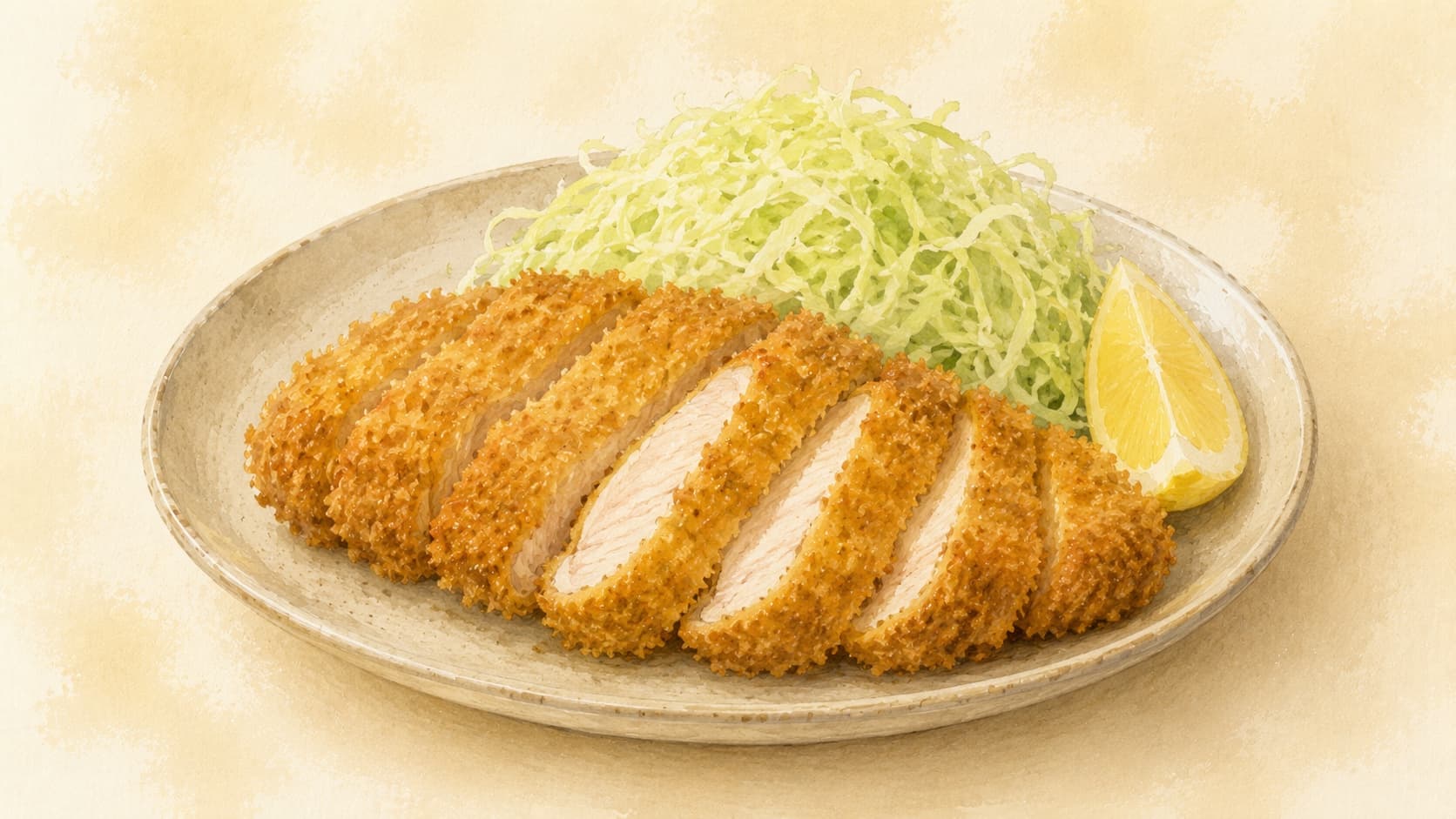
A breaded and deep-fried pork cutlet that emphasizes texture and flavor through precise cooking techniques.
Contents (5 sections)▾
Ingredients
- 4 boneless pork loin chops
- Salt and pepper to taste
- 1/2 cup all-purpose flour
- 2 large eggs
- 1 cup panko breadcrumbs
- Vegetable oil for frying
- 1 cup shredded cabbage
- Tonkatsu sauce for serving
Steps
Pound the pork chops to an even thickness of about 1/2 inch.
Season the pork with salt and pepper on both sides.
Dredge each chop in flour, dip in beaten eggs, and coat with panko.
Heat oil in a skillet over medium-high heat until shimmering.
Fry the pork chops for 3-4 minutes per side until golden and cooked through.
Serve with shredded cabbage and drizzle with tonkatsu sauce.
Tools you'll want
Why this works
Pork loin chops are chosen for their balance of fat and meat, promoting juiciness. Pounding the meat ensures even cooking and tenderizes the fibers. The three-step breading process—flour, egg, and panko—creates layers that trap moisture while enhancing crunch. Frying at 350°F (175°C) allows for rapid cooking, sealing the exterior and preserving the interior's moisture.
The use of panko breadcrumbs contributes to the distinctively light and airy texture. Unlike traditional breadcrumbs, panko’s larger flakes provide increased surface area, resulting in a superior crunch. Adjusting oil temperature is crucial; too low absorbs excess oil, while too high can burn the breading before the meat cooks.
Common mistakes
Wrong pork cut.
Target: Pork loin (rosu, ロース) with the fat cap intact OR pork tenderloin (hire, ヒレ) for lean. Thickness 1.5–2 cm.
Why it matters: Tonkatsu's defining quality is the contrast between crispy crust and tender pork. Lean modern pork chops (without fat) cook to dry by the time the crust is golden. Loin with fat cap (rosu-katsu) or true tenderloin (hire-katsu) are the canonical cuts.
What to do: Source pork from a butcher who knows katsu cuts. Look for a 1.5–2 cm thick piece with a 5–10 mm fat strip.
Workarounds:
- Only lean pork available? Brine for 1 hour in 5 % salt water before breading — adds moisture insurance.
- For ultra-tender results, pound the pork lightly with the back of a knife (don't flatten — just break fibers).
Skipping the score-and-rest step.
Target: Make shallow cuts in the connective tissue between meat and fat. Salt both sides, rest 15 minutes.
Why it matters: The connective tissue (silver skin) between the meat and fat shrinks faster than the surrounding pork when heated — without scoring, the pork curls into a "U" shape during frying, leading to uneven cooking. Salt + rest also draws out water and seasons throughout.
What to do: Score every 2 cm along the fat-meat junction. Don't cut deep, just through the connective layer.
Workarounds:
- For hire-katsu (no fat), score is unnecessary, but the salt rest is still valuable.
Using regular breadcrumbs.
Target: Real panko (Japanese-style breadcrumbs made from crustless white bread, with large flaky shards that fry up exceptionally crisp) — the irregular, jagged Japanese-style breadcrumbs. Look for fresh, soft (not dry) panko.
Why it matters: Panko's irregular shape creates pockets of air during frying, producing the characteristic light, shattering crust. Regular breadcrumbs are uniform and pack densely, producing a flat, dense coating.
What to do: Buy from an Asian market or specialty store. Fresh panko (refrigerated) is best; shelf-stable panko is acceptable.
Workarounds:
- No panko? Tear stale white bread (no crust) into pieces and pulse briefly in a food processor — closer to panko than uniform crumbs.
- For extra crunch, dredge twice: flour → egg → panko → egg → panko.
Wet pork.
Target: Pork patted dry with paper towels before flour dredging (lightly coating with flour so the egg has something to grip).
Why it matters: Water on the pork surface prevents the flour from adhering properly. Without that flour layer, the egg won't stick, and the panko falls off during frying.
What to do: Pat dry aggressively. Then dredge: flour → shake off excess → egg → panko → press gently to adhere.
Workarounds:
- For extra grip, dust the pork with cornstarch (instead of flour) before egg — sticks better in humid conditions.
Frying at the wrong temperature.
Target: 170 °C oil, measured with a thermometer. The pork should sizzle on contact but not violently.
Why it matters: Below 160 °C — the panko absorbs oil and gets greasy without crisping. Above 180 °C — the panko browns before the pork cooks through (internal pork temperature needs to reach 63 °C for safety).
What to do: Use a thermometer. Allow 30 seconds between batches for the oil to recover temperature.
Workarounds:
- No thermometer? Drop a piece of panko into the oil — it should bubble immediately and rise within 2 seconds.
- For a thicker, well-cooked tonkatsu, fry at 165 °C for 5 minutes per side; for thin, fast tonkatsu, 175 °C for 3 minutes per side.
Cutting tonkatsu immediately.
Target: Rest 3 minutes on a wire rack BEFORE cutting.
Why it matters: Cutting the pork immediately, while it is screaming-hot, means more juice on the cutting board; a short rest lets it cool off its peak, so less runs out when cut. Also: resting on paper towels traps steam against the bottom → soggy crust. A wire rack keeps it crispy.
What to do: Wire rack, 3 minutes, THEN slice into 1.5 cm strips.
Workarounds:
- No rack? Stand the tonkatsu on its edge (the fat strip) — minimizes contact with the surface.
What to look for
- A golden-brown crust that is crisp and flaky.
- Juices running clear when the meat is pierced — pork interior fully cooked through (at least 63°C / 145°F) and no pink remaining.
- A light sizzle when the pork is placed in hot oil.
- A fragrant aroma of frying breadcrumbs.
Chef's view
Tonkatsu emerged in the late 19th century, influenced by Western culinary practices. It represents Japan's adaptation of foreign food while maintaining local flavors. The dish is not merely a meal; it encapsulates a philosophy of balance—between crispiness and tenderness, seasoning and simplicity.
The act of preparing tonkatsu is a ritual that celebrates the craftsmanship of Japanese cuisine. Each step, from selecting high-quality pork to frying, requires mindfulness and precision. Tonkatsu is more than comfort food; it is a cultural expression that values quality ingredients and careful technique.
<!-- beginner-glossed v1 -->Get the essays in your inbox — free
Weekly notes on flavor, fermentation, and food history — the writing behind the Atlas of Flavor. No spam; unsubscribe anytime.