
Poached Egg
Vinegar, gentle water movement, 63–65°C, three minutes. A poached egg is a lesson in controlled protein coagulation in an aqueous medium.
Contents (7 sections)▾

Ingredients
- 2 very fresh large eggs (freshness is critical — see notes)
- 1 litre water
- 20 ml white wine vinegar (or cider vinegar)
- 5 g fine sea salt
Steps
Fill a wide, shallow saucepan or sauté pan with 8–10 cm of water. Add the vinegar and salt. Bring to a temperature of 80–85°C — small bubbles forming at the base and rising to the surface, but no rolling simmer. This is the most critical step. At 100°C, the turbulence tears the white apart before it sets. At 70°C, the white never fully coagulates. The 80–85°C window gives gentle movement that encourages the white to fold over the yolk, and a temperature high enough to set the white quickly before the egg disperses.
Crack each egg into a small cup or ramekin. Doing this separately lets you check for broken yolks before committing to the pan, and allows a more controlled release of the egg into the water. Stir the water briefly with a spoon to create a slow, circular current. The current is not a whirlpool — it is a gentle spiral that helps the white wrap around the yolk as the egg hits the water.
Lower the ramekin to just above the water surface and release the egg gently into the center of the circular current. Do not drop it from height. Repeat immediately with the second egg. The white will begin to set within 15–20 seconds, visibly turning from translucent to opaque at the base.
Cook for 3–4 minutes without moving the eggs. The timing depends on egg size and your target yolk consistency. At 3 minutes, the white is fully set and the yolk is warm but completely fluid — the classic *oeuf poché* for eggs Benedict or with asparagus. At 4 minutes, the yolk develops a thin set layer at its surface while remaining liquid at the center. Test by lifting the egg gently with a slotted spoon and pressing the yolk with a fingertip — it should feel like a water balloon.
Remove with a slotted spoon and drain briefly on a clean towel. Trim any ragged white edges with kitchen scissors if serving formally. Season with a few grains of coarse salt and serve immediately, or hold in a bowl of warm water (60°C) for up to 15 minutes.
Tools you'll want
Why this works
A poached egg is an exercise in coagulating the white while leaving the yolk liquid — which requires precise temperature management in an aqueous environment.
Egg white proteins (primarily ovalbumin, ovotransferrin, and ovomucin) denature and coagulate at 63–80°C. The white begins to set around 63°C and is fully firm by 80°C. The yolk proteins coagulate in a higher range: 65–70°C for a flowing yolk, above 70°C for a set yolk. This means there is a temperature window — roughly 80–85°C in the poaching water — where the white can be brought to full firmness while the yolk stays below its set point. The cooking time (3–4 minutes) is chosen to bring the white to full coagulation while keeping the center of the yolk below 65°C.
The vinegar serves a chemical function. In an acidic environment, the pH of the egg white drops, which shifts the coagulation temperature of the white proteins downward — they begin to set at a lower temperature and set more firmly. This tighter coagulation at the surface of the white is what produces the compact, defined shape of a well-poached egg. Without vinegar, the white proteins drift and spread before setting, producing trailing streamers of cooked white around a loose core.
The freshness of the egg is structural, not aesthetic. Fresh egg whites have higher viscosity — the albumen gel is tighter, with more intact ovomucin fibers holding the white in a cohesive mass. As an egg ages, the ovomucin network degrades, the white becomes watery and loses its capacity to stay cohesive in the poaching water. An old egg produces white that spreads and trails no matter how good the technique. For poaching, use the freshest eggs available — ideally less than 5 days from laying.
Safety — runny yolk: A poached egg is cooked to set the white while the yolk stays fluid, so this method does not include a validated step that reliably kills Salmonella — and a runny look, the timing, or the heat of the water are not proof that it is safe. Fresh eggs poach better, but freshness is not a safety control either — Salmonella can be inside an intact, clean egg. When you want the yolk runny, use a shell egg pasteurized in the shell, through to the contents (heat-treated to destroy Salmonella); an ordinary egg that has only been washed, graded, or surface-sanitized — no matter how fresh — is not pasteurized through the contents. Pregnant people, infants and young children, older adults, and anyone immunocompromised should cook the yolk through until set, or use pasteurized eggs.
Common mistakes
Water too hot.
Target: 80-85°C — small bubbles rising from base, no rolling simmer.
Why it matters: Boiling water (100°C) creates turbulence that tears the white apart before it can set around the yolk — result is shredded whites trailing through the water. The 80-85°C window is gentle enough for coagulation, hot enough for speed.
What to do: Thermometer in the water. Adjust burner to maintain steady 80-85°C.
Workarounds:
- No thermometer → look for small bubbles rising from bottom but no breaking the surface; off-heat just enough that the water "shivers" rather than simmers.
Dropping egg from height.
Target: Crack into ramekin first, then lower ramekin to just above water surface before releasing.
Why it matters: Drop from height = impact breaks the egg structure on surface contact, white spreads everywhere before it can wrap around the yolk.
What to do: Crack into small cup beforehand. Lower cup almost touching water, then tip the egg in.
Workarounds:
- Multiple eggs → space release by 5-10 seconds so each has time to start setting before the next.
Skipping the vinegar.
Target: 20 ml vinegar per liter (2%) — white wine vinegar or cider vinegar.
Why it matters: Acid lowers white's coagulation temperature, so it sets faster and tighter — compact egg shape, no trailing ribbons of cooked white. Vinegar is structural, not optional.
What to do: Add vinegar and salt to the water before heating.
Workarounds:
- Vinegar flavor concern → 30 ml lemon juice can substitute; acid level similar.
Using old eggs.
Target: Eggs ≤5 days from laying for ideal results.
Why it matters: Egg whites lose viscosity with age — old whites are watery, spread on contact, can't form compact poached shape regardless of technique. No method recovers degraded whites.
What to do: Date-check at purchase. For poaching, prioritize fresh local eggs.
Workarounds:
- Older eggs → strain whites through a fine mesh to remove watery portion; helps slightly.
Moving eggs during cooking.
Target: Don't touch eggs for the full 3-4 minutes. Let them set undisturbed.
Why it matters: Stirring or disturbing the eggs while whites are setting interrupts coagulation — patchy, uneven texture. The vortex method (some recipes recommend) is widely overrated and often counterproductive.
What to do: Set timer. Walk away from the pan after the eggs are in.
Workarounds:
- Worried about overcooking → set timer for 2:30, check at then.
Forgetting to drain on a towel.
Target: Lift eggs with slotted spoon, briefly drain on clean towel or paper towel before plating.
Why it matters: Cooking water clings to the egg and makes the plate watery. Brief drain = clean plate, no diluted sauce, professional presentation.
What to do: Have clean kitchen towel ready beside the pan. Lift, blot 2-3 seconds, plate.
Workarounds:
- Want maximum cleanness → trim ragged edges with kitchen scissors before plating.
What to look for
- Water temperature: small, steady bubbles rising from the base — not simmering, not still. 80–85°C. Verify with a thermometer if uncertain.
- Egg entering water: the white immediately begins to fold over the yolk, turning white within 15–20 seconds at the base. The egg should hold together, not spread.
- At 3 minutes: the white is opaque and set. Lift gently with a slotted spoon — the egg holds its shape. Press the yolk: it gives like a water balloon.
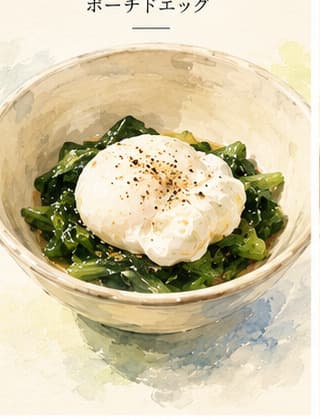
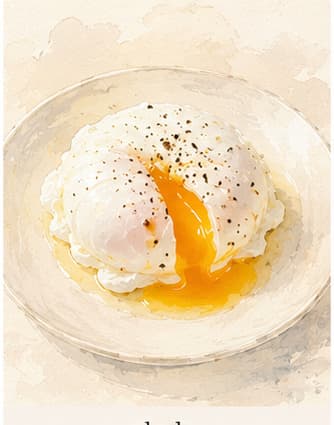
- Plated: compact, oval shape. White fully set with no translucent areas. Yolk visible as a golden dome just beneath the surface.
Chef's view
Poached eggs are one of the most technically revealing tests of both egg freshness and water temperature control. A poached egg made with a two-week-old egg at 90°C looks nothing like a poached egg made with a three-day-old egg at 83°C — even if the recipe is identical. The technique exposes every variable.
The tradition of making poached eggs in bulk for restaurant service involves a preliminary poach — cooking until the white is barely set, then immediately plunging into ice water to arrest the coagulation. The eggs are stored in cold water and reheated to order in 60°C water for 2–3 minutes. This produces consistently timed eggs at service pace. For home use, cooking to order is always preferable — the texture of a freshly poached egg is superior to a reheated one.
For oeufs pochés (French for "poached eggs") in the classical tradition, the egg is finished with a trimmed, clean edge, either placed on a crouton (a small slice of toasted or fried bread) rubbed with garlic, or served atop vegetables with sauce hollandaise (a warm emulsified sauce of egg yolks and butter). The poached egg in this context is a vehicle for the sauce — the compactness of the white allows a sauce to pool on top without running immediately.
Chef Test Notes
Tested vinegar amounts: 10 ml, 20 ml, and 30 ml per litre of water. At 10 ml, slight improvement over no vinegar, but some trailing white. At 20 ml, compact shape and minimal trailing. At 30 ml, the white had a faint vinegar flavor. 20 ml was the optimal amount. Also tested egg freshness: 2-day-old eggs vs 10-day-old eggs at identical conditions. The 2-day eggs produced compact, clean shapes; the 10-day eggs spread visibly and produced ragged whites despite good temperature control. Tested the holding method: ice-water arrest followed by 60°C reheating. The reheated eggs were structurally identical to freshly poached but slightly less glossy on the surface.
Related glossary terms
- Protein coagulation — the mechanism controlling both white and yolk set at different temperatures
- Denaturation — the initial stage before coagulation, where proteins unfold
- Emulsion — the structure of the raw egg, before poaching disrupts the yolk-white boundary
Get the essays in your inbox — free
Weekly notes on flavor, fermentation, and food history — the writing behind the Atlas of Flavor. No spam; unsubscribe anytime.